
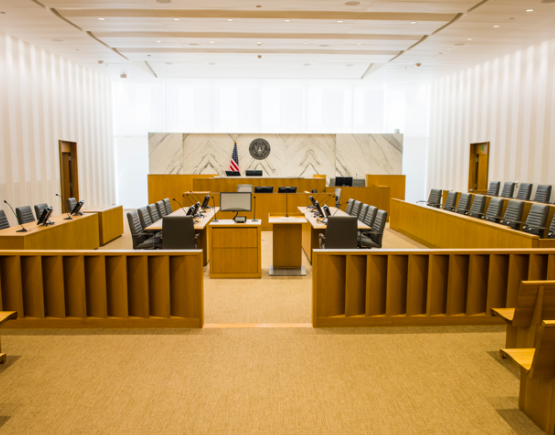
Central District of California in Los Angeles courtroom. (Photo: uscourts.gov)
Tribal Court Civil Money Judgment Act
Explains that the Uniform Foreign-Country Money Judgments Recognition Act
By Chris Micheli, December 19, 2025 5:24 pm
The Code of Civil Procedure, in Part 3, Title 11, Chapter 3, deals with special proceedings in civil actions and money judgments of other jurisdictions. Section 1730 states that this chapter is known as the Tribal Court Civil Money Judgment Act.
Section 1731 provides that this chapter governs the procedures by which the superior courts of the State of California recognize and enter tribal court money judgments of any federally recognized Indian tribe. Determinations regarding recognition and entry of a tribal court money judgment pursuant to state law do not have any effect upon the independent authority of that judgment.
Generally, the Code of Civil Procedure applies. Also, this chapter does not apply to four types of tribal court money judgments.
Section 1732 defines the following terms: “applicant,” “civil action or proceeding,” “due process,” “good cause,” “respondent,” “tribal court,” and “tribal court money judgment.”
Section 1733 requires an application for entry of a judgment under this chapter to be filed in a superior court. The proper county for the filing of an application is either of the two specified counties.
Section 1733.1 provides that, if the parties to the underlying tribal court proceeding agree, the parties may file a joint application for the recognition of a tribal court order that establishes a right to child support, spousal support payments, or marital property rights to such spouse, former spouse, child, or other dependent of a participant in a retirement plan or other plan of deferred compensation, which order assigns all or a portion of the benefits payable with respect to the participant to an alternate payee.
Section 1734 allows an applicant to apply for recognition and entry of a judgment based on a tribal court money judgment by filing an application in superior court pursuant to Section 1733. The application must be executed under penalty of perjury and include all of the specified information.
Section 1735 requires the applicant to serve upon the respondent a notice of filing of the application to recognize and enter the tribal court money judgment, together with a copy of the application and any documents filed with the application. The applicant files a proof of service of the notice promptly following service.
Section 1736 requires the clerk to certify, if no objections are timely filed, that no objections were timely filed, and a judgment is entered. The judgment entered by the superior court is based on and contain the provisions and terms of the tribal court money judgment.
Section 1737 specifies that any objection to the recognition and entry of the tribal court money judgment must be served and filed within 30 days of service of the notice of filing. If any objection is filed within this time period, the superior court sets a time period for replies and sets the matter for a hearing.
A tribal court money judgment cannot be recognized and entered if the respondent demonstrates to the superior court that at least one of the three actions occurred. Also, the superior court must decline to recognize and enter a tribal court money judgment if any one of the eight specified grounds applies.
Section 1738 requires the superior court to grant a stay of enforcement if the respondent establishes one of the specified items to the superior court.
Section 1739 provides that an action to recognize a tribal court money judgment or any renewal thereof it to be commenced within the earlier of the two specified periods.
Section 1740 allows the superior court, after notice to all parties, to attempt to resolve any issues raised regarding a tribal court money judgment by contacting the tribal court judge who issued the judgment.
Section 1741 explains that the Uniform Foreign-Country Money Judgments Recognition Act applies to all actions to enforce tribal court money judgments as defined that are commenced in superior court on or after January 1, 2015.


- Temporary Guardians - August 30, 2026
- Estates in General - August 30, 2026
- Why Do We Say August 31 Is the Last Day of Session? - August 29, 2026
RELATED ARTICLES
-
 August 12, 2022
 -
 February 27, 2025
 -
 December 16, 2025