

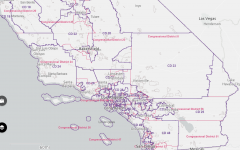
California redistricting map 2025. (Photo: Redistricting Partners)
Time to Take The Human Touch Out Of Redistricting
Computer programs can do the job fairly in seconds
By Martin Marks, January 20, 2026 3:30 am
In the wake of the recent California Central District Federal Court’s decision upholding California’s Congressional Redistricting Map—the genesis of which emanated from the passage of Proposition 50, the topic of gerrymandering continues to be a hot topic not only in California, but all around the nation.
The term Gerrymandering has an interesting origin. In 1812 Massachusetts Governor Eldridge Gerry signed a bill that established new state legislative district lines which arguably and not so subtly favored his party and ultimately resulted in his party gaining control of the Massachusetts state legislature. At the time a Boston Gazette editorial labeled this process as “Gerry-mandering” as the irregular outline of one district resembled that of a salamander. The definition of Gerrymandering was soon accepted as:
the political tactic of manipulating boundaries of electoral districts for unfair political advantage.
And since then, gerrymandering has been a time-honored political tradition by both Democrats and Republicans not only in creating state legislative districts, but also in the establishment of congressional district lines which ultimately factors heavily into which party will control the House of Representatives in Washington, D.C.
Every ten years the United States goes through a census process which outlines many facets of our demographics, most importantly where our population resides. Once that data is obtained, each state is apportioned the number of congressional seats commensurate with that population. More often than not, that number remains the same, but because of population migration and other factors, there are times when states will either gain or lose congressional seats. Once that number is known, the states will then go through a process that will determine the establishment of electoral district lines for both state legislatures and congressional seats. Every state has their own procedures for drawing these lines but the process must also comply with federal guidelines established in the U.S. Constitution and in subsequent federal acts and U.S. Supreme Court rulings.
The Federal criteria for establishing electoral district lines are:
- Districts should contain approximately the same number of residents.
- Creation of districts prohibits states by Section 2 of the Voting Rights Act (1965) from imposing any voting qualification, practice, or procedure that results in denial or abridgement of the right to vote based on race, color, or membership in a language minority.
- The districts must be compact and contiguous and ought not divide municipalities or counties where possible.
- And while the districts cannot result in denial or abridgement of the right to vote based on race, color, or membership in a language minority, these criteria cannot be used as the predominant factors in establishing district lines. It certainly can be cogently argued that California Proposition 50 and its resulting district map violates this provision. However, I will leave that up to you, dear reader, and to the higher levels of the Federal Judiciary that will undoubtedly hear its challenges.
And yet, these guidelines are seemingly and routinely violated all the time as the political parties seek to gain political advantage. All too often, legislative and congressional district maps are challenged resulting in drawn out court cases similar to what we see happening in the Golden State.
Ask the average American what the greatest threat to Democracy is and they might respond that it is the increasingly relevant impact of money in politics. And while there can be no question that money plays a huge role in influencing politicians, one cannot discount the related influence of gerrymandering as a threat to a legitimate and fair legislative process. If one were to “follow the money” of political donations, you would invariably find that well-monied interests do not necessarily make maximum contributions to a candidate based upon a shared ideology or support for a specific issue, but rather those contributions are made based upon the donor’s perception of who has the best chance to win an election. And of course, those with the best chance of winning election or more aptly re-election, are those who have had their districts gerrymandered into impregnable strongholds for one party or the other. Make no mistake, while the main goal of gerrymandering is for one party to gain political advantage in the House of Representatives or any given state legislature, deals are also made to carve out safe districts for elected officials who will find themselves in the minority as backroom deals are made.
And where does that leave us? When it comes to the U.S. House of Representatives, it means that there will never be that many competitive seats. In fact, for the upcoming 2026 mid-term elections, the Cook Political Report ranks only 18 out of 435 seats up for grabs as Competitive, while most others (375) are ranked as Solid for either the Democrat or Republican. So, to whom are these automatic electees ultimately answerable? Certainly not their constituents as the voters in these districts reflexively vote for incumbents in overwhelming numbers.
One of the more compelling surveys that demonstrates just how outrageous gerrymandering has become is from Pew Research. We all know that the public’s opinion of Congress has become increasingly negative. Pew tells us that the numbers are upside-down with more than 7 in 10 (72%) having an unfavorable opinion of our Legislative Branch and only 26% holding a favorable view. This disparity is at a four-decade high. However, ask those very same people what is their opinion of their member of Congress and you get a different story with the favorable/unfavorable numbers at 41-27% with an unexplained 32% declining to answer. Still, this contrast is rather compelling and clearly demonstrates the effect of gerrymandering. The phenomenon is known as Fenno’s Paradox named for political scientist Richard Fenno who in the 1970’s observed that Americans generally disapprove of the U.S. Congress as an institution but hold their own individual Member of Congress in much higher regard with resultant incumbent re-election, and he specifically cites gerrymandering for the phenomenon.
So, as we transition out of the Information Age and hurtle headlong into the Artificial intelligence (AI) Age with all its potential benefits and pitfalls, why do we still tolerate leaving this most critical aspect of American politics to mere mortals who invariably abuse the process for personal and/or partisan benefit?
All states have their own methods for drawing new state legislative and congressional district lines. Some appoint well-connected politicos to redistricting commissions and some leave it to the state legislatures. Some use a combination where the commissions propose a new map with final approval left to state legislative approval.
There are now numerous computer programs available for the purpose of creating district maps. Software such as Maptitude, Districtbuilder, and districtr are a few of the many software programs available to assist in drawing district lines. In fact, many states require public input regarding redistricting (California is one of them) and members of the public frequently turn to these programs to create their own maps which in turn are submitted to the redistricting commissions and state legislatures during this arduous process. Once census data is entered into the program, the new district lines are produced in a matter of seconds, and without regard to partisanship. To what extent these publicly submitted district maps are actually given more than passing consideration is a matter of conjecture. Yet ultimately, the insiders and politicians themselves have the final say on the final and increasingly gerrymandered maps.
Why not just be done with partisan map design by the well-connected politicos altogether and simply rely on the sophisticated algorithms of a computer program to draw fairer maps and ones that would pass constitutional muster? Doing so would require an act of state legislatures and governors to make that transition, and in this age of hyper-partisanship what legislature or governor will cede this most powerful tool to a computer program—especially in states like California where one-party control has been all but automatic for many years? As it is doubtful that the likes of Gavin Newsom and California Democrats would willingly relinquish redistricting power, it is equally unlikely that Governor Greg Abbott of Texas or Ron DeSantis of Florida in Republican-dominated states would surrender the potential to gerrymander district lines.
In California, where the Initiative and Referendum process results in ubiquitous ballot propositions in every election, one would think that taking the redistricting power away from politicians via a well-constructed ballot proposition ought to be an initiative worth pursuing.


- Time to Take The Human Touch Out Of Redistricting - January 20, 2026
- Vice President Vance Visits The Golden State - February 22, 2025
- Is DEI Ready To DIE? - January 4, 2025
RELATED ARTICLES
-
 February 3, 2022
 -
 August 17, 2025
 -
Computer programs are written by people. Any program that would be put forth in California will be rigged in favor of the Demonrats just like electronic voting. One of the most insidious lies that have been enslaving us is “trust the science”.
In California we DID take the power away from the legislature and then the low information voters of California gave it back to “Get Trump.”
You can’t save California from liberal Californians.
“The districts must be compact and contiguous and ought not divide municipalities or counties where possible.”
How does Paul Mitchell explain western Ventura County being lumped in with Malibu and Pacific Palisades (aka “The Burn Zone”) in Los Angeles County?
What do they have in common?
Oh yeah, both areas were burned out in the Woolsey Fire in 2018 and the Palisades Fire in 2025, thanks to Democrat policies that favored deep-pocketed utilities and progressive donors, many of whom are now homeless, thanks to their homes being burned down.
And Woolsey fire victims are only now starting to get their homes back, over FIVE YEARS LATER, thanks to the California “environmentalist” policies that slow-walk the ability to pull permits and get homes rebuilt…
EASTERN, not western, got my thoughts muddled…
Is there any computer program that draws districts in such a way as to make each vote’s value the same as each
other vote within any state in the USA? If so, which is the easiest one to use?