
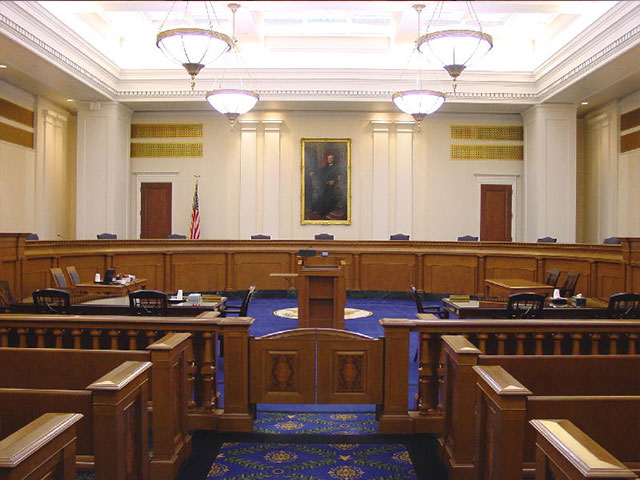
Courtroom (Photo: public domain)
Exchange Services for Supervised Child Visitation
Every other year, the Judicial Council must report to the Legislature
By Chris Micheli, February 6, 2026 2:30 am
Division 8, Part 2, Chapter 13 of the Family Code deals with supervised visitation and exchange services, education, and counseling relating to the custody of minor children.
Section 3200 required the Judicial Council to develop standards for supervised visitation providers in accordance with the guidelines set forth in this section. For the purposes of the development of these standards, the term “provider” includes any individual who functions as a visitation monitor, as well as supervised visitation centers, including those housed in superior court locations. Judicial Council had to consider eight specified issues.
Section 3200.5 requires any standards for supervised visitation providers adopted by the Judicial Council to conform to this section. A provider must be a professional provider or nonprofessional provider.
The terms “nonprofessional provider” and “professional provider” are defined. A nonprofessional provider has to meet four specified requirements, while a professional provider has to meet thirteen specified requirements. The ratio of children to a professional provider is contingent on six specified conditions.
Professional providers of supervised visitation are required to do three specified actions. In addition, professional take four specified actions.
Section 3201 requires any supervised visitation maintained or imposed by the court to be administered in accordance with Judicial Council Standards.
Section 3201.5 requires the programs described in this chapter to be administered by the family law division of the superior court in the county. The term “education about protecting children during family disruption” is defined.
Section 3202 requires all supervised visitation and exchange programs funded to comply with all requirements of the Uniform Standards of Practice for Providers of Supervised Visitation. The family law division of the superior court may contract with eligible providers of supervised visitation and exchange services, education, and group counseling to provide services under this chapter. The term “eligible provider” is defined.
Section 3203 allows the family law division of the superior court in each county to establish and administer a supervised visitation and exchange program, programs for education about protecting children during family disruption, and group counseling programs for parents and children under this chapter.
The programs are required to allow parties and children to participate in supervised visitation between a custodial party and a noncustodial party or joint custodians, and to participate in the education and group counseling programs, irrespective of whether the parties are or are not married to each other or are currently living separately and apart on a permanent or temporary basis.
Section 3204 requires the Judicial Council to annually submit an application to the federal Administration for Children and Families for a grant to fund child custody and visitation programs pursuant to this chapter. The Judicial Council is charged with the administration of the grant funds.
The grant funds are to be awarded with the intent of approving as many requests for proposals as possible while assuring that each approved proposal would provide beneficial services and satisfy the overall goals of the program under this chapter. The Judicial Council is required to determine the final number and amount of grants. Requests for proposals are to be evaluated based on the specified criteria.
In addition, the family law division of the superior court in each county approves sliding scale fees that are based on the ability to pay for all parties, including low-income families, participating in a supervised visitation and exchange, education, and group counseling programs under this chapter.
Every other year, the Judicial Council must report to the Legislature on the programs funded pursuant to this chapter and whether and to what extent those programs are achieving the goal of promoting and encouraging healthy parent and child relationships between noncustodial or joint custodial parents and their children while ensuring the health, safety, and welfare of children, and the other goals described in this chapter.


- How to Read a Bill in the California Legislature - September 23, 2026
- Credit Card Disclosures - September 23, 2026
- Contingencies in California Legislation - September 22, 2026
RELATED ARTICLES
-
 December 24, 2025
 -
January 26, 2026
-
 January 7, 2026