
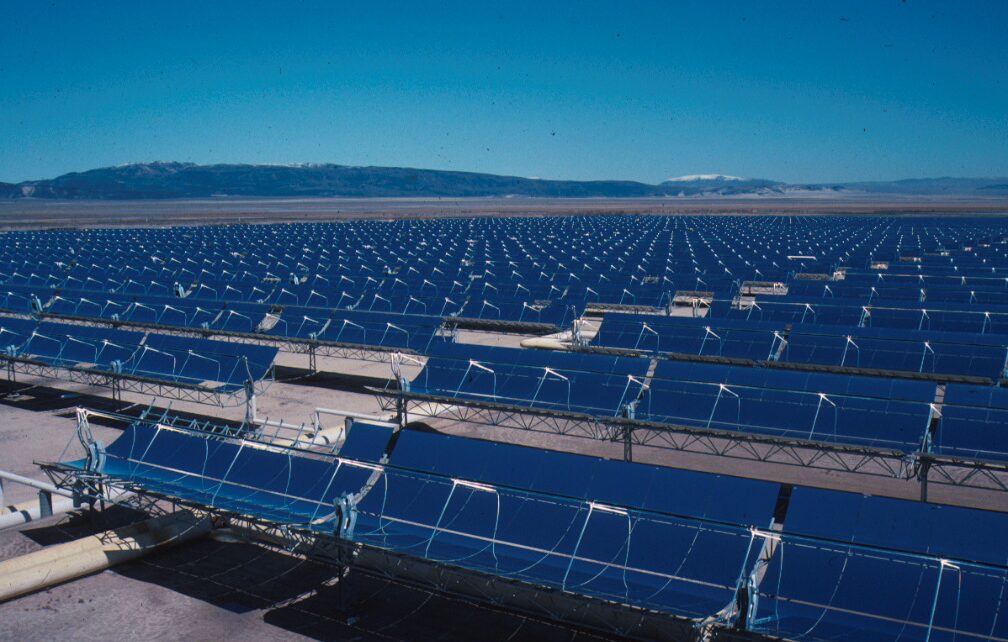
Solar plant (Photo: public domain)
Ringside: Commercializing Hydrocarbon Production from Air and Water
Terraform Industries has built its business model on the premise of much lower costs
By Edward Ring, July 16, 2026 8:30 am
Whenever evaluating a new energy technology, caution is warranted. During what was arguably the first big clean tech boom around 2009, schemes were sold to angel investors thrilled to find a hot sector in the wake of the recent financial crash. Almost anything that sounded good got funded. Some of these schemes, such as a “clean” car that would run on compressed air, were ridiculous. Others were just ahead of their time. And some surpassed expectations, increasing their share of global energy production at an astonishing pace.
Solar electricity, sourced from photovoltaic (PV) cells, is perhaps the most dramatic example of this. In 2006, estimated worldwide capacity of PVs was around 6 gigawatts. At the end of 2025 the total had risen to nearly 2.4 terawatts. Compared to 20 years ago, there is 400 times as much PV capacity today, and there is no end in sight.
To put this into one useful context, 2.4 terawatts of PV capacity at a 25 percent year-round worldwide yield (taking into account night and the variation of climate and seasons) would equate to 5,300 terawatt-hours per year. Total raw energy production worldwide in 2025 was 600 exajoules (EJs), that is, 167,000 terawatt-hours (TWH). Accounting for the journey energy takes from raw fuel to end user applications, shedding two-thirds of its power in transmissions and conversions, we may estimate worldwide energy services in 2025 totaled roughly 200 exajoules, or 55,000 TWH. So if PV energy fulfilled its promise of much greater efficiency, making its trip from solar panel to application while retaining two-thirds of its energy, it would have delivered 3,500 TWH of end user energy services in 2025, 6 percent of total applied energy.
That’s a lot. Total worldwide production of raw energy in 2006 was around 450 EJs, increasing by 33 percent to 600 EJs by 2025. PV production is up by 40,000 percent over the same period of time.
More to the point is the plummeting price. At today’s installed price of $1 million per megawatt of capacity with a 25 percent yield, the financing cost to purchase and install PVs (20 year, 4 percent loan) is only $0.03 per kilowatt-hour. This is very cheap electricity, and we may expect the price will continue to drop.
Which brings us to Terraform Industries, a company that has developed a process that could revolutionize energy production as the price of electricity drops. They are using electricity to produce combustible fuel and other products that currently depend on the petrochemical industry, starting with methane and methanol. To do this, they use electrolysis to extract hydrogen from water, and combine that with CO2 extracted from the atmosphere. Using these precursors renders the fuel at a level of purity that far exceeds conventional fossil production, justifying a higher sale price.
From Terraform’s website are the four elements of the technology they are using for their pilot plant:
“1 – An industrial-scale 1 megawatt (5 acre) solar array to concentrate solar energy into usable electricity.
2 – An electrolyzer to convert solar electricity directly into hydrogen without inverters or transmission.
3 – A CO2 absorption bed to process large volumes of air and filter out the CO2, which can also produce water as a byproduct.
4 – A Sabatier reactor to convert locally produced CO2 and hydrogen into pipeline-ready natural gas without intermediate compression or transport.”
Also from the website are clues to the operating economics of their pilot plant. They expect a five acre PV array to produce 6 megawatt-hours per day, sufficient energy to produce 6.4 Kcf/day (thousand cubic feet per day) of natural gas. The industrial price per Kcf of natural gas varies a lot. According to the US EIA, over the past 20 years it peaked at $13.06 in July 2008 and hit a low of $2.58 in July 2020.
To get into the weeds a bit, these variables imply a break-even price of $13.93 per MWh if the natural gas is sold at the July 2008 high rate, and $2.75 if the sale price drops to the July 2020 low. This compares to the aforementioned construction financing cost estimate for solar of $0.03/kWh which equates to $30.00/MWh. But Terraform Industries has built its business model on the premise of much lower costs, and claims the PV array they’ve installed at their pilot facility in Rosamond is already delivering electricity at around $17.00/MWh.
In the “Performance” section of their Terraform Industries Whitepaper 2.0, they assume a price of $10.00 per MWh. But of course there are the costs for the rest of the plant: the electrolyzer, the CO2 absorption bed, and the Sabatier reactor.
The team running Terraform Industries includes Founder and CEO Casey Handmer, a Caltech PhD physicist who previously held key roles at Hyperloop and NASA JPL. Their Director of R&D Stephanie Coronel is also a Caltech PhD who has worked at Boeing and Sandia Labs. The engineers and technical team include alumni from Hyperloop, SpaceX, GE, and elsewhere. This is a venture that typifies what California still does best, despite a regulatory environment that often seems determined to chase away the best talent.
One thing appears certain. The question isn’t if the price of electricity will drop to a point where technological processes with conversion efficiencies that were nowhere near commercial viability suddenly can operate and make a profit. That line is moved further every year.
When that line is crossed for Terraform Industries, we might have commercially competitive direct synthesis of methane, along with many other products that currently depend on petroleum, extracted from water and air.


- Ringside: Comments on the ‘Water Quality Control Plan’ for the Delta - September 9, 2026
- Ringside: Where Does California Get its Energy? - September 2, 2026
- Ringside: Without Sediment Removal in the Delta, Catastrophic Flooding is Coming to California - August 27, 2026
RELATED ARTICLES
-
 January 4, 2024
 -
 June 26, 2025
 -
 October 16, 2025
If my math is correct 5 acres of solar would create $16.51 (max $83.58) worth of methane per day. In what universe is this worthwhile? The maximum number would not even cover the depreciation on the solar panels much less all the other equipment costs.
More proof that “green” requires a firm grip on fantasy.
Yeah, my inner chemist was going… they’re making methane, exactly how does that scale? Thank you for doing the math!
Green energy: a method of sucking greenbacks out of venture capitalists.
No venture capitalist would touch this project without massive government subsidies. This is truly a project only a corrupt communist would love.
Despite the incredible growth of renewable energy, the use of fossil fuels remains virtually unchanged as a percentage of primary energy use over the past 15 years. Illustrating this point in 2010, fossil fuels comprised approximately 84% of U. S. primary energy consumption. In 2024, fossil fuels continue to comprise approximately 82% of U. S. primary energy consumption Maybe in a 100 years oil and natural gas will go the way of whale oil,, but then again, it was production of crude oil that stopped the slaughter of whales for their oil.