

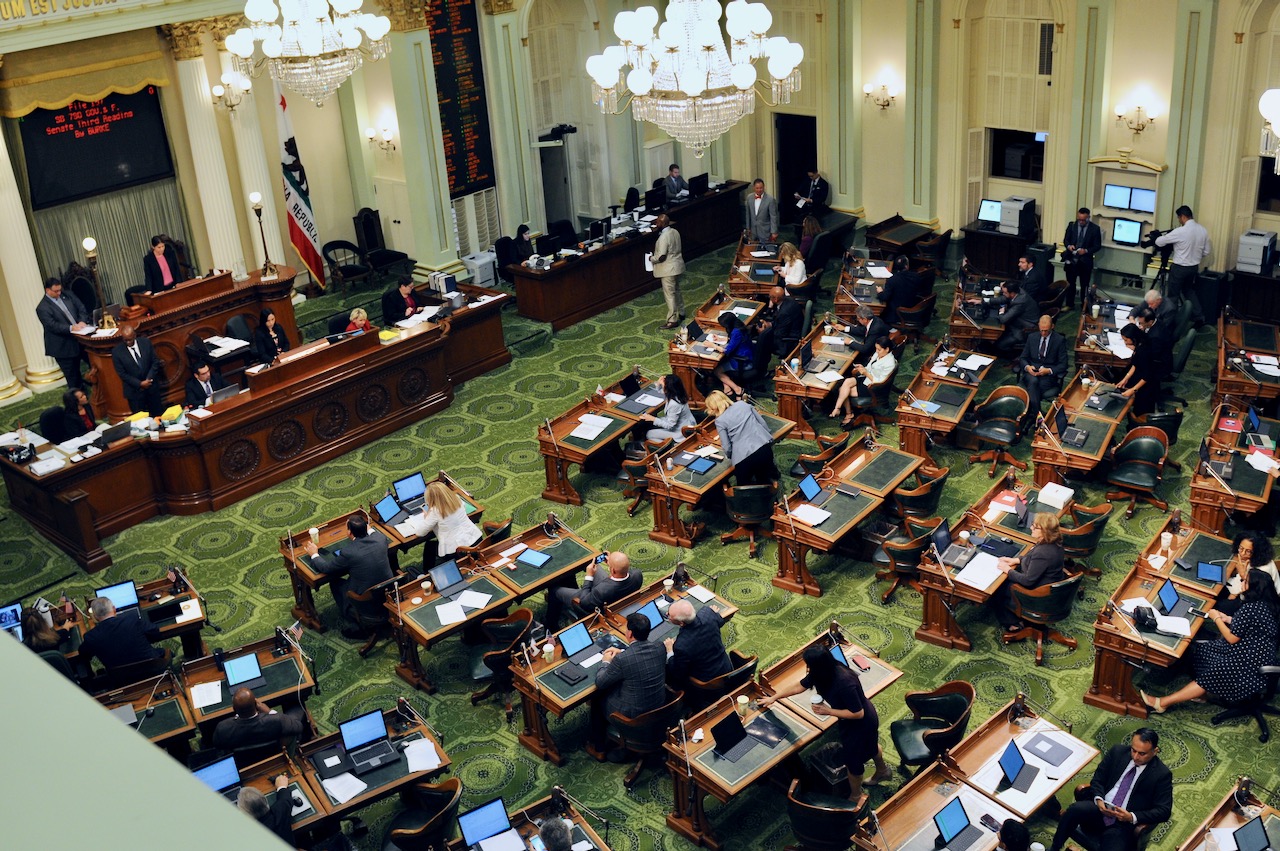
California Assembly. (Photo: Katy Grimes for California Globe)
Chart of Sections of the Assembly and Senate Daily Files
The first reading of the bill takes place when it is actually introduced in either house
By Chris Micheli, July 16, 2026 2:00 pm
The following is a chart of the main sections of the Assembly and Senate Daily Files used in the California Legislature:
| Section | Purpose |
| First Reading | The first reading of the bill takes place when it is actually introduced in either house. The bill is placed “across the desk (of the Assembly or Senate)” which is the official act of introducing a bill in the Legislature. In the Assembly, the Chief Clerk or his or her representative at the Assembly Desk receives the measure. In the Senate, the Secretary of the Senate or his or her representative takes the bill. The bill is given a bill number upon introduction. Once a bill passes over to the other house for consideration, it is simply read for the first time. Introduced bills are noted in the Assembly Daily File or the Senate Daily File, but there is no “first reading” portion of either Daily File. No floor analysis is prepared of the introduced bill. |
| Second Reading | The second reading of the bill takes place after the bill has been reported out of committee, either the policy or fiscal committee, to the Floor of either the Assembly or Senate. This process occurs whether the bill has been amended or not. Also, a bill can be on Second Reading several times, such as when the bill has been reported out of the policy committee and then again after being reported out of the fiscal committee. There is a Second Reading portion in both the Assembly and Senate Daily Files. This portion lists by file number (assigned to each bill once it has been listed in the File) each bill that has been reported out of committee to the floor. The general rule is that a bill remains on the Second Reading File for one day before moving to the Third Reading File. No floor analysis is prepared for the Second Reading file bills. |
| Third Reading | The third reading of the bill takes place when the bill is about to be taken up for consideration (i.e., presentation, debate and vote) on either the Assembly Floor or the Senate Floor for final passage. There is a Third Reading portion in both the Assembly and Senate Daily Files. This portion lists by file number each bill that is eligible to be taken up for a final vote on either Floor. A Third Reading Analysis is prepared for bills eligible for consideration on either the Assembly or Senate Floors. This analysis of the bill generally provides an explanation of existing law, what this bill does to existing law, any amendments, a listing of supporters and opponents, etc. |
| Unfinished Business File | Both the Assembly Daily File and the Senate Daily File contain a portion titled “Unfinished Business,” which is the section that contains bills that have returned to their house of origin from the other house and await a concurrence vote due to amendments that were made to the bill by the other house. This section of the Daily File also contains bills that were vetoed by the Governor. They remain on the Daily File for a 60-day period after the gubernatorial veto. Thereafter, unless voted upon, they are removed from the Daily File and can no longer be considered. |
| Inactive File | The other section of the Daily File to be aware of is for bills that made it to the Floor of either the Assembly or the Senate, but for whatever reason the bill’s author does not want to proceed with the measure. Bills that have failed passage can be moved to the Inactive File upon request of the bill’s author. If an author has moved a bill to the Inactive File, he or she can remove it from the Inactive File at a later date with public notice. |


Chris Micheli is an attorney and lobbyist with Snodgrass & Micheli, LLC, as well as an Adjunct Professor at McGeorge School of Law.
Latest posts by Chris Micheli (see all)
- Unique Aspects of California’s Legislative Process - September 16, 2026
- Employment Agencies and Counseling - September 16, 2026
- Digital Age Assurance Act - September 15, 2026
RELATED ARTICLES
-
 September 2, 2024
 -
 April 10, 2022
 -
 October 31, 2025