

Red, white, and blue vote buttons background. (Photo: Leigh Prather/Shutterstock)
Everything You Always Wanted to Know About California’s 14 Ballot Measures in November
There are high-stakes proposed initiatives pushing tax increases, misleading housing bonds, and the SEIU’s healthcare spending Billionaire tax
By Katy Grimes, July 31, 2026 6:00 am
As of July 27, 2026, 14 statewide ballot propositions have qualified for the November 3, 2026 election, confirmed by the California Secretary of State.
What’s so pressing in California that 14 initiatives qualified for the ballot, and why should you pay attention to them? Why should you vote for or against these?
There are high-stakes proposed initiatives pushing tax increases, misleading housing bonds, and the SEIU’s healthcare spending Billionaire tax.
As the Globe reported, California’s billionaire wealth tax is theft. According to President Trump’s AI and crypto czar David Sacks, “This is not a tax — this is asset seizure,” said billionaire venture capitalist David Sacks to CNBC’s“Squawk Box.” Sacks insisted that “it’s not a one-time, it’s a first time.”
“And if they get away with it, there’ll be a second time and a third time. And this will be the beginning of something new and different in this country, which is asset seizure,” he said.
Let’s start at the end: A “Yes vote on Propositions 41, 42, and 43 will make it harder for politicians to raise your taxes” – something most voters can agree on.
Tired of constant tax hikes in CA???
Yes on Prop 41, 42, and 43 will make it harder for politicians to raise your taxes.
Help Reform California pass what we're calling the "TAXPAYER PROTECTION TRIO" in November!
(link in thread) pic.twitter.com/qxqdihS179
— Carl DeMaio (@carldemaio) July 30, 2026
Assemblyman Carl DeMaio (R-San Diego) is a wonderful resource and has done the heavy lifting on some of the best and worst of the initiatives on his Reform California website. The description in all caps is from the Secretary of State’s Office, and some of the descriptions below the bright boxes came from Assemblyman DeMaio.
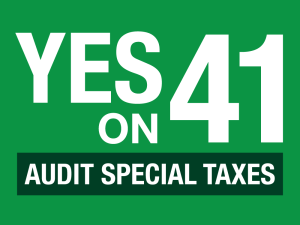
Proposition 41
REQUIRES AUDITS OF PROGRAMS FUNDED BY NEW STATE SPECIAL TAXES. PROHIBITS NEW STATE TAXES THAT ARE EXCLUDED FROM EXISTING VOTER-APPROVED STATE SPENDING LIMIT. INITIATIVE CONSTITUTIONAL AMENDMENT.
Assemblyman DeMaio says, “Prop 41 would make it harder for state and local politicians to impose special taxes on you. Prop 41 requires that all special taxes include audits on all revenues raised and programs funded through the tax to prevent waste, fraud and abuse or diversion of the funds by politicians. Prop 41 also requires that these special taxes adhere to the state’s constitutionally-mandated spending limit.”
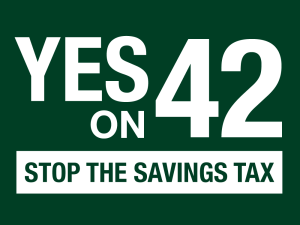
Proposition 42
PROHIBITS NEW STATE PERSONAL PROPERTY TAXES AND CERTAIN RETROACTIVE STATE TAXES. INITIATIVE CONSTITUTIONAL AMENDMENT.
DeMaio says, “Prop 42 would prohibit state and local politicians from imposing a Savings Tax on Californians. Prop 42 would prohibit politicians from taxing the value of your savings, checking account, 401k, stock portfolio, and current equity in your home. We already pay the highest taxes on income, sales, property, gas and our cars – we don’t need a Savings Tax on top of all that!”
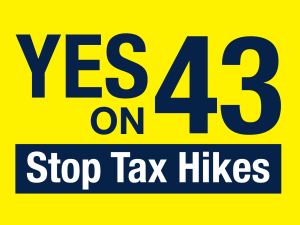
Proposition 43
ACA 22 (Wicks) Local taxes: limitation. (Res. Ch. 132, 2026) (PDF)
DeMaio says, “Prop 43 is known as the Save Prop 13 – Local Taxpayer Protection Initiative. Prop 43 makes it harder for local politicians to raise your taxes by restoring the two-thirds vote requirement on any local tax measures. It also closes loopholes the politicians have created in Prop 13 to violate the property tax caps that voters originally imposed.”
Back to the beginning…
Proposition 1
SB 417 (Limón) The Veterans and Affordable Housing Bond Act of 2026 (Ch. 16, 2026) (PDF) The Legislative Analyst’s Office describes Prop 1:
Proposition 1 is the Veterans and Affordable Housing Bond Act of 2026, enacted via SB 417. It authorizes $11.25 billion in bonds if approved by a majority of voters.
As Sen. Shannon Grove (R-Bakersfield) said in debate in the Senate, “this is not a veterans housing bond. It’s a veterans bait bond. To say you’re going to allow it to be a veterans bond when it uses $10 billion for other than veterans services is completely not true.”
She’s right. The deviousness behind using veterans to get a housing bond passed is reprehensible.
This is how it breaks down: $10 billion in general obligation (GO) bonds, go for “affordable rental housing, homeownership programs, preservation, infrastructure, and related uses.”
Proposition 2
ACA 20 (Gabriel) Save for California’s Future Act. (Res. Ch. 130, 2026) (PDF) passed the Legislature on June 25, 2026 along party lines.
The Legislative Analyst’s Office describes Prop 2:
Extends and expands debt payments, or as the LA Times put it, “Democrats want California voters to give them more flexibility over spending.”
LAO: Prolongs required extra debt payments until 2039–40 (from the prior endpoint around 2030) and broadens eligible uses to include Proposition 98 settle-up obligations, budgetary borrowing, and repayment of federal Unemployment Insurance loans. Notably, Prop 2 is a proposed constitutional amendment that would change how the Gann Limit (State Appropriations Limit) treats certain reserve deposits and withdrawals. It reduces pressure to return excess revenues to taxpayers and expands fiscal flexibility for spending later.
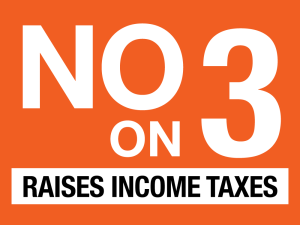
Proposition 3
PROVIDES PERMANENT FUNDING FOR SCHOOLS AND HEALTHCARE BY EXTENDING EXISTING TAX ON HIGH INCOMES. INITIATIVE CONSTITUTIONAL AMENDMENT.
DeMaio says “California already has the highest income tax rates in the nation – and Prop 3 would make those high rates PERMANENT and impose a multi-billion hit to struggling taxpayers! If Prop 3 passes, it will backfire by costing our state jobs reducing revenue to the state budget as more high-income residents flee the state.”
Prop 3 would make permanent the higher state personal income tax rates on high-income earners that voters first approved in 2012 (Proposition 30) and extended in 2016 (Proposition 55). Those rates are currently scheduled to expire after 2030. So naturally, Democrats want them extended. Taxpayers were promised that these were “temporary” taxes. (just as they promise that Prop 40 the Billionaire’s tax is a “one-time” tax).
As we warned back in 2012, Proposition 30 created the “temporary” higher rates and a “temporary” sales-tax increase, sold to voters as protecting education funding. Then-Gov. Jerry Brown called it a “millionaires’ tax,” but it affected anyone making over $250,000 per year, and increase the sales tax for all. Proposition 55 in 2016 extended the income-tax portion through 2030, as we predicted.
Proposition 4
Prop 4 amends the voter-approved Political Reform Act of 1974 (specifically provisions stemming from Proposition 73 of 1988), it requires voter approval to take effect.
It removes the general statewide ban on using public funds for candidates seeking elective office. Currently, only charter cities (e.g., Los Angeles, Long Beach) can operate such programs; the measure would extend the option to the state, counties, districts, and general-law cities.
A similar effort (SB 1107 in 2016) was blocked by courts, which ruled that changes to the relevant Political Reform Act provisions needed voter approval.
The California Taxpayers Association opposes Prop 4 and has concerns about taxpayers funding political speech they may oppose, and risks of fraud or abuse.
Proposition 5
SCA 1 (Newman) Elections: recall of state officers. (Res. Ch. 204, 2024)
Prop 5 amends the California Constitution regarding the recall of state officers. Under current law, a state officer recall election asks two questions:
(1) whether to remove the officer (majority vote required), and
(2) who the successor should be (plurality wins). The officer subject to recall cannot run as a successor candidate.
Election Integrity Project California opposes the measure because it weakens voters’ ability to choose a replacement immediately after removing an official and that automatic succession (especially elevating the Lieutenant Governor) and can deny voters a direct say.
Proposition 37
CREATES LOAN PROGRAM FOR MIDDLE-INCOME BUYERS OF QUALIFIED NEW HOMES. INITIATIVE STATUTE.
Proposition 37 is titled “Creates Loan Program for Middle-Income Buyers of Qualified New Homes.” It is also known as the “Middle-Class Homeownership and Family Home Construction Act of 2026” or the “Second Mortgage Homebuyer Program and Revenue Bond Initiative.”
Prop 37 authorizes the California Housing Finance Agency (CalHFA) to issue up to $25 billion in revenue bonds to fund a new “middle-class homeownership loan” program. These function as second mortgages (down-payment assistance) covering up to 17% of the purchase price of a qualified new home. Buyers must put down at least 3% and obtain a primary mortgage for the rest.
A YES vote creates the program and authorizes the bonds. A NO vote means the state is not required to create it. I ask why.
Proposition 38
AUTHORIZES BONDS FOR IMMUNOLOGY RESEARCH. INITIATIVE STATUTE.
According to the Legislative Analyst’s Office, Proposition 38 is an initiative statute titled “Authorizes Bonds for Immunology Medical Research” (or similar wording: “Authorizes Bonds for Immunology Research”). It would authorize the state to issue $8.4 billion in general obligation bonds to fund immunology and immunotherapy research (approaches that use or enhance the body’s immune system to prevent, treat, or cure disease).
Allocation: Funds are split roughly equally between:
- A University of California-affiliated nonprofit medical research institute selected by the California Department of Public Health based on criteria in the measure (size, funding, collaboration with a UC campus, etc.).
- A competitive grant program for California public or nonprofit universities and research institutions, overseen by a council that includes representatives from UC campuses and other institutions.
Why can’t the Dept of Public Health fund this? Why do taxpayers have to fund additional billions for “research” when our state universities are already research universities?
Notably, Prop 38 will increase state costs of about $500 million to $600 million annually for 25 years to repay the bonds.
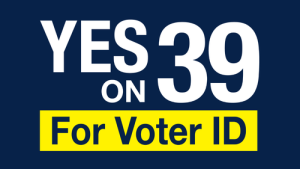
Proposition 39
ESTABLISHES ADDITIONAL VOTER IDENTIFICATION AND CITIZENSHIP VERIFICATION REQUIREMENTS. INITIATIVE CONSTITUTIONAL AMENDMENT.
California Attorney General Rob Bonta was credibly accused last week of rigging the ballot language for Proposition 39, the Voter Identification, Citizenship Verification, and Registered Voter List Administration Initiative, just months before the November 2026 election, the Globe reported.
Prop 39 is the California Voter ID Initiative — a state constitutional amendment to impose a Voter ID requirement for all future elections in California. Because the proposal is a constitutional amendment, once approved by the voters, state politicians will be compelled to comply with it for all future elections – no exceptions.
Here’s what Prop 39 requires:
1. Photo ID to Vote: Voters would provide a government issued ID for in-person voting or provide last four digits of a government ID for voting by mail.
2. Verification of Citizenship: Election officials would be required to verify that only eligible individuals are registered to vote and receive ballots. Citizenship must be verified.
Voter ID has bipartisan/non-partisan public support based on polling:
- Support often registers in the mid-50s% to higher overall in California surveys (e.g., Berkeley IGS polls around 56% yes in one April 2026 reading after a basic description; other polls have shown majorities for related ID/citizenship rules).
- Cross-party numbers are frequently cited (strong Republican majorities, substantial independent support, and sometimes plurality or majority Democratic support depending on exact wording and framing). National polls (e.g., Gallup) have long shown broad majorities favoring voter ID, including among Democrats.
Proposition 40 – One Time “Billionaire Tax”
IMPOSES ONE-TIME TAX ON CERTAIN INDIVIDUALS AND TRUSTS. INITIATIVE CONSTITUTIONAL AMENDMENT AND STATUTE.
California Proposition 40 is a combined initiated constitutional amendment and statute formally titled “Imposes One-Time Tax on Certain Individuals and Trusts.” It is commonly known as the Billionaire Tax Act or One-Time Wealth Tax for State-Funded Healthcare, Education, and Food Assistance Programs Initiative.
The measure was sponsored primarily by SEIU-UHW (via the Save California Health Care and Public Education PAC).
According to the Legislative Analyst’s Office:
Key Provisions
- Tax imposed: A one-time tax of up to 5% on the net worth (worldwide assets) of certain California resident individuals and applicable trusts with covered assets valued over $1 billion.
- Who is covered: Individuals (including married couples treated as one unit) who were California residents as of January 1, 2026 (the “tax obligation date”), and certain trusts (e.g., non-grantor trusts receiving transfers from such individuals, with rules attributing values from 2025–2026 transfers). Roughly 200–250 people are estimated to be affected.
- Valuation date: Net worth generally measured as of December 31, 2026.
- Covered assets: Include businesses, securities, stocks, bonds, art, collectibles, intellectual property, and other personal property/interests. Real property (real estate) held directly, as well as certain pensions and retirement accounts, are generally excluded. Business-held real estate is typically included.
Gov. Newsom claims he does not support California’s billionaire tax proposal, but he proposed a nationwide billionaire tax, demonstrating how he speaks out of both sides of his mouth.
It's time for a national billionaires tax and a new social contract.
10% of Americans own two-thirds of the wealth. Wages have stagnated. The cost of living has skyrocketed.
The system is fundamentally broken.
The federal tax code, a corporate code, and an inheritance code… pic.twitter.com/tLRbUId6yi
— Gavin Newsom (@GavinNewsom) June 26, 2026
Newsom said:
“It’s time for a national billionaires tax and a new social contract. 10% of Americans own two-thirds of the wealth. Wages have stagnated. The cost of living has skyrocketed. The system is fundamentally broken. The federal tax code, a corporate code, and an inheritance code were written for a different set of Americans. It’s time for an economic reset.”
What Gavin Newsom doesn’t say is, according to the latest IRS data, the top 10% of earners pay roughly 70-75%, or more in some years, of total U.S. federal individual income taxes.
The system is not fundamentally broken, but Democrats sure are. They are running out of other people’s money to spend.
California billionaires are leaving the state in record numbers, and taking their billions with them. According to one billionaire in January more than $1 trillion already left, the Globe reported – seven months ago.
Democrats are good at one thing – killing the goose that lays the golden eggs.
Proposition 44
REQUIRES COMMUNITY HEALTH CLINICS SPEND 90% OF REVENUE ON PROGRAM SERVICES. INITIATIVE STATUTE.
Proposition 44 requires private nonprofit safety net clinics to spend at least 90 percent of their total revenue each year on providing health care services. This means that spending on other expenses, such as administrative costs, would be limited to no more than 10 percent of revenue, According to the Legislative Analyst’s Office. The California Attorney General would define in more detail which kinds of expenses are related to providing health care services, and which are other expenses, using existing reports to the federal government as a starting point. Affected clinics could ask the state for a temporary waiver of the requirements in some cases.
According to the Legislative Analyst’s Office, these private nonprofit safety-net clinics currently spend an average of about 80% of revenue on health care services (with variation across clinics). There are roughly 1,000–2,000 such safety-net clinics in California; the measure targets the private nonprofit ones (not those operated by public entities such as counties).
The LAO says Prop 44 will increase state costs in the low tens of millions of dollars per year to enforce the new requirements on certain private nonprofit health care clinics, covered by fees charged to the affected clinics.
Proposition 45
MODIFIES ENVIRONMENTAL REVIEW FOR CERTAIN PROJECTS. INITIATIVE STATUTE.
Prop 45 amends CEQA to expedite environmental review of specified project categories (including most housing, transportation, water, health, and clean energy projects), according to the Secretary of State. For these projects, the measure:
- Sets deadlines for public agencies to complete environmental review and take required actions.
- Allows expedited review of a project’s environmental impacts, limiting public agencies’ current obligation to consider a full range of feasible project alternatives to reduce impacts.
- Limits court review of project approvals by establishing deadlines for filing and resolving lawsuits and restricting the evidence courts may consider and the relief they can order
Covered “essential” projects generally include:
- Housing of all types
- Water systems (excluding Delta conveyance facilities)
- Clean energy and electricity
- Medical facilities (hospitals and clinics)
- Public safety infrastructure and wildfire prevention/resilience (excluding jails/prisons)
- Broadband and telecommunications
- Education facilities (public schools, etc.)
- Transportation (roads, bridges, transit; excluding high-speed rail
Summary of estimate by Legislative Analyst and Director of Finance of fiscal impact on state and local governments: State and local government implementation costs in the tens of millions of dollars annually for the first several years. Over the long term, the annual net fiscal effects are uncertain, but state and local governments likely would experience net savings due to reduced administrative and legal workload. Net fiscal effects on state trial courts ranging from annual savings of up to the tens of millions of dollars to annual costs of up to the low tens of millions of dollars. (25-0023A1.)
Competing measures (especially Props 40, 41, and 42) include conflict provisions: if both a tax and a conflicting limit pass, the one with more votes generally prevails.
The Globe will monitor all ballot initiatives and report accordingly.

A California native and Navy mom, Katy lives in Sacramento, CA.
- Female Athletes File Title IX Sex Discrimination Class Action AgainstUC Davis - September 30, 2026
- Financial Challenges Facing California’s Independent Gas Stations - September 30, 2026
- Newsom Signs Unlawful Immigration Bills Again, After 2025 Bills Were Overturned by Ninth Circuit - September 29, 2026
RELATED ARTICLES
-
-
 January 30, 2022
 -
 July 17, 2026
Two points:
1.
Prop 40 can be amended by a 2/3 vote of the legislature, so all purported limits on the reach of the wealth tax are not really limits. The Dems drool at the prospect of taxing the equity in our homes and private retirement accounts.
2.
It would be good to know who supports and opposes each initiative. That is often more helpful in deciding how to vote than the description/summary.
Just read the Sacramento Bee’s recommendations…then do the exact opposite. You’ll be on the right side every time.
Appreciate very much this advance overview of CA ballot measures from Katy Grimes.
We have to steel ourselves to battle these Dem/Commies and becoming very familiar very early with their tricks is a very good thing.