
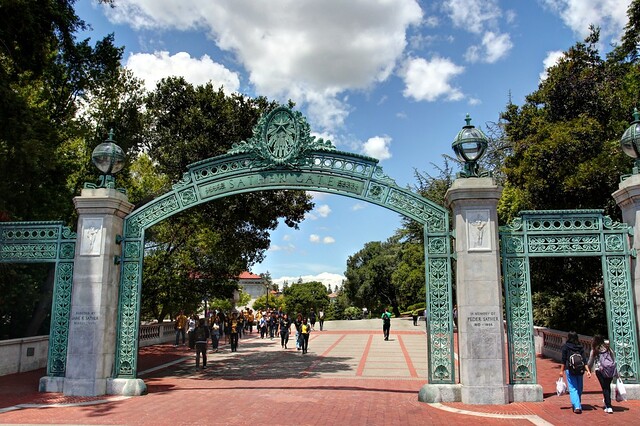
Arched entrance to U.C. Berkeley. (Photo: berkeley.edu)
UC Berkeley Professor Discovers What Her Peers Built
California’s education establishment spent the better part of a decade elevating social and racial justice rhetoric over measurable competence
By J. Mitchell Sances, August 22, 2026 6:00 am
A University of California, Berkeley mathematics professor recently expressed public frustration that her college students arrive unable to handle basic skills—fractions, elementary algebra, the kind of material once expected well before high school graduation. The complaint is real, the classroom reality is documented, and the irony is thick enough to cut with a protractor.
The professor, Zvezdelina Stankova, was born in communist Bulgaria and after immigrating to the United States, she went on to obtain a PhD in mathematics at Harvard University. She penned an op-ed in the San Francisco Standard where she discussed the abysmal admissions standards and claimed that many of her calculus students did not understand basic math concepts such as fractions. “Some students are five to eight years behind in mathematics. Office hours that should be spent discussing integrals instead become lessons on fractions and basic algebra you would expect students to learn in middle school,” Stankova wrote in her op-ed.
California’s K-12 math performance has been sliding for years. On the National Assessment of Educational Progress (NAEP), the state’s fourth-grade math scores fell from 240 in 2013 to 230 in 2022; eighth-grade scores dropped from 276 to 264 over the same period. High-school indicators track the same downward path: California’s average SAT math score for the class of 2023 hovered around 520–530 for public-school test-takers, well below national averages of earlier decades, while CAASPP results show only about one-third of students meeting or exceeding grade-level standards in mathematics in recent testing cycles. Elementary and middle-school proficiency rates have stagnated or declined since the mid-2010s, with the sharpest losses concentrated after pandemic disruptions and after years of curriculum experiments that de-emphasized procedural fluency in favor of “equity” frameworks and delayed algebra pathways.
These numbers did not appear by accident. California’s education establishment spent the better part of a decade elevating social and racial justice rhetoric over measurable competence. The University of California system’s decision to eliminate the SAT and ACT as admission requirements—framed explicitly as a remedy for disparate impact and systemic bias—removed one of the few remaining objective signals of academic readiness. Proponents insisted the tests were barriers; the predictable result was larger cohorts of underprepared students admitted under holistic criteria, only to discover in college classrooms that fractions and linear equations had not been mastered. The policy did not close achievement gaps. It imported them into higher education and then expressed surprise when professors noticed.
It is difficult to summon sympathy for the institutions and faculty who spent years defending the very policies that produced this outcome. The same academic culture that cheered the elimination of standardized testing, that promoted “anti-racist” math frameworks skeptical of traditional rigor, and that treated objective performance metrics as suspect now confronts the downstream consequences in its own lecture halls. A professor forced to reteach middle-school arithmetic is not the victim of an external assault on education; she is harvesting what her peers and the broader progressive education apparatus sowed. The students themselves are the ones who paid the highest price, arriving at one of the nation’s flagship public universities without the tools their high-school diplomas claimed to certify.
California’s experiment in substituting justice narratives for academic standards has delivered exactly what rigorous critics predicted: lower proficiency, diluted college readiness, and a professoriate suddenly discovering that ideology does not substitute for fractions. The data are public. The classroom complaints are public. The responsibility is not mysterious.


- WGA East Partners With Cloak to Keep AI Script Summaries Off the Table - October 22, 2026
- Netflix’s ‘14th’ Filmmakers Urge Americans to ‘Fight’ While Lecturing on Autocracy - October 19, 2026
- Private Initiative Steps Up While Sacramento and City Hall Stall: Caruso, Skydance, and the Bay Theater’s Return to the Palisades - October 15, 2026
RELATED ARTICLES
-
December 29, 2025
-
-

Well, everyone gets a participation trophy for merely showing up k-12 with presence counting toward school funding, with educational focus on sexual perversion and which box to select on a ballot during votin season.
Then higher education appears to be all about group sex party time and communist indoctrination.
What else can be expected?
This is just another institution the Progressive liberal Democrats have destroyed. They destroy EVERYTHING they come into contact with. It’s in their nature. On to the next.
This UCB professor is a first generation immigrant from a then Soviet Bulgaria. She knows very well what a “social justice state” is. Any freedom-loving person should be supportive of this brave woman and her effort to restore sanity. Snickering at her is cheap and not smart.