
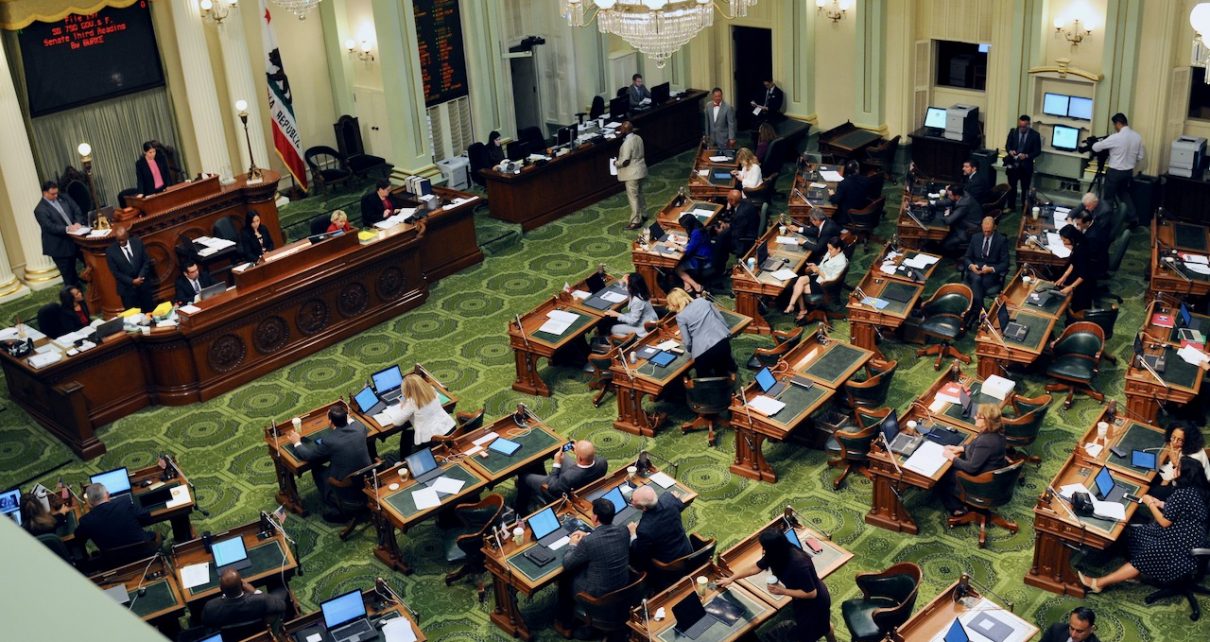
California State Assembly Chamber. (Photo: Kevin Sanders for California Globe)
A Refresher on California Special Sessions
The power to call a special session by the Governor is set forth in the Constitution
By Chris Micheli, September 10, 2026 7:27 am
With growing talk of a special session of the California Legislature this month or next on wildfire liability, it is a good time for a refresher about special or extraordinary sessions. We start with the California Constitution and Article IV which establishes the legislative branch of state government. Specifically, Section 3(b) provides:
On extraordinary occasions the Governor by proclamation may cause the Legislature to assemble in special session. When so assembled it has power to legislate only on subjects specified in the proclamation but may provide for expenses and other matters incidental to the session.
As a result, the power to call a special session by the Governor is set forth in the Constitution. But after that, it is up to the Legislature to convene and pass any legislation. There are other special session provisions in the Constitution including:
- Section 8(c)(1) which deals with the time a statute enacted at a special session goes into effect.
- Section 10(b)(4) deals with the 12-day veto period after adjournment of a special session.
- Section 12(h) deals with expenses paid to legislators during regular or special sessions.
When it comes to the Joint Rules of the Assembly and Senate, the term “extraordinary session” is used almost exclusively as set forth below:
- Joint Rule 3.5 relates to the effect of the adoption of joint rules for any extraordinary session.
- JR 13 deals with the distribution of legislative publications for any regular or extraordinary session.
- JR 13.3 deals with the Summary Digest at each regular and extraordinary session.
- JR 50.3 deals with the designation of all extraordinary sessions.
Once issued, be sure to review the Governor’s proclamation and what is the broad or narrow scope of the subject matter of the special session.
Just as with the convening of a regular session, a special session is convened with officers being elected and rules adopted. There may be some differences in a few house or joint rules between the regular and special sessions. Also, while all of the standing committees could be used in a special session, usually the Assembly and Senate establish one or more committees that deal with the subject matter of a special session.
When the business of the special session has been completed, assuming it does not continue until November 30, 2026 when the Legislature (and any pending special session) will adjourn sine die, the Assembly and Senate will adopt a concurrent resolution that will provide that the Extraordinary Session of the Legislature will “stand adjourned sine die at midnight on the date that this measure has been adopted by both houses of the Legislature.”
The normal 12-day rule for gubernatorial action applies to special session bills. In other words, the Governor has 12 days to act on a special session bill or else it becomes law without the governor’s signature. In the case with the Legislature sends a bill to the governor’s desk and then adjourns the special session, the Governor can still veto the bill within the 12-day period, but returns the vetoed bill to the Secretary of State, rather than the house of origin.
Regarding effective dates, Article IV, Section 8(c)(1) provides: “…. a statute enacted at a special session shall go into effect on the 91st day after adjournment of the special session at which the bill was passed.” This is intended to allow a referendum to be pursued against a bill enacted in a special session (except the four types of bills that are not subject to referendum).
Because of this constitutional provision, a bill enacted (absent an urgency clause, tax levy, or budget appropriation) in a special session has to wait for the special session to adjourn sine die before the 90-day clock begins. Recall that effective dates (when a new law is “on the books”) are different than operative dates (when a new law’s provisions apply).
Finally, recall that bills in a special session are not subject to many of the rules and deadlines contained in the Joint Rules of the Senate and Assembly. This includes Joint Rule 61 and 62 deadlines, as well as file notice requirements.


- A Refresher on California Special Sessions - September 10, 2026
- No Contest Clauses - September 10, 2026
- Regulation of Restricted Wildlife - September 9, 2026
RELATED ARTICLES
-
 October 12, 2022
 -
 October 20, 2024
 -
 October 23, 2019