

County of Santa Barbara 2026 Board of Supervisors. (Photo: countyofsb.org)
The Intersectionality of Solar, Oil and Housing
Santa Barbara County is helping to sabotage the efforts of several cities seeking to expand their boundaries to meet state mandates for housing
By Andy Caldwell, September 16, 2026 12:00 pm
If you had to pick out one issue in California that best represents the affordability crises, it would have to be the cost of housing. Housing everywhere is, of course, affected by the law of supply and demand, but in California, this “law” is completely distorted by government regulations, red tape, and other priorities.
In this piece, I will discuss the fact that Santa Barbara County will allow 16,000 acres of farm and ranch lands to be converted to solar farms and battery energy systems, while they are helping to sabotage the efforts of several cities to expand their boundaries to meet state mandates for housing. These mandates require virtually every county in the state to add tens of thousands of new homes in the aggregate, and that is just for starters.
The problem with fulfilling these mandates in Santa Barbara County, which has no shortage of land available for housing, has to do with government impediments to the same. Decades ago, the County of Santa Barbara drew a line around the boundary of every city in the county and zoned everything outside of those limits’ “agriculture”. It made no difference if these “ag” lands have no water, poor soils, steep gradients, and the like. Moreover, not only are these ag-zoned lands pretty much off limits to housing, farmers also must go through arduous permit processes to build facilities to process their ag products including coolers, greenhouses, and wineries. That is, the county really treats “ag-zoned” properties as defacto open space, thereby limiting development of any kind on these properties.
What’s worse? While county supervisors can rezone ag properties that are in the unincorporated areas of the county to other zoning designations to allow for the construction of housing, industrial and retail, the cities have no such authority. Cities must go through an organization known as LAFCO, the Local Agency Formation Commission, to annex the “ag” lands surrounding their city to covert the same to urban type uses. The LAFCO board is comprised of a couple of county supervisors, city reps, and public members.
The insult to injury? The hypocrites on the Board of Supervisors conveniently rezone ag properties in the county to urban uses as they see fit by way of their own authority, while the county supervisors who sit on the LAFCO board do everything within their power to block annexations by the cities that would allow them to expand their urban footprint.
This is extremely problematic by virtue of a law known as RHNA, the Regional Housing Needs Allocation, which requires all jurisdictions to facilitate housing growth in their communities to facilitate population growth. If your city is surrounded by ag, you either must annex land or rely on infill projects. That is, your only two choices are to go up or out!
Below are the current RHNA cycle numbers, (24,856 units total) thru 2031 for our region:
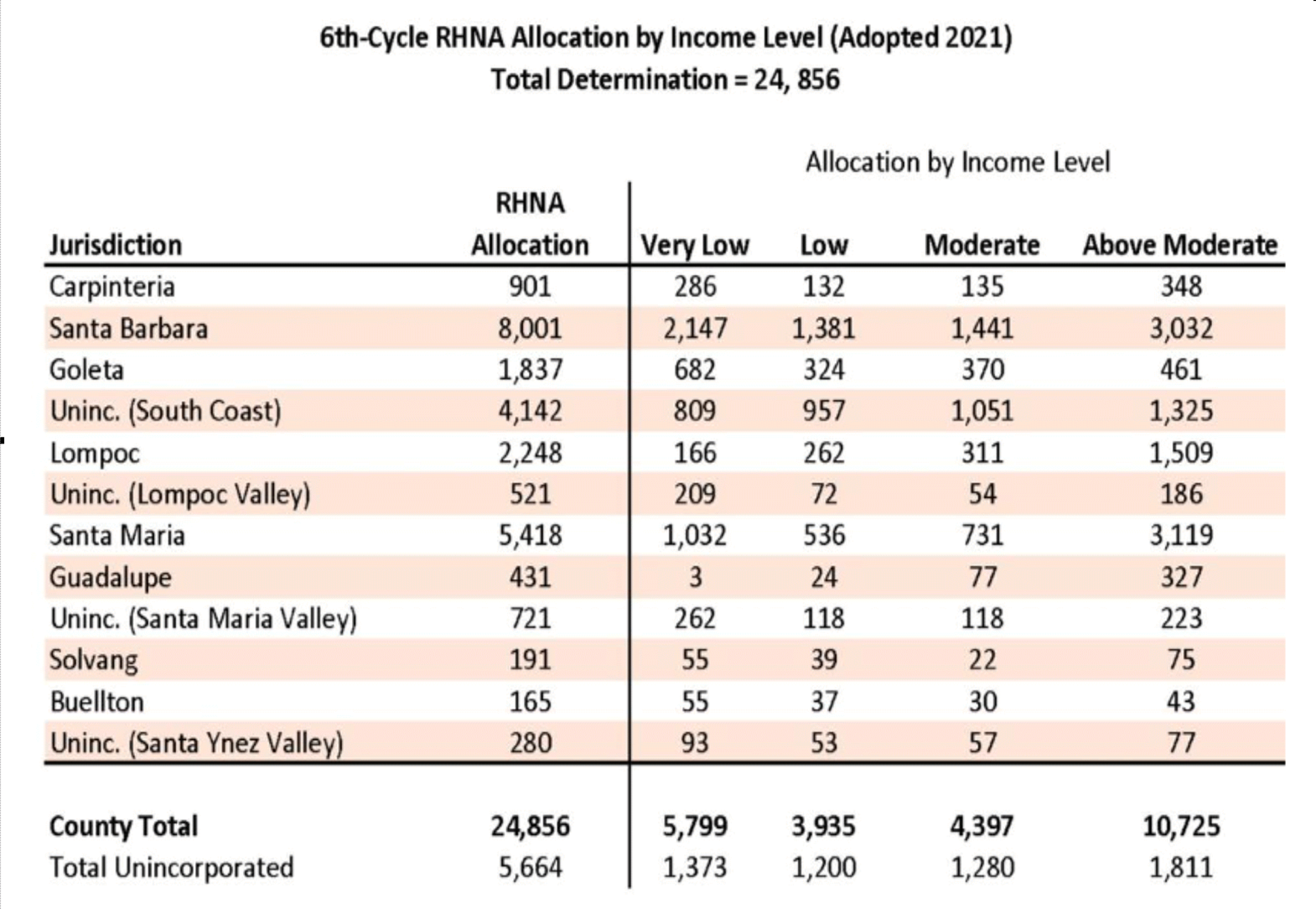
For example, the City of Santa Maria, which is surrounded by actual farm fields, has done its best to avoid conversion of the same. But the RHNA process is currently requiring the city to build another 5,400 units (to accommodate some 15,000 people) by 2031. Beyond 2031, the city expects it will have to build another 15,000 units to accommodate another 34,000 people by 2050.
Santa Maria is proposing to annex up to 1,000 acres to accommodate this growth. But LAFCO is insisting that this growth be absorbed by way of infill projects via converting empty spaces within the current city boundaries. However, the brain trust at LAFCO is failing to recognize that to accommodate a 50% increase in population over the next 2.5 decades, the city would need 250 acres of parks for the new population growth, along with 10 new elementary schools (10 acres each), 4 new junior high schools (20 acres each), and 2-3 new high schools (40 to 60 acres each). Thus, these public serving “amenities” could take up over 600 acres, and that is without the tens of thousands of new homes driven by state mandates.
There are a couple of major problems the supervisors glossed over when they opened up 16,000 acres of land, including lands on the Gaviota coast, to solar and battery development. The first thing they ignored was fire! The very real possibility of wildland fires burning up the solar and battery farms or battery fires burning up the wildlands.
Second, the county envisions that building these electricity generation and storage units will enhance our local grid stability when our power gets shut off by our utilities. However, they are ignoring the fact that the one wind turbine plant in the county, near the city of Lompoc, generates power used by Marin County as they purchased the power from the project. The one large solar farm in Cuyama generates power for Kern County, not Santa Barbara County. In other words, we may end up sacrificing our coastline and our ag lands for the benefit of other jurisdictions, and all we get out of it is the impacts and associated risks.
Finally, at the same time the sups are going all in on solar and battery, they are also trying to ban new oil drilling and eliminate existing oil production. As we all know, one of the biggest costs to housing is the price of land. This is why cities who are doing infill projects are starting to build 3 and 4 story buildings on a routine basis in some parts of the county, which we have never seen before. Regardless, consider the fact that solar fields take up much more land that will no longer be available for housing and farming, while oil and gas facilities have such a smaller physical footprint and easily coexist with agriculture. Oil turbines produce far more electricity per acre than solar PV. For example, a 100 MW diesel plant on 12 acres yields ~8.3 MW per acre, while a 100 MW solar farm on 700 acres yields ~0.14 MW per acre! You would have to cover pretty much every acre of ag land in CA to try and replace our oil industry while simultaneously eliminating the same amount of land for future housing!
Too bad nobody on the Santa Barbara Board of Supes or LAFCO sees the big picture.


- The Intersectionality of Solar, Oil and Housing - September 16, 2026
- The Kissing Cousins of the Affordability Crises - September 1, 2026
- A Religious Revolution Deadly to Men - August 10, 2026
RELATED ARTICLES
-
-
 July 19, 2023
 -
 April 24, 2024
This is what happens when the county has TWO GENERATIONS of Capps on the Board of Supervisors, and BOTH of them have a combined IQ of about 60, total….
Two incompetent “community organizers” that have no idea how to manage….
And Laura was appointed by Newscum after being married to an Obama advisor….
Train wreck….