

‘It’s the Economy, Stupid’ – and it’s Robust
Ignore the media, spread the good economic news, and pray for California
By Katy Grimes, September 29, 2026 8:04 am
“It’s the economy, stupid!” was the pivotal message in the 1992 U.S. presidential campaign, by James Carville, Bill Clinton’s political advisor. Because it always comes down to the current economic trend that determines whether voters are satisfied with an administration, or whether they will vote it out.
But the U.S. media is constantly perpetuating the fiction that we are in such a high state of emergency that only ousting Trump will the ends justify the means. If the media delivered the truth everyday, America would be a different country.
The truth is that the U.S. economy is robust.
Retail sales were higher than expected in August despite higher prices on gasoline and other goods. This is important because retail sales serve as a barometer for the overall health of an economy. It reflects consumer spending patterns, which are a significant driver of economic activity.
Americans spent heavily during the World Cup and on Amazon Prime Day, Just the News reported. Sales in April and May were solid as Americans spent their government tax refunds. Retail sales exceeded expectations last month, rising 1.2% after recording a revised dip of 0.5% in July, new Commerce Department data shows. Even excluding business at gas stations, retail sales rose 1.1% in August, signaling consumer resilience.
The Trump economy has delivered record low child and Hispanic poverty rates. The poverty rate for children and Hispanics just hit record lows, while median household incomes have hit a record high.
“Median household income also hit a record high of $87,460. That is the highest median household income in the world, dwarfing all other large industrial nations that are not petro-states or tax havens,” Victor Davis Hanson reports. “The same holds true for our GDP per capita—which, incidentally, was already over $34,000 higher than in Canada.”
The Labor Department reported unemployment claims dropped to 196,000, beating expectations, the fewest since mid-July and down from 206,000 the week before. For the past year, jobless claims have remained within a historically low range of 200,000 to 230,000 per week. The number of people applying for unemployment benefits dropped sharply last week, signaling the country is seeing few layoffs.
Atlanta Fed GDPNow estimate for Q3 growth jumps to 5.1% from 4.4%… That means the economy is growing at 5%, up from 4.4 percent on September 10. After recent releases from the U.S. Census Bureau, the U.S. Bureau of Labor Statistics, and the Treasury’s Bureau of the Fiscal Service, the GDPnow casts of third-quarter real personal consumption expenditures growth and third-quarter real government expenditures growth increased from 3.6 percent and 1.3 percent, respectively, to 4.1 percent and 2.3 percent…
The timing is important, Investing Live reported mid-September. The update shows the U.S. economy growing at a strong pace heading into the recent FOMC rate decision, when the Federal Reserve raised its target rate by 25 basis points. Markets are pricing a roughly 90% probability of that outcome. Strong growth by itself is generally good news. However, for the Federal Reserve, an economy growing at an estimated 5.1% annualized pace—supported by accelerating consumer spending—may also create additional inflation pressure.
Unleash Prosperity reports, Women’s Earnings Surge Under Trump:
The latest Census data on incomes finds that women’s earnings are now higher than ever AND the pay gap is now lower than anytime in history.
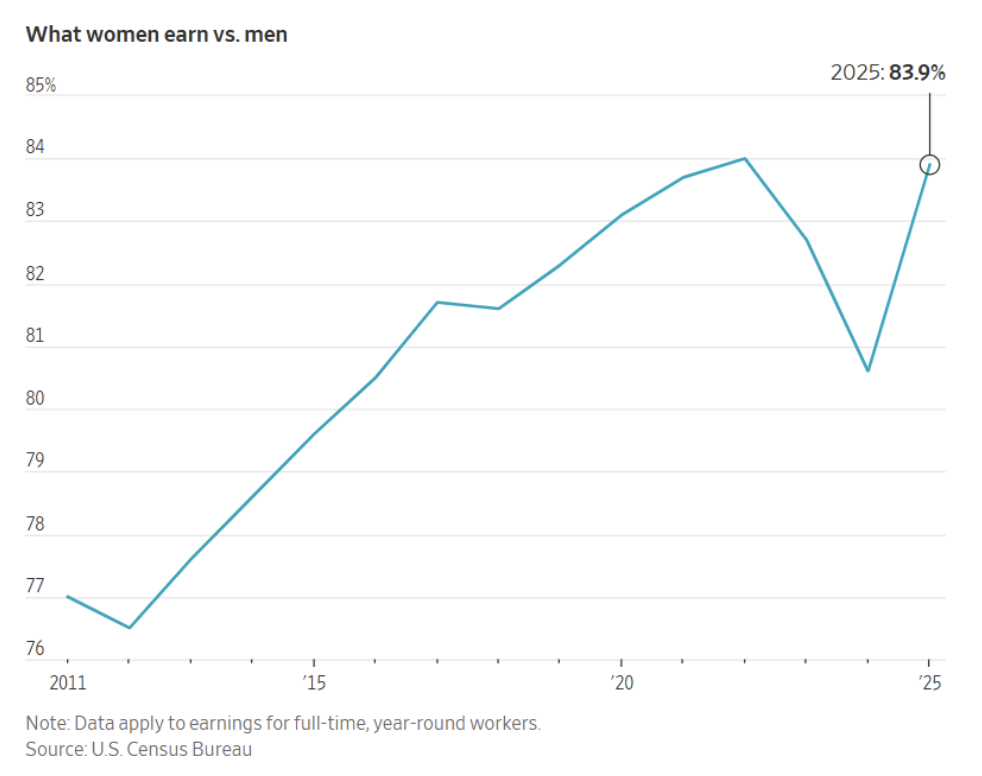
One political irony is that liberal women hate Trump. But their husbands support the President. “No president in this century has done more to lift women’s earnings than Donald Trump, Stephen Moore at Unleash Prosperity reports. “Will they thank him. Sure and hell will also freeze over.”
Now for the bad news: While the U.S. economy is robust, the California economy has some serious issues that everyone is feeling.
California has a distinctly worse unemployment rate, a severe housing and cost-of-living problem, a fragile and volatile budget, and ongoing net domestic outflows of people and business headquarters. Those are not just talking points; they show up in BLS, BEA, LAO, and PPIC data.
California’s unemployment rate is 5.1% – tied for highest among states – versus 4.1% nationally. The labor force has been shrinking even as payrolls ticked up. Wage growth has lagged the U.S. average. Growth is concentrated in education/health and government-adjacent sectors; manufacturing, information, construction, and professional services have been weaker, the California Center for Jobs and the Economy reports.

“The labor force numbers continued to show losses. The number of employed workers dropped by another 36,500, bringing total losses over the year to 278,500 or a drop of 1.5%. After previous gains, the number of workers employed in the state is now 263,700 lower than the peak prior to the pandemic.”
That is huge, and the crux of the economic problem in the state.
The PPIC reports California home values are more than double the national figure. Homeownership is among the lowest in the country, especially for younger households. Estimates of the housing shortage run from 1 million to 3.5 million units. California accounts for about a quarter of the nation’s homeless population.
High housing, energy, and tax costs continue to drive domestic out-migration even when international inflows keep total population roughly flat.
The state has faced repeated budget shortfalls despite revenue growth, because spending has outpaced even strong capital-gains and high-income tax collections. Analysts have flagged multi-year operating deficits in the tens of billions once one-time measures and stock-market windfalls fade. Revenues are unusually concentrated and volatile, the Legislative Analyst’s Office reports.
Headquarters and businesses have continued to leave California for lower-cost, lower-tax states, and net domestic migration remains negative. Texas has received most of California’s migrating businesses.
California’s economy is still huge – roughly $4.4 trillion annualized in early 2026 and about 14% of U.S. output. But it is not managed well. A $4.4 trillion economy can look impressive while still having costly frictions in housing, energy, permitting, fiscal planning, and cost of living.
The Paramount merger with Warner Bros. would have cost California more than 150,000 jobs, as Attorney General Rob Bonta prioritized politics over economics. The deal and potential loss was only averted at the last minute.


A California native and Navy mom, Katy lives in Sacramento, CA.
- ‘It’s the Economy, Stupid’ – and it’s Robust - September 29, 2026
- Gov. Newsom Vetoes Important California Water Bill, Despite Unanimous Passage by Legislature - September 28, 2026
- The 2026 State Freedom Index: Not-So-Free-California - September 28, 2026
RELATED ARTICLES
-
-
 April 18, 2024
 -
 December 2, 2024