
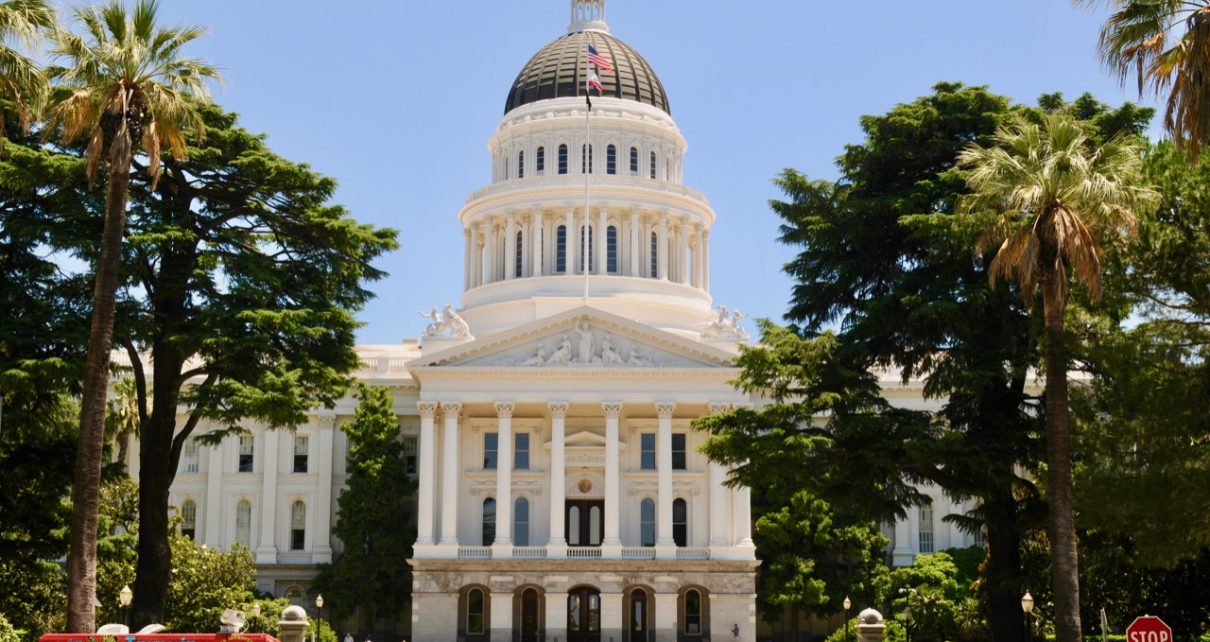
California State Capitol. (Photo: Kevin Sanders for California Globe)
Common Carriers of Persons
Deals with common carriers of persons
By Chris Micheli, October 14, 2026 2:31 am
Civil Code Division 3, Part 4, Title 7, Chapter 5, Article 2 deals with common carriers of persons. Section 2180 provides that a common carrier of persons, unless his vehicle is fitted for the reception of persons exclusively, must receive and carry a reasonable amount of baggage for each passenger without charge.
Section 2181 allows luggage to consist of whatever the passenger takes with him for his personal use and convenience, according to the habits or wants of the particular class to which he belongs, either with reference to the important necessities or to the ultimate purposes of his journey.
Section 2182 specifies that the liability of a carrier for luggage received by him with a passenger is the same as that of a common carrier of property.
Section 2183 states that a common carrier must deliver every passenger’s luggage, whether within the prescribed weight or not, immediately upon the arrival of the passenger at his destination; and, unless the vehicle would be overcrowded or overloaded thereby, must carry it on the same vehicle by which he carries the passenger to whom it belonged, except that where luggage is transported by rail, it must be checked and carried in a regular baggage car; and whenever passengers neglect or refuse to have their luggage so checked and transported, it is carried at their risk.
Section 2184 explains that a common carrier of persons must provide a sufficient number of vehicles to accommodate all the passengers who can be reasonably expected to require carriage at any one time.
Section 2185 provides that a common carrier of persons must provide every passenger with a seat. He must not overload his vehicle by receiving and carrying more passengers than its rated capacity allows.
Section 2186 allows a common carrier of persons to make rules for the conduct of his business, and may require passengers to conform to them, if they are lawful, public, uniform in their application, and reasonable.
Section 2187 states that a common carrier may demand the fare of passengers, either at starting or at any subsequent time.
Section 2188 says that a passenger who refuses to pay his fare or to conform to any lawful regulation of the carrier, may be ejected from the vehicle by the carrier. But this must be done with as little violence as possible, and at any usual stopping place or near some dwelling house.
Section 2190 states that, after having ejected a passenger, a carrier has no right to require the payment of any part of his fare.
Section 2191 specifies that a common carrier has a lien upon the luggage of a passenger for the payment of such fare as he is entitled to from him. This lien is regulated by the Title on Liens.


- Advice on Lobbying in California - October 14, 2026
- Common Carriers of Persons - October 14, 2026
- Space Flight Liability - October 13, 2026
RELATED ARTICLES
-
 January 15, 2026
 -
 March 19, 2023
 -
 May 17, 2026