

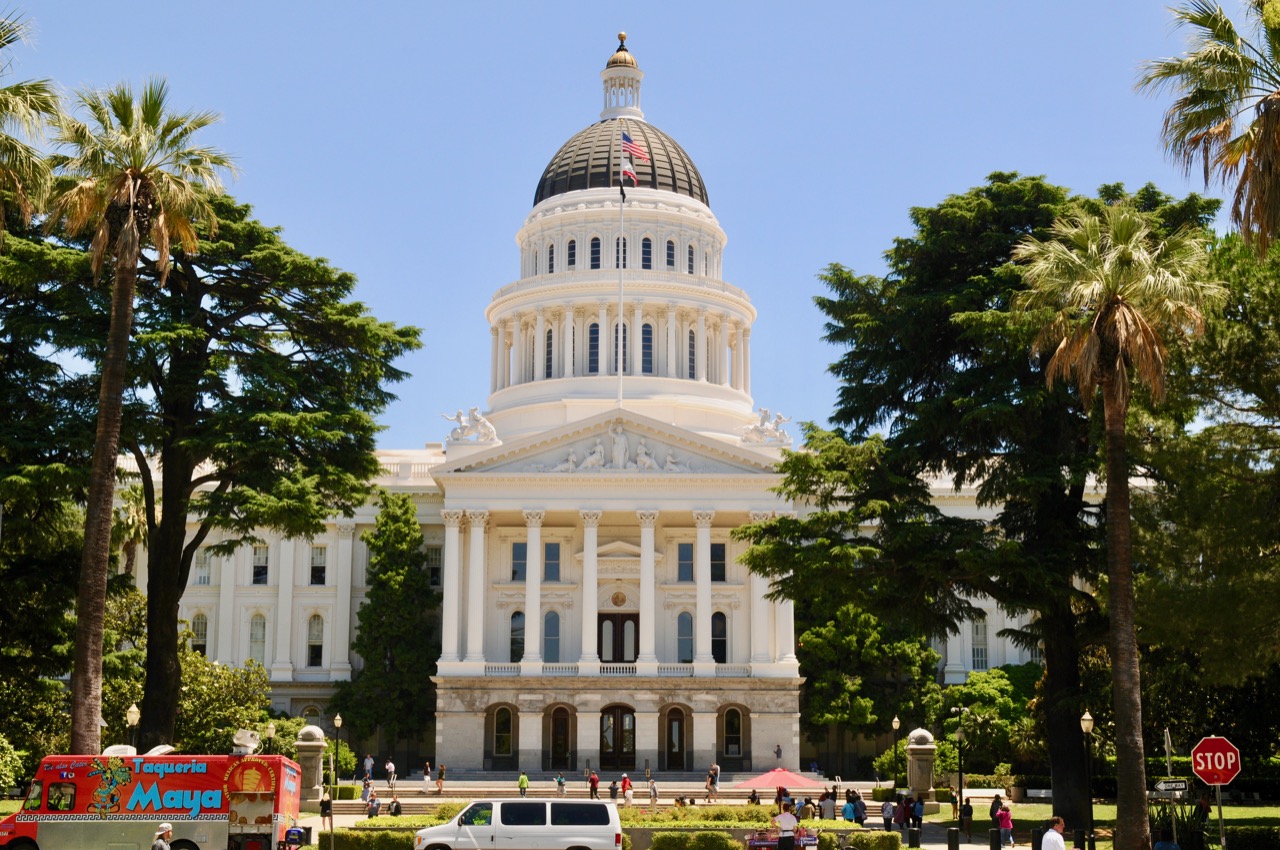
California State Capitol. (Photo: Katy Grimes for California Globe)
Physically Disabled Persons
Deals with blind and other physically disabled persons in California
By Chris Micheli, October 20, 2026 2:47 pm
Part 2.5 of Division 1 of the Civil Code deals with blind and other physically disabled persons in California.
Section 54 provides that individuals with disabilities or medical conditions have the same right as the general public to the full and free use of the streets, highways, sidewalks, walkways, public buildings, medical facilities, including hospitals, clinics, and physicians’ offices, public facilities, and other public places. The terms “disability” and “medical condition” are defined. A violation of the right of an individual under the Americans with Disabilities Act of 1990 (Public Law 101-336) also constitutes a violation of this section.
Section 54.1 requires individuals with disabilities to be entitled to full and equal access, as other members of the general public, to accommodations, advantages, facilities, medical facilities, including hospitals, clinics, and physicians’ offices, and privileges of all common carriers, airplanes, motor vehicles, railroad trains, motorbuses, streetcars, boats, or any other public conveyances or modes of transportation (whether private, public, franchised, licensed, contracted, or otherwise provided), telephone facilities, adoption agencies, private schools, hotels, lodging places, places of public accommodation, amusement, or resort, and other places to which the general public is invited, subject only to the conditions and limitations established by law, or state or federal regulation, and applicable alike to all persons.
The terms “telephone facilities,” “full and equal access” and “housing accommodations” are defined. A person renting, leasing, or otherwise providing real property for compensation is prohibited from refusing to permit an individual with a disability, at that person’s expense, to make reasonable modifications of the existing rented premises if the modifications are necessary to afford the person full enjoyment of the premises.
However, any modifications under this paragraph may be conditioned on the disabled tenant entering into an agreement to restore the interior of the premises to the condition existing before the modifications. No additional security may be required on account of an election to make modifications to the rented premises under this paragraph, but the lessor and tenant may negotiate, as part of the agreement to restore the premises, a provision requiring the disabled tenant to pay an amount into an escrow account, not to exceed a reasonable estimate of the cost of restoring the premises.
It is deemed a denial of equal access to housing accommodations within the meaning of this subdivision for a person, firm, or corporation to refuse to lease or rent housing accommodations to an individual who is blind or visually impaired on the basis that the individual uses the services of a guide dog, an individual who is deaf or hard of hearing on the basis that the individual uses the services of a signal dog, or to an individual with any other disability on the basis that the individual uses the services of a service dog, or to refuse to permit such an individual who is blind or visually impaired to keep a guide dog, an individual who is deaf or hard of hearing to keep a signal dog, or an individual with any other disability to keep a service dog on the premises. The terms “guide dog,” “signal dog,” and “service dog” are defined.
It is deemed a denial of equal access to housing accommodations within the meaning of this subdivision for a person, firm, or corporation to refuse to lease or rent housing accommodations to an individual who is blind or visually impaired, an individual who is deaf or hard of hearing, or other individual with a disability on the basis that the individual with a disability is partially or wholly dependent upon the income of his or her spouse, if the spouse is a party to the lease or rental agreement. This subdivision does not prohibit a lessor or landlord from considering the aggregate financial status of an individual with a disability and his or her spouse.
Section 54.2 explains that every individual with a disability has the right to be accompanied by a guide dog, signal dog, or service dog, especially trained for the purpose, in any of the places specified in law without being required to pay an extra charge or security deposit for the guide dog, signal dog, or service dog. However, the individual is liable for any damage done to the premises or facilities by his or her dog.
Section 54.25 states that a peace officer or firefighter assigned to a canine unit or the handler of a search and rescue dog assigned to duty away from his or her home jurisdiction because of a declared federal, state, or local emergency, or an official mutual aid request or training, and in the course and scope of his or her duties cannot be denied service based on the presence of the dog or discriminated against in hotels, lodging establishments, eating establishments, or public transportation by being required to pay an extra charge or security deposit for the dog. However, the peace officer’s law enforcement agency, the firefighter’s fire agency, or the handler of a search and rescue dog is liable for any damages to the premises or facilities caused by the dog.
The terms “declared emergency,” “handler of a search and rescue dog,” “peace officer’s or firefighter’s dog,” and “search and rescue dog” are defined. Nothing in this section is intended to affect any civil remedies available for a violation of this section.
Section 54.27 provides that an attorney who provides a prelitigation letter to an education entity is required to do two specified tasks. Also, an attorney who sends or serves a complaint against an education entity is required to do two specified acts. The California Commission on Disability Access is required to review and report on the prelitigation letters, complaints, and notifications of case outcomes it receives. The terms “complaint,” “construction-related accessibility claim,” “claim,” “education entity,” and “prelitigation letter” are defined.
Section 54.3 provides that any person or persons, firm or corporation who denies or interferes with admittance to or enjoyment of the public facilities or otherwise interferes with the rights of an individual with a disability is liable for each offense for the actual damages and any amount as may be determined by a jury, or the court sitting without a jury, up to a maximum of three times the amount of actual damages but in no case less than $1,000, and attorney’s fees as may be determined by the court suffered by any person denied any of the rights provided in Sections 54, 54.1, and 54.2. The term “interfere” is defined.
Any person who claims to be aggrieved by an alleged unlawful practice in violation of Section 54, 54.1, or 54.2 may also file a verified complaint with the Civil Rights Department pursuant to Section 12948 of the Government Code. The remedies in this section are nonexclusive and are in addition to any other remedy provided by law. A person may not be held liable for damages pursuant to both this section and Section 52 for the same act or failure to act.
Section 54.4 requires a blind or otherwise visually impaired pedestrian to have all of the rights and privileges conferred by law upon other persons in any of the places, accommodations, or conveyances, notwithstanding the fact that the person is not carrying a predominantly white cane (with or without a red tip), or using a guide dog. The failure of a blind or otherwise visually impaired person to carry a cane or to use a guide dog does not constitute negligence per se.
Section 54.5 requires the Governor to annually and publicly proclaim October 15 as White Cane Safety Day. The proclamation must include five specified items.
Section 54.6 defines the term “visually impaired.”
Section 54.7 explains that the provisions of this part are not to be construed to require zoos or wild animal parks to allow guide dogs, signal dogs, or service dogs to accompany individuals with a disability in areas of the zoo or park where zoo or park animals are not separated from members of the public by a physical barrier. The term “physical barrier” does not include an automobile or other conveyance.
Section 54.8 provides that, in any civil or criminal proceeding, including small claims court, family court proceedings and services, and juvenile court proceedings, in any court-ordered or court-provided alternative dispute resolution, including mediation and arbitration, or in any administrative hearing of a public agency, where a party, witness, attorney, judicial employee, judge, juror, or other participant who is deaf or hard of hearing, the individual who is deaf or hard of hearing, upon his or her request, must be provided with a functioning assistive listening system or a computer-aided transcription system. Any individual requiring this equipment is required to give advance notice of his or her need to the appropriate court or agency at the time the hearing is set or not later than five days before the hearing.
Section 54.9 states that a manufacturer or distributor of touch-screen devices used for the purpose of self-service check-in at a hotel or at a facility providing passenger transportation services is required to offer for availability touch-screen self-service check-in devices that contain the necessary technology. The terms “necessary technology” and “hotel” are defined. This section is not to be construed to preclude or limit any other existing right or remedy as it pertains to self-service check-in devices and accessibility.
Section 55 provides that any person who is aggrieved or potentially aggrieved by a violation of specified laws may bring an action to enjoin the violation. The prevailing party in the action is entitled to recover reasonable attorney’s fees.
Section 55.1 says that, in addition to any remedies available under the federal Americans with Disabilities Act of 1990, the district attorney, the city attorney, the Department of Rehabilitation acting through the Attorney General, or the Attorney General may bring an action to enjoin any violation of specified laws.
Section 55.2 states that, if a violation of specified laws is alleged or the application or construction of any of these sections is in issue in any proceeding in the Supreme Court of California, a state court of appeal, or the appellate division of a superior court, each party must serve a copy of the party’s brief or petition and brief, on the State Solicitor General at the Office of the Attorney General.
Section 55.3 defines the terms “complaint,” “construction-related accessibility claim,” “demand for money,” and “demand letter.” An attorney is required to provide the specified items with each demand letter or complaint sent to or served upon a defendant or potential defendant alleging a construction-related accessibility claim.
Section 55.31 states that a demand letter alleging a construction-related accessibility claim must state facts sufficient to allow a reasonable person to identify the basis of the violation or violations supporting the claim, including all of the three specified items. A demand letter may offer prelitigation settlement negotiations, but cannot include a request or demand for money or an offer or agreement to accept money.
Section 55.32 sets forth that an attorney who provides a demand letter is required to do two specified tasks. Also, an attorney who sends or serves a complaint, or a complaint alleging that an internet website is not accessible, is required to do two specified tasks. The California Commission on Disability Access is required to review and report on the demand letters, complaints, and notifications of case outcomes it receives.


- Physically Disabled Persons - October 20, 2026
- What are Some Unique Aspects of California’s Judicial Branch? - October 20, 2026
- Employer Subrogation - October 20, 2026
RELATED ARTICLES
-
 October 14, 2026
-
 January 15, 2026
-
 March 15, 2023