

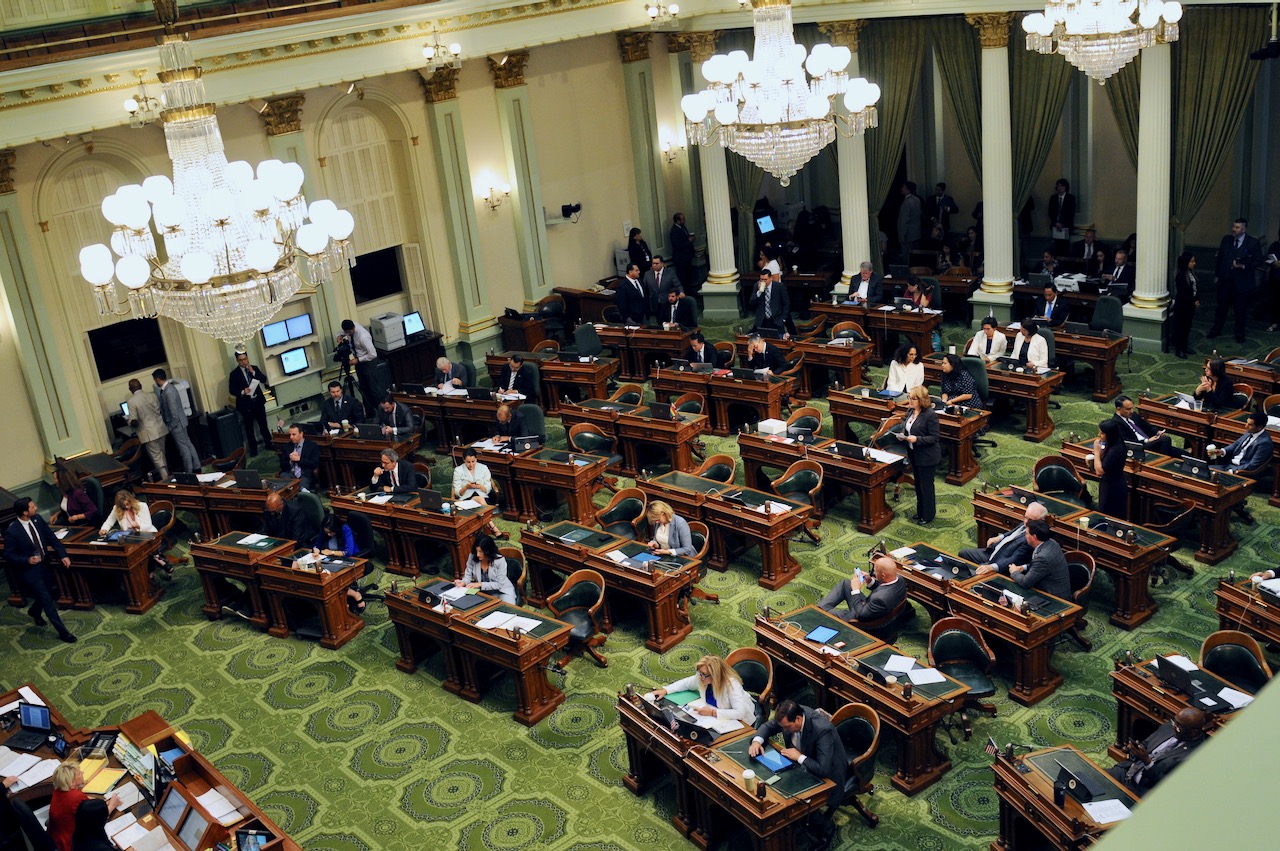
California State Capitol. (Photo: Katy Grimes for California Globe)
Disadvantages Between California and Parliamentary Governments
There are several structural limitations of California’s presidential-style separation of powers and direct democracy system
By Chris Micheli and Vincent Micheli, October 30, 2026 10:40 am
What are some of the disadvantages between California’s government structure and parliamentary governments? There are several structural limitations of California’s presidential-style separation of powers and direct democracy system with the characteristics of European parliamentary governments. When looking at these two structures, several distinct disadvantages emerge regarding California’s model of governance:
The government of California differs from European parliamentary governments in how power is separated between branches, how leaders are chosen, and how the state/national system operates.
Gridlock and Executive-Legislative Division
In California’s system, the executive branch (headed by the Governor) and the legislative branch are elected independently. When there is a division in political alignment or deep factionalism, it can lead to systematic gridlock. Conversely, European parliamentary systems naturally merge the executive and legislative branches; the Prime Minister is chosen directly from the majority coalition in parliament, ensuring that the government can pass its legislative agenda with fewer structural standoffs.
California has fixed election cycles that cannot easily adapt to political crises. In a parliamentary system, if a government loses the confidence of the legislature, it can be dissolved quickly through a vote of no confidence, triggering new elections to resolve political stalemates rapidly.
The Volatility of Direct Democracy (Citizen Ballot Initiatives)
California allows citizens to pass binding laws and constitutional amendments directly through ballot propositions. Over decades, voters have locked in specific spending mandates (e.g., Proposition 98 for school funding) and tax restrictions (e.g., Proposition 13). This severely restricts the state legislature’s ability to balance the budget dynamically during economic downturns. European parliamentary governments generally maintain absolute control over the budget, allowing elected representatives to shift revenues and expenditures as economic conditions dictate.
Ballot measures in California are often written by special interest groups and cannot be amended easily by the legislature once passed. This creates a patchwork of uncoordinated laws. European parliaments rely on professional, centralized legislative drafting that undergoes rigorous committee review before becoming law.
Representation and Factionalism
California’s “top-two” primary system, while designed to encourage moderation, operates within a rigid two-party framework that effectively leads to a Democratic supermajority or absolute polarization. European parliamentary systems frequently utilize proportional representation. This encourages a multi-party ecosystem where minor parties have a legitimate voice and governments are forced to build broad, consensus-based governing coalitions.
Under a winner-take-all voting system, a substantial portion of California’s voting population can feel completely unrepresented if their preferred party loses. Proportional parliamentary systems ensure that if a political faction wins 15% of the popular vote, they generally receive roughly 15% of the seats in parliament.
Accountability and Bureaucracy
Because California divides power among an independently elected Governor, a bicameral legislature, and a hyper-fragmented system of local counties and cities, it is incredibly difficult for voters to pinpoint who is responsible for systemic issues like housing shortages or infrastructure delays. In a parliamentary system, accountability is highly centralized: the ruling coalition takes full credit for success and full blame for policy failures.
Hybrid and Direct Democracy Elements
Both California and certain European democracies (such as Italy) blend representative democracy with direct citizen input. California heavily utilizes the initiative, referendum, and recall process, allowing voters to directly pass or reject laws. Similarly, some European countries incorporate digital platforms, public consultations, or referendums into their policy-making framework.
Strong Multi-Party / Factional Dynamics
While the U.S. federal government is strictly a two-party system, California’s large, diverse population creates distinct ideological wings (progressive, moderate, and conservative factions) within and outside the dominant party. European parliamentary systems operate with multi-party coalitions, requiring broad-tent negotiations, compromise, and coalition-building among different interest groups to pass a budget or major legislation, which is a reality California legislative leaders face regularly.
Separation of Policy-Making and Administrative State Growth
In both California and modern European states, the day-to-day governance and implementation of complex regulations have shifted heavily toward executive agencies, boards, and departments (the administrative state), rather than just floor debates in the legislature.
Separation of Powers vs. Fusion of Powers
California operates under a strict separation of powers defined by the California Constitution. The executive branch (headed by the Governor) and the legislative branch (the California State Legislature, consisting of the Assembly and the State Senate) are independent of each other. The Governor is not a member of the legislature.
In European parliamentary democracies (such as the UK, Germany, or Italy), the executive and legislative branches are fused. The head of government (Prime Minister, Chancellor, etc.) is a sitting member of the parliament and is chosen directly by that parliament.
Selection of the Chief Executive
Voters directly elect the Governor of California in a statewide election every four years, independent of who controls the state legislature.
Voters elect members of parliament (MPs), and the majority party or a coalition of parties in parliament selects the Prime Minister or Chancellor. If the parliamentary majority shifts or loses confidence, the head of government can change immediately without a public gubernatorial election.
Head of State vs. Head of Government
The Governor serves as both the head of state (ceremonial leader) and the head of government (chief executive officer running the state administration), similar to the U.S. federal system.
Many European parliamentary nations separate these roles. They have a distinct ceremonial head of state—either a monarch (e.g., in Spain or the Netherlands) or a non-executive president (e.g., in Germany or Italy)—while the Prime Minister acts as the actual head of government.
Judicial Review and Constitutions
California is subject to both the California Constitution and the U.S. Constitution. State and federal courts have broad power to perform judicial review and strike down state laws or executive actions if they violate constitutional rights.
While many European countries have constitutional courts (like Germany’s Federal Constitutional Court), traditional parliamentary systems (such as the UK) historically operated under the doctrine of parliamentary sovereignty, where laws passed by parliament could not be overturned by a supreme court in the same manner.
Federalism vs. Regional Unitary or Devolved Structures
California is a subnational state within a federal system (the United States), meaning it shares constitutional sovereignty and powers with the U.S. federal government.
European countries are either unitary states (where local/regional governments execute policies set by the central national parliament) or decentralized/devolved systems (like Spain’s autonomous communities or Germany’s Länder), rather than sovereign states in a classic U.S.-style federation.
No Formal Opposition Role
Many parliamentary systems formally recognize an official opposition, often with a “shadow cabinet” whose members follow specific ministries and offer alternative policies. This gives voters a clear picture of what the alternative government would do. California has no equivalent structure. The minority party has limited formal tools, and when one party holds a supermajority, there is little organized pressure on the majority’s agenda.


Vincent Micheli is a registered lobbyist and an associate at Snodgrass & Micheli, LLC.
- Disadvantages Between California and Parliamentary Governments - October 30, 2026
- Differences Between California and the European Union - October 30, 2026
RELATED ARTICLES
-
 July 11, 2026
-
 July 12, 2020
-
 October 6, 2020