
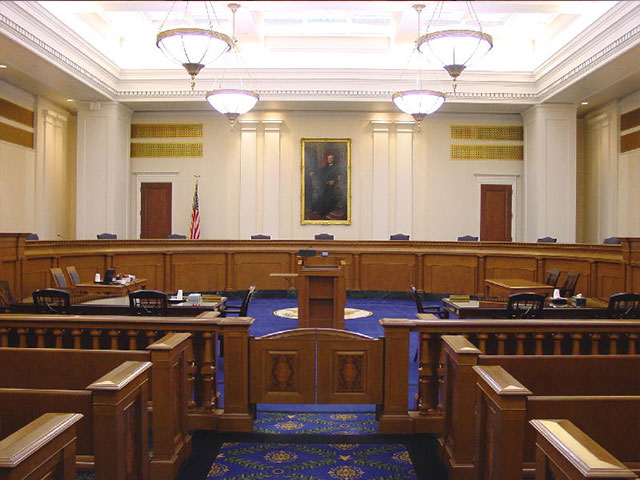
Courtroom (Photo: public domain)
Attorney Fees and Costs in Family Law Cases
The court has to rule on an application within 15 days of the hearing
By Chris Micheli, September 15, 2025 2:30 am
Family Code Division 6, Part 1, Chapter 3.5 deals with attorneys’ fees and costs in nullity, dissolution, and legal separation cases.
Section 2030 provides that, in a proceeding for dissolution of marriage, nullity of marriage, or legal separation of the parties, the court is required t ensure that each party has access to legal representation, including access early in the proceedings, to preserve each party’s rights by ordering, if necessary based on the income and needs assessments, one party, except a governmental entity, to pay to the other party, or to the other party’s attorney, whatever amount is reasonably necessary for attorney’s fees and for the cost of maintaining or defending the proceeding during the pendency of the proceeding.
When a request for attorney’s fees and costs is made, the court has make findings on whether an award of attorney’s fees and costs under this section is appropriate, whether there is a disparity in access to funds to retain counsel, and whether one party is able to pay for legal representation of both parties. Attorney’s fees and costs within this section may be awarded for legal services rendered or costs incurred before or after the commencement of the proceeding.
Section 2031 states that, during the pendency of a proceeding for dissolution of marriage, for nullity of marriage, for legal separation of the parties, or any proceeding subsequent to entry of a related judgment, an application for a temporary order making, augmenting, or modifying an award of attorney’s fees, including a reasonable retainer to hire an attorney, or costs or both must be made by motion on notice or by an order to show cause.
The court has to rule on an application within 15 days of the hearing on the motion or order to show cause. An order may be made without notice by an oral motion in open court at either of the two specified times.
Section 2032 allows the court to make an award of attorney’s fees and costs where the making of the award, and the amount of the award, are just and reasonable under the relative circumstances of the respective parties. In determining what is just and reasonable under the relative circumstances, the court is required to take into consideration the need for the award to enable each party, to the extent practical, to have sufficient financial resources to present the party’s case adequately, taking into consideration, to the extent relevant, the circumstances of the respective parties.
The court may order payment of an award of attorney’s fees and costs from any type of property, whether community or separate, principal or income. Either party may, at any time before the hearing of the cause on the merits, on noticed motion, request the court to make a finding that the case involves complex or substantial issues of fact or law related to property rights, visitation, custody, or support.
Section 2033 provides that either party may encumber the party’s interest in community real property to pay reasonable attorney’s fees in order to retain or maintain legal counsel in a proceeding for dissolution of marriage, for nullity of marriage, or for legal separation of the parties. This encumbrance is known as a “family law attorney’s real property lien” and attaches only to the encumbering party’s interest in the community real property.
Notice of a family law attorney’s real property lien must be served either personally or on the other party’s attorney of record at least 15 days before the encumbrance is recorded. This notice is required to contain a declaration signed under penalty of perjury containing all of the five specified items.
The nonencumbering party may file an ex parte objection to the family law attorney’s real property lien. The objection is required to include a request to stay the recordation until further notice of the court and contain a copy of the notice received. The objection also has include a declaration signed under penalty of perjury as to all three specified items.
Section 2034 states that, on application of either party, the court may deny the family law attorney’s real property lien based on a finding that the encumbrance would likely result in an unequal division of property because it would impair the encumbering party’s ability to meet the party’s fair share of the community obligations or would otherwise be unjust under the circumstances of the case.
On receiving an objection to the establishment of a family law attorney’s real property lien, the court may, on its own motion, determine whether the case involves complex or substantial issues of fact or law related to property rights, visitation, custody, or support. If the court finds that the case involves one or more of these complex or substantial issues, the court may determine the appropriate, equitable allocation of fees and costs and the court has jurisdiction to resolve any dispute arising from the existence of a family law attorney’s real property lien.


- Validating Proceedings in California - March 7, 2026
- Manner of Sale of Real and Personal Property - March 7, 2026
- Bankruptcy Reorganizations - March 6, 2026
RELATED ARTICLES
-
 May 24, 2025
 -
 May 31, 2025
 -
 May 15, 2025