

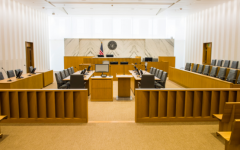
Justice Court. (Photo: Nirat.pix/Shutterstock)
Child Support Obligations
The local child support agency must comply with all regulations and directives established by the department
By Chris Micheli, December 12, 2025 2:30 am
Division 17, Chapter 2, Article 1 of the Family Code deals with support obligations and child support enforcement in this state.
Section 17400 requires each county to maintain a local child support agency that has the responsibility for promptly and effectively establishing, modifying, and enforcing child support obligations, including medical support, enforcing spousal support orders established by a court of competent jurisdiction, and determining paternity in the case of a child born out of wedlock.
The local child support agency is required to take appropriate action, including criminal action in cooperation with the district attorneys, to establish, modify, and enforce child support and, if appropriate, enforce spousal support orders if the child is receiving public assistance, including Medi-Cal, and, if requested, take the same actions on behalf of a child who is not receiving public assistance, including Medi-Cal.
Provided that no reduction in aid or payment to a custodial parent would result, the local child support agency is to cease enforcement of child support arrearages assigned to the state and other fees and costs owed to the state that the department or the local child support agency has determined to be uncollectible. In determining the meaning of uncollectible for purposes of arrearages assigned to the state and other fees and costs owed to the state, the department and the local child support agency are required to consider nine specified factors.
In addition, attorneys employed within the local child support agency may direct, control, and prosecute civil actions and proceedings in the name of the county in support of child support activities of the Department of Child Support Services and the local child support agency.
Actions brought by the local child support agency to establish paternity or child support or to enforce child support obligations must be completed within the time limits set forth by federal law. The local child support agency’s responsibility applies to spousal support only if the spousal support obligation has been reduced to an order of a court of competent jurisdiction. In any action brought for modification or revocation of an order that is being enforced.
The county is required to undertake an outreach program to inform the public that the services that are available to persons not receiving public assistance. There must be prominently displayed in every public area of every office of the agencies established by this section a notice, in clear and simple language prescribed by the Director of Child Support Services, that the services provided are available to all individuals, whether or not they are recipients of public assistance.
The term “enforcing obligations” is defined and includes at least five specified items. The local child support agency may intervene in any action under this code, or other proceeding in which child support is an issue or a reduction in spousal support is sought. By notice of motion, order to show cause, or responsive pleading served upon all parties to the action, the local child support agency may request any relief that is appropriate that the local child support agency is authorized to seek.
The local child support agency must comply with all regulations and directives established by the department that set time standards for responding to requests for assistance in locating noncustodial parents, establishing paternity, establishing child support awards, and collecting child support payments. Medical support activities that the local child support agency is authorized to perform are limited to those specified.
Venue for an action or proceeding under this division is determined as specified. The local child support agency of one county may appear on behalf of the local child support agency of any other county in an action or proceeding under this part.
Section 17400.5 provides that, if an obligor has an ongoing child support order being enforced by a local child support agency and the obligor is disabled, meets the SSI resource test, and is receiving Supplemental Security Income/State Supplemental Payments (SSI/SSP) or, but for excess income, and the obligor has supplied the local child support agency with proof of eligibility for, and, if applicable, receipt of, SSI/SSP or Social Security Disability Insurance benefits, then the local child support agency is required to prepare and file a motion to modify the support obligation within 30 days of receipt of verification from the noncustodial parent or any other source of the receipt of SSI/SSP or Social Security Disability Insurance benefits.
Section 17401 provides that, if the parent who is receiving support enforcement services provides to the local child support agency substantial, credible, information regarding the residence or work address of the support obligor, the agency is required to initiate an establishment or enforcement action and serve the defendant, if service is required, within 60 days and inform the parent in writing when those actions have been taken.
Section 17401.5 specifies that all of the required items must include notice of, and information about, the child support service hearings provided that there is federal financial participation available. The local child support agency must provide notice of, and information about, the child support services hearings available in any regularly issued notices to custodial and noncustodial parents.
Section 17402 provides that, in any case of separation or desertion of a parent or parents from a child or children that results in aid being granted to that family, the noncustodial parent or parents is obligated to the county for an amount equal to the amount specified in an order for the support and maintenance of the family issued by a court of competent jurisdiction.
The local child support agency has to take appropriate action and may establish liability for child support when public assistance was provided by another county or by other counties. The amount of the obligation established for each parent with a liability is determined by using the appropriate child support guideline currently in effect and is computed as specified. And, a parent must pay the amount of support specified in the support order to the local child support agency.
Section 17402.1 requires each local child support agency, on a monthly basis, to remit to the department both the federal and state public assistance child support payments received.
Section 17404 provides that, in any action brought by the local child support agency for the support of a minor child or children, the action may be prosecuted in the name of the county on behalf of the child, children, or a parent of the child or children. The parent who has requested or is receiving support enforcement services of the local child support agency cannot be a necessary party to the action but may be subpoenaed as a witness.
Judgment in an action brought pursuant to this section may be rendered pursuant to a noticed motion, that informs the defendant that in order to exercise the right to trial, the defendant must appear at the hearing on the motion. If the defendant appears at the hearing on the motion, the court inquires of the defendant if the defendant desires to subpoena evidence and witnesses, if parentage is at issue and genetic tests have not already been conducted whether the defendant desires genetic tests, and if the defendant desires a trial.
If the defendant’s answer is in the affirmative, a continuance is granted to allow the defendant to exercise those rights. A continuance cannot postpone the hearing to more than 90 days from the date of service of the motion. If a continuance is granted, the court may make an order for temporary support without prejudice to the right of the court to make an order for temporary support as otherwise allowed by law.
Section 17404.1 allows the local child support agency or petitioner to either (1) request the issuance of a summons or (2) request the court to issue an order requiring the respondent to appear personally at a specified time and place to show cause why an order should not be issued as prayed in the petition or comparable pleading on file.
Section 17404.2 states that, prior to filing, a petition that is received by the local child support agency or the superior court and the county in which the pleadings are received is not the appropriate jurisdiction for trial of the action, the court or the local child support agency must forward the pleadings and any accompanying documents to the appropriate court of this state or to the jurisdiction of another state without filing the pleadings or order of the court, and notify the petitioner, the California Central Registry, and the local child support agency of the receiving county where and when the pleading was sent.
Section 17404.3 requires hearings by telephone, audiovisual means, or other electronic means to be permitted in child support cases in which the local child support agency is providing child support services.
Section 17404.4 requires either the department or the local child support agency to issue a notice to change payee on a support order issued in this state, upon request from the support enforcement agency of another state where a custodial party has either assigned the right to receive support or has requested support enforcement services.
Section 17405 requires the local child support agency to interview the custodial parent within 10 business days of opening a child support case. This interview must solicit financial and all other information about the noncustodial parent.
Section 17406 provides that, in all actions involving paternity or support, the local child support agency and the Attorney General represent the public interest in establishing, modifying, and enforcing support obligations. No attorney-client relationship is deemed to have been created between the local child support agency or Attorney General and any person by virtue of the action of the local child support agency or the Attorney General in carrying out these statutory duties.
Section 17407 provides, if the Attorney General is of the opinion that a support order or support-related order is erroneous and presents a question of law warranting an appeal, or that an order is sound and should be defended on appeal, in the public interest the Attorney General may take one of two specified actions.
Section 17407.5 states that a declaration of state reciprocity issued by the Attorney General remains in full force and effect unless one of the three specified actions occur.
Section 17408 allows the superior court, upon noticed motion of the local child support agency, to consolidate or combine support or reimbursement arrearages owed by one obligor to one obligee in two or more court files into a single court file, or combine or consolidate two or more orders for current child support into a single court file.
A motion to consolidate may be made by a local child support agency only if it is seeking to enforce the orders being consolidated. The motion must be filed only in the court file the local child support agency is seeking to have designated as the primary file. Orders may be consolidated regardless of the nature of the underlying action.
The court is required to designate which court file the support orders are being consolidated into the primary file, and which court files are subordinate. Upon consolidation, the court is to order the local child support agency to file a notice in the subordinate court actions indicating the support orders in those actions were consolidated into the primary file. After consolidation of court orders, a single wage assignment for current support and arrearages may be issued when possible.
Section 17410 provides that, in any action filed by the local child support agency, the local child support agency is required to provide the mother and the alleged father the opportunity to voluntarily acknowledge paternity by signing a paternity declaration prior to a hearing or trial where the paternity of a minor child is at issue.
Section 17412 authorizes an action for child support may be brought by the local child support agency on behalf of a minor child or caretaker parent based upon a voluntary declaration of parentage, which must be given the same force and effect as a judgment for parentage entered by a court of competent jurisdiction.
Section 17414 requires the court to enter a judgment establishing parentage upon the filing of a written stipulation between the parties provided that the stipulation is accompanied by a written advisement and waiver of rights which is signed by the defendant.
Section 17415 provides that it is the duty of the county welfare department to refer all cases in which a parent is absent from the home, or in which the parents are unmarried and parentage has not been established by the completion and filing of a voluntary declaration of paternity or a court of competent jurisdiction, to the local child support agency immediately at the time the application for public assistance, including Medi-Cal benefits, or certificate of eligibility, is signed by the applicant or recipient.
If an applicant is found to be ineligible, the applicant is notified in writing that the referral of the case to the local child support agency may be terminated at the applicant’s request. The county welfare department must cooperate with the local child support agency and make available all pertinent information.
Whenever a court order has been obtained, any contractual agreement for support between the local child support agency or the county welfare department and the noncustodial parent is deemed null and void to the extent that it is not consistent with the court order. Whenever a family that has been receiving public assistance, including Medi-Cal, ceases to receive assistance, including Medi-Cal, the local child support agency must continue to enforce support payments from the noncustodial parent until the individual on whose behalf the enforcement efforts are made sends written notice to the local child support agency requesting that enforcement services be discontinued.
Section 17416 provides that, when the local child support agency has undertaken enforcement of support, the local child support agency may enter into an agreement with the noncustodial parent, on behalf of a minor child or children, a spouse, or former spouse for the entry of a judgment without action determining paternity, if applicable, and for periodic child and spousal support payments based on the noncustodial parent’s reasonable ability to pay or, if for spousal support, an amount previously ordered by a court of competent jurisdiction.
A judgment based on the agreement is entered only if one of the specified requirements is satisfied. The clerk files the agreement, together with any certificate of the attorney or finding of the court, without the payment of any fees or charges. If the requirements of this section are satisfied, the court enters judgment thereon without action.
Section 17418 requires the local child support agency to inquire of both the custodial and noncustodial parent as to the number of minor children each is legally obligated to support. The local child support agency must consider the needs of all of these children in computing the level of support requested to be ordered by the court.
Section 17420 provides that, after judgment in any court action brought to enforce the support obligation of a noncustodial parent pursuant to the provisions of this division, the court is required to issue an earnings assignment order for support.
Section 17422 requires the state medical insurance form to include at least four specified items of information. In an action brought or enforcement proceeding instituted by the local child support agency under this division for payment of child or spousal support, a completed state medical insurance form is obtained and sent by the local child support agency to the State Department of Health Care Services in the manner prescribed by the State Department of Health Care Services.
The local child support agency must take appropriate action, civil or criminal, to enforce the obligation to obtain health insurance when there has been a lapse in insurance coverage or failure by the responsible parent to obtain insurance as ordered by the court. The local child support agency has to inform all individuals upon their application for child support enforcement services that medical support enforcement services are available.
Section 17424 states that a parent who has been served with a medical insurance form must complete and return the form to the local child support agency’s office within 20 calendar days of the date the form was served.
Section 17428 provides, in any action or judgment brought or obtained, a supplemental complaint may be filed seeking a judgment or order of paternity or support for a child of the mother and father of the child whose paternity and support are already in issue before the court. A supplemental complaint for paternity or support of children may be filed without leave of court either before or after final judgment in the underlying action.
Section 17430 states that, in an action filed by the local child support agency in which the proposed child support amount is based on actual income, a judgment is to be entered without hearing, without the presentation of any other evidence or further notice to the defendant, upon the filing of proof of service by the local child support agency evidencing that more than 30 days have passed since the simplified summons and complaint, proposed judgment, blank answer, blank income and expense declaration, and all notices required by this division were served on the defendant.
If the defendant fails to file an answer with the court within 30 days of having been served in an action in which the proposed child support amount is based on actual income, or at any time before the default judgment is entered, the proposed judgment filed with the original summons and complaint is conformed by the court as the final judgment and a copy provided to the local child support agency, unless the local child support agency has filed a declaration and amended proposed judgment.
Section 17432 provides that, in any action filed by the local child support agency, the court may set aside that part of the judgment or order concerning the amount of child support to be paid. This relief may be granted after the six-month time limit has elapsed, based on the grounds, and within the time limits, specified in this section.
The court may set aside the child support order contained in a judgment if the support obligor’s income or earning capacity was substantially different for the period of time during which judgment was effective compared with the income or earning capacity the support obligor was presumed to have. The term “substantially different” is defined. The party seeking to set aside the order has the burden of proving that the actual income or earning capacity of the support obligor was substantially different from the presumed income or earning capacity.
Section 17433 requires the court, in an action in which a judgment or order for support was entered after the entry of the default of the defendant, to relieve the defendant from that judgment or order if the defendant establishes that the defendant was mistakenly identified in the order or in any subsequent documents or proceedings as the person having an obligation to provide support.
Section 17433.5 provides that, in any action enforced pursuant to this article, no interest shall accrue on an obligation for current child, spousal, family, or medical support due in a given month until the first day of the following month.
Section 17434 requires the department to publish a booklet describing the proper procedures and processes for the collection and payment of child and spousal support. The booklet must be written in language understandable to the lay person and direct the reader to obtain the assistance of the local child support agency, the family law facilitator, or legal counsel where appropriate. The department may contract on a competitive basis with an organization or individual to write the booklet.
Section 117440 requires the Department of Child Support Services to work with all branches of the United States military and the National Guard to ensure that information is made available regarding the rights and abilities of activated service members to have their support orders modified based on a change in income resulting from their activation, or other change of circumstance affecting the child support calculation, or to have a portion of their child support arrearages compromised.
Within five business days of receipt of a properly completed form, the local child support agency is obligated to bring a motion to modify the support order. The local child support agency must bring the motion if the change in circumstances would result in any change in the dollar amount of the support order.


- Nonprofit Mergers - March 24, 2026
- Commodities Crimes - March 24, 2026
- Fish and Wildlife Protection - March 23, 2026
RELATED ARTICLES
-
 November 10, 2025
 -
 November 18, 2025
 -
November 21, 2025
And let’s not forget this on how men are raped by the laws in this state.
Yes, California can enforce child support obligations for individuals who are not the biological parents of a child, provided they are legally recognized as a parent under state law. The state prioritizes legal parentage over biological ties, meaning that a non-biological father may still be required to pay child support if he has established a legal parental relationship through marriage, adoption, a Voluntary Declaration of Paternity, or by acting as a parent in a way that constitutes “parentage by estoppel.
If a man is married to the child’s mother at the time of birth, California law presumes him to be the legal father, regardless of biological connection, and he can be ordered to pay child support.