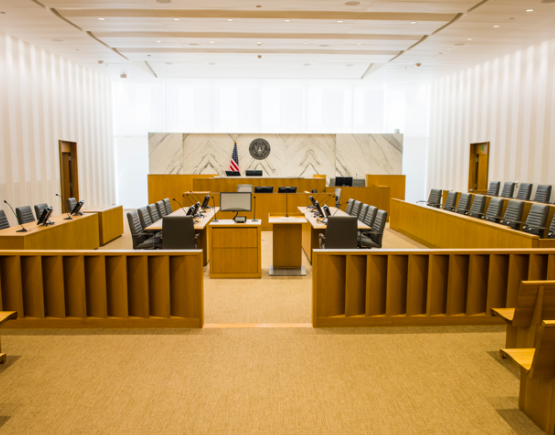
Central District of California in Los Angeles courtroom. (Photo: uscourts.gov)
Hearings on Third-party Claims
Code of Civil Procedure deals with hearings on third-party claims and related procedures
By Chris Micheli, February 18, 2026 2:30 am
Part 2, Title 9, Division 4, Chapter 4 of the Code of Civil Procedure deals with hearings on third-party claims and related procedures for enforcement of judgments in California.
Section 720.310 provides that, not later than 15 days after the third-party claim is filed with the levying officer, either the creditor or the third person may petition the court for a hearing to determine the validity of the third-party claim and the proper disposition of the property that is the subject of the claim. The hearing may be held whether or not an undertaking has been filed but not if a deposit has been made. The hearing must be held within 20 days after the filing of the petition unless continued by the court for good cause shown.
Section 720.320 requires the petitioner to complete two specified tasks. The notice of hearing that must be filed has to include a statement that the purpose of the hearing is to determine the validity of the third-party claim and the proper disposition of the property that is the subject of the third-party claim.
Section 720.330 specifies that, promptly after receipt of the notice of the hearing on the third-party claim, the levying officer is required to file five specified papers with the court.
Section 720.340 states that, if the creditor has not filed a statement with the levying officer in opposition to a third-party claim by a secured party.
Section 720.350 provides that subject to the power of the court to permit an amendment in the interest of justice the third-party claim constitutes the pleading of the third person.
Section 720.360 states that, at a hearing on a third-party claim, the third person has the burden of proof.
Section 720.370 says that, if the petition for a hearing was made by the third person, neither the petition nor the proceedings pursuant thereto may be dismissed without the consent of the creditor. If the petition for a hearing was made by the creditor, neither the petition nor the proceedings pursuant thereto may be dismissed without the consent of the third person.
Section 720.380 authorizes the court to make an order staying the sale of the property under a writ or enjoining any transfer or other disposition of the property levied upon under a writ until proceedings for the determination of the rights of a third person can be commenced and prosecuted to termination and may require such undertaking as it considers necessary as a condition for making the order. An order made pursuant to this section may be modified or vacated by the court at any time prior to the termination of the proceedings upon such terms as are just.
Section 720.390 states that, at the conclusion of the hearing, the court is required to give judgment determining the validity of the third-party claim and may order the disposition of the property or its proceeds in accordance with the respective interests of the parties.
Section 720.400 specifies that no findings are required in proceedings under this chapter.
Section 720.410 provides that there is no right to a jury trial in a proceeding pursuant to this chapter.
Section 720.430 says that an appeal may be taken from a judgment given pursuant to Section 720.390.
Section 720.430 states that, if property has been released, it may be levied upon or otherwise sought to be applied to the satisfaction of the judgment only if it is determined in the hearing on the third-party claim that the debtor has an interest in the property that may be levied upon or otherwise applied to the satisfaction of the judgment.


- Powers of the Corporations Commissioner - March 11, 2026
- Offers in Compromise - March 11, 2026
- Enforcing an Arbitration Award - March 10, 2026
RELATED ARTICLES
-
 January 6, 2026
 -
 May 12, 2025
 -