
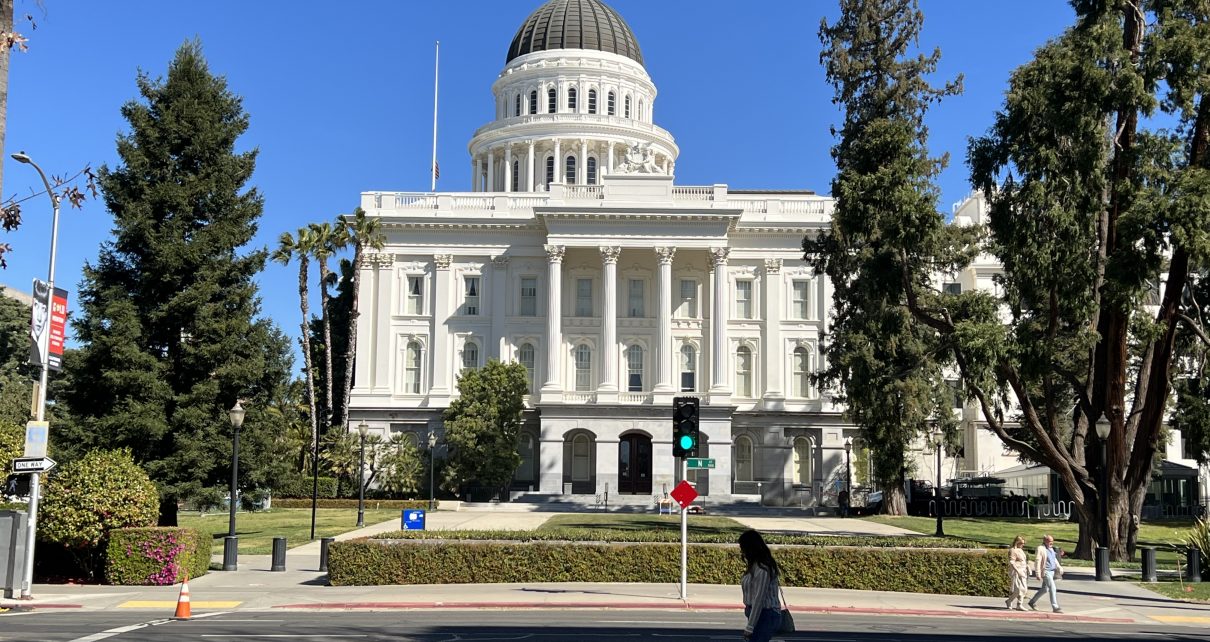
California State Capitol on March 11, 2022. (Photo: Kevin Sanders for California Globe).
Third-party Claims
Deals with third-party claims of ownership and possession
By Chris Micheli, January 6, 2026 2:27 am
Code of Civil Procedure Part 2, Title 9, Division 4 deals with third-party claims and related procedures for the enforcement of judgments in California.
Chapter 1 deals with definitions. Section 720.010 specifies that the definitions in this chapter govern the construction of this division.
Section 720.020 defines the term “creditor.” Section 720.030 defines the term “debtor.”
Chapter 2 deals with third-party claims of ownership and possession.
Section 720.110 provides that a third person claiming ownership or the right to possession of property may make a third-party claim under this chapter in any of the two specified cases if the interest claimed is superior to the creditor’s lien on the property.
Section 720.120 states that a person making a third-party claim under this chapter is required to file the claim with the levying officer, together with two copies of the claim, after levy on the property but before the levying officer does any of the three specified actions.
Section 720.130 requires the third-party claim to be executed under oath and contain all of the four specified items. A copy of any writing upon which the claim is based must be attached to the third-party claim. At a hearing on the third-party claim, the court in its discretion may exclude from evidence any writing a copy of which was not attached to the third-party claim.
Section 720.140 provides that, not later than five days after the third-party claim is filed with the levying officer, the levying officer is required to serve four specified items personally or by mail on the creditor.
The time allowed the creditor for objecting to the third person’s undertaking to release the property or for filing an undertaking is 10 days after service. Within the time allowed for service on the creditor, the levying officer must serve a copy of the papers specified in subdivision (a) on the debtor. Service shall be made personally or by mail.
Section 720.150 provides that, if a third-party claim is timely filed, the levying officer may not do any of the three specified items with respect to the property in which an interest is claimed. The interest of the third person in the property levied upon is not affected by the third person’s failure to file a third-party claim under this chapter.
Section 720.160 provides that, if the creditor files with the levying officer an undertaking that satisfies the requirements of this section within the time allowed, the levying officer has to conduct two specified actions.
Section 720.170 states that, in a case where the third person has not filed with the levying officer an undertaking to release the property, if the creditor does not within the time allowed file with the levying officer an undertaking (or file a notice if the creditor is a public entity) that satisfies the requirements of law, the levying officer releases the property unless it is to be held under another lien or unless otherwise ordered by the court.


- Referees in Partition Actions - March 14, 2026
- Payment of Claims for Unclaimed Property - March 13, 2026
- Commencement of Eminent Domain - March 13, 2026
RELATED ARTICLES
-

-
-
 February 9, 2025