
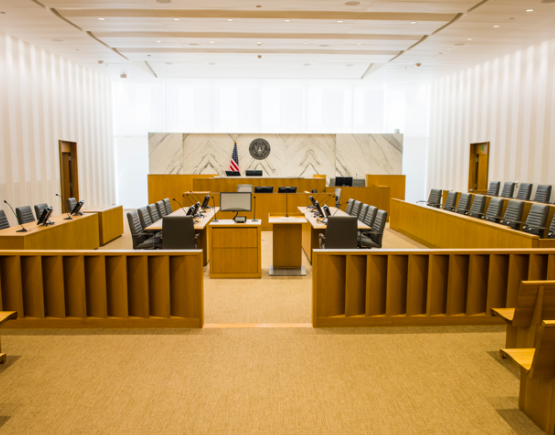
Central District of California in Los Angeles courtroom. (Photo: uscourts.gov)
Trial by the Court in California
The court as trier of the facts weighs the evidence and renders a judgment in favor of the moving party
By Chris Micheli, December 7, 2025 6:30 am
Part 2, Title 8, Chapter 5 deals with trial by the court and judgment in civil actions.
Section 631 provides that the right to a trial by jury as declared by Section 16 of Article I of the California Constitution is preserved to the parties inviolate. In civil cases, a jury may only be waived pursuant to law.
At least one party demanding a jury on each side of a civil case pays a nonrefundable fee of $150, unless the fee has been paid by another party on the same side of the case. The fee offsets the costs to the state of providing juries in civil cases.
The fee is due on or before the date scheduled for the initial case management conference in the action, except is four specified circumstances. The parties demanding a jury trial are required to deposit with the clerk or judge, at the beginning of the second and each succeeding day’s session, a sum equal to that day’s fees and mileage of the jury, including the fees and mileage for the trial jury panel if the trial jury has not yet been selected and sworn.
If more than one party has demanded a jury, the respective amount to be paid daily by each party demanding a jury are to be determined by stipulation of the parties or by order of the court. A party waives trial by jury in any of the six specified ways. The court may, in its discretion upon just terms, allow a trial by jury although there may have been a waiver of a trial by jury.
Section 631.2 allows the superior court to pay jury fees in civil cases from general funds of the court available. Nothing in this section is to be construed to change the requirements for the deposit of jury fees in any civil case by the appropriate party to the litigation at the time and in the manner otherwise provided by law.
Section 631.3 states that, when a party to the litigation has deposited jury fees with the judge or clerk and that party waives a jury or obtains a continuance of the trial, or the case is settled, none of the deposit is to be refunded if the court finds there has been insufficient time to notify the jurors that the trial would not proceed at the time set.
All jury fees and mileage fees that may accrue by reason of a juror serving on more than one case in the same day are to be transmitted to the Controller for deposit into the Trial Court Trust Fund.
Section 631.5 provides that, in all cases of eminent domain, the deposits of jury fees and mileage are made by the party seeking condemnation regardless of which party has demanded a jury trial, and the trial cannot proceed until deposits are made.
Section 631.7 states that ordinarily, unless the court otherwise directs, the trial of a civil action tried by the court without a jury proceeds in the order specified.
Section 631.8 specifies that, after a party has completed his presentation of evidence in a trial by the court, the other party, without waiving his right to offer evidence in support of his defense or in rebuttal in the event the motion is not granted, may move for a judgment. The court as trier of the facts weighs the evidence and renders a judgment in favor of the moving party.
If it appears that the evidence presented supports the granting of the motion as to some but not all the issues involved in the action, the court is required to grant the motion as to those issues and the action proceed as to the issues remaining. Despite the granting of this motion, no final judgment is to be entered prior to the termination of the action, but the final judgment in the action must award judgment as determined by the motion.
Section 632 specifies in superior courts, upon the trial of a question of fact by the court, written findings of fact and conclusions of law are not required. The court issues a statement of decision explaining the factual and legal basis for its decision as to each of the principal controverted issues at trial upon the request of any party appearing at the trial.
The request must be made within 10 days after the court announces a tentative decision, unless the trial is concluded within one calendar day or in less than eight hours over more than one day in which event the request must be made prior to the submission of the matter for decision. The request for a statement of decision must specify those controverted issues as to which the party is requesting a statement of decision.
Section 634 provides that, when a statement of decision does not resolve a controverted issue, or if the statement is ambiguous and the record shows that the omission or ambiguity was brought to the attention of the trial court either prior to entry of judgment or in conjunction with a motion, it cannot be inferred on appeal or upon a motion that the trial court decided in favor of the prevailing party as to those facts or on that issue.
Section 635 states that, in all cases where the decision of the court has been entered in its minutes, and when the judge who heard or tried the case is unavailable, the formal judgment or order conforming to the minutes may be signed by the presiding judge of the court or by a judge designated by the presiding judge.
Section 636 specifies that, on a judgment for the plaintiff upon an issue of law, he may proceed in the manner prescribed, upon the failure of the defendant to answer. If judgment is for the defendant upon an issue of law, and the taking of an account, or the proof of any fact, it is necessary to enable the Court to complete the judgment, a reference may be ordered, as in that section provided.


- Manner of Sale of Real and Personal Property - March 7, 2026
- Bankruptcy Reorganizations - March 6, 2026
- Objections to Taking in Eminent Domain - March 6, 2026
RELATED ARTICLES
-
 October 29, 2024
 -
November 14, 2024
-
 September 13, 2024