
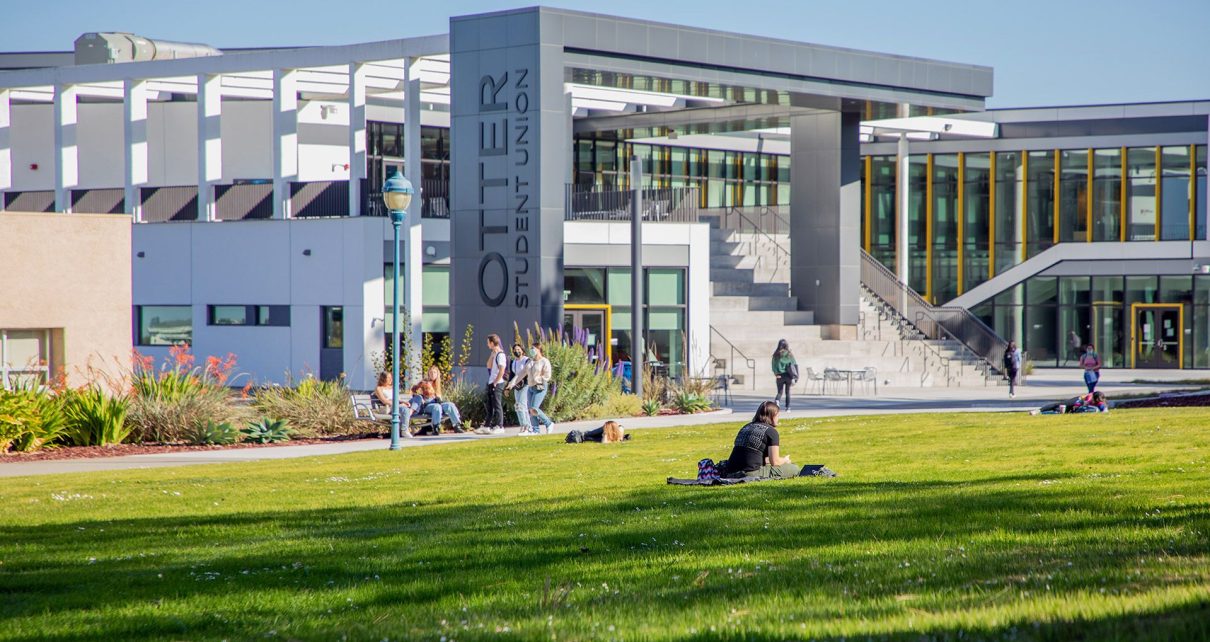
CSU Monterey Bay. (Photo: montereybay.edu)
How California Colleges Mislead Students
If hospitals, lenders, food producers, and publicly traded companies have regulatory disclosure standards and requirements that carry the weight of both civil and criminal law, then why not colleges?
By Jim Andrews, July 12, 2025 2:55 am
Thomas Jefferson wrote of the University of Virginia, “The object of this institution is to form the statesmen, legislators and judges, on whom public prosperity and individual happiness are so much to depend.” The assumption that California’s colleges and universities solely serve the public interest is naive. Today, colleges see themselves as private enterprises, seeking to maximize revenue while minimizing expenses. This creates a perverse incentive to offer programs that are cheap to run and easy to finish with little economic value. Students and society bear the cost: wasted time, lost opportunities to gain valuable skills, a lifetime of debt, and erosion of trust in institutions that should be engines of opportunity.
Schools entice students by promising aspirational jobs for programs with open enrollment and few academic prerequisites. At CSU Monterey Bay, for example, the Kinesiology B.S. is one of the school’s top programs. While the university’s website lists 17 different possible careers, according to CareerOneStop.gov and the Bureau of Labor Statistics Occupational Outlook Handbook, the most common outcome with this degree is fitness trainer, which, oddly enough, the school doesn’t mention. There is no mechanism that compels CSU Monterey Bay, or any California institution for that matter, to disclose the most likely career outcome for its students. Instead, colleges often tout their programs as pathways to senior roles that require advanced education and years of experience, leaving students to discover the gap between marketing and reality only after they graduate.
The harm is real. Students often take on debt based on unlikely job prospects, only to find themselves in low-paying roles that don’t justify their investment. According to the U.S. Department of Education’s College Scorecard, five years after graduation, CSU Monterey Bay’s Kinesiology B.S. majors have median earnings and debt of $59,247 and $13,750, respectively. By contrast, according to the U.S. Bureau of Labor Statistics, many California workers with only a high school diploma and about a decade of experience earn $52,000–$56,000 annually ($25–$27/hr) in fields like retail supervision and delivery driving—without taking on student debt.
The recently enacted Higher Education Reform Act of 2025 requires the U.S. Department of Education to terminate federal student loan eligibility for programs where most graduates earn less than the median high school graduate in their state. At CSU Monterey Bay, more than half of its baccalaureate degree awards are in low economic value programs like Kinesiology, Psychology, and Liberal Studies that will struggle to meet this very low standard. However, these programs may squeeze by. Nevertheless, California education leaders have a moral and professional obligation to provide education programs that improve economic outcomes for their graduates—or, failing that, to at least honestly inform students what they are getting into. California can go further by requiring colleges to report employment outcomes that reflect the jobs graduates actually obtain.
If hospitals, lenders, food producers, and publicly traded companies have regulatory disclosure standards and requirements that carry the weight of both civil and criminal law, then why not colleges? Transparency and accountability should not be optional when the stakes are years of a young person’s life and tens of thousands in student loans. California should lead by requiring colleges to report outcomes honestly, so public funds support pathways that deliver on their promise—and students can make decisions that truly serve their futures.


- California Math Framework: Equity or Academic Sabotage? - August 11, 2025
- The Monkees, Grok, and the Myth of Machine Wisdom - August 8, 2025
- How California Colleges Mislead Students - July 12, 2025
RELATED ARTICLES
-
-
 March 21, 2022
 -
 July 10, 2022
As long as tenure guarantees employment mediocrity will continue.
DEI, CRT, SEL. influence hiring, academic acceptance and curriculum. State colleges are training teachers who aren’t prepared for educating students in math, reading, writing, history and science as much as social behavioral practices and preferences.
Our family member attended CSUM for a school counseling degree. She could not morally accept a job that aligned with shame and blame of racial and socio-economic inequities. Fortunately, she worked to pay off her debt but her best employment opportunities require her to get another degree.
The state needs to invest more in revamping and refining the K-12 system. Offer and reinstate vocational programs. Let scholarship advance by reducing ideological professors, excessive administrators and lavish campus student centers. The emphasis on college degrees has amounted to nothing but debt and despair.
Lets hope that when the Fed starts pulling the money away from these institutions it will force some much needed overdue changes.
Great report.
This is how you fix the problem: Make sid colleges and universities liable for student debt repayment, if the former student defaults it comes out of the institution’s coffers – not taxes, they do their own collections or they write it off. Limit foreign students to 5% of the student body, don’t charge them any more than domestic students and ban said institutions from accepting foreign donations or grants.
What a welcome subject!
The example of the Kinesiology degree is perfect.
I appreciate what you are advocating for.
Starbucks will lose some great advanced degree baristas if this ever goes into effect.
It is also my understanding that recent STEM
students are now having difficulty landing a job because of AI.
Otters and Democrats share comparable mood swings. In the blink of an eye, as they say.
It would be lovely to get full disclosure out of these institutions, as you suggest – but they are far too self serving and ossified to do it. Here in Cali the rot runs deep, so forces like unions will align to shield them from scrutiny.
Hiring and wage stats or recent graduates have to be gathered outside the system. That may help push legislation.
Things will only change when students and parents stop being such sheep do their own homework on the values.
The old mantra of “ get a degree, any degree “ has been dead for decades , but like zombies, they keep marching to the registration office.