
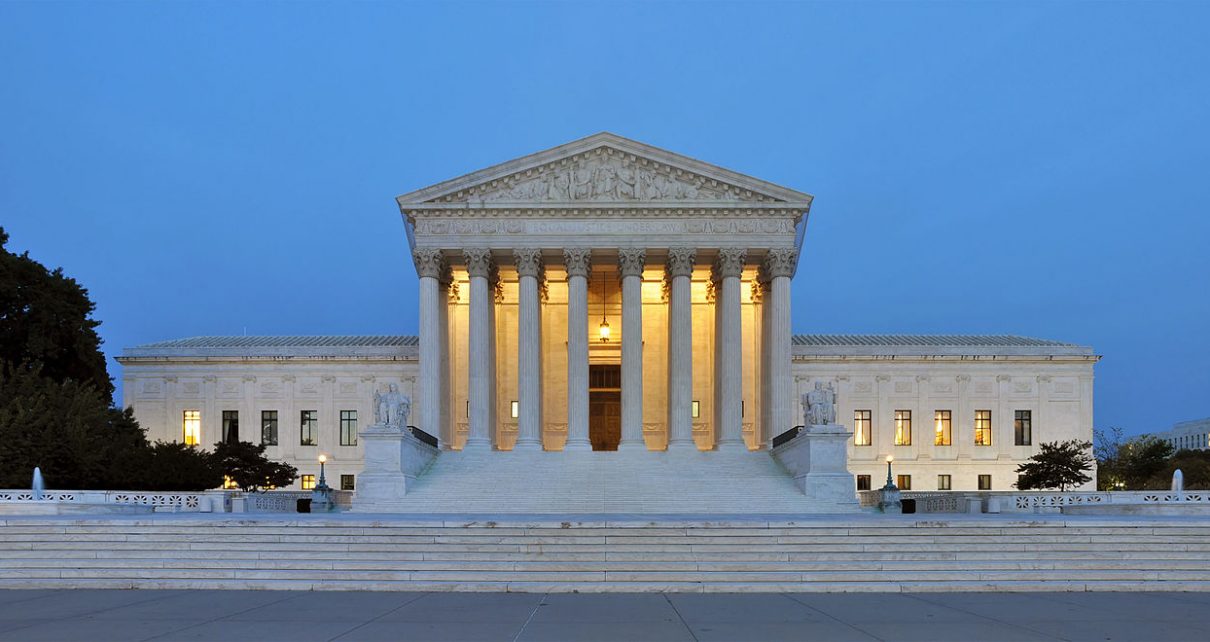
Supreme Court of the United States. (Photo: U.S. Supreme Court)
RNC Petitions Supreme Court to Uphold Arizona Voters’ Mandate for Proof-of-Citizenship Requirement
The RNC is seeking review of Ninth Circuit rulings that have blocked key elements of Arizona’s long-standing, voter-approved proof-of-citizenship law
By Megan Barth, February 20, 2026 2:50 pm
The Republican National Committee filed a petition with the U.S. Supreme Court on Thursday seeking review of Ninth Circuit rulings that have blocked key elements of Arizona’s long-standing, voter-approved proof-of-citizenship law.
Approved by Arizona voters more than two decades ago via Proposition 200, the requirement mandates documentary proof of U.S. citizenship — such as a passport or birth certificate — for full participation in state and local elections using state registration forms.
The RNC’s petition in Republican National Committee v. Mi Familia Vota challenges Ninth Circuit decisions limiting provisions of HB 2492 and related measures. Those provisions include requiring documentary proof for state forms, restricting federal-only registrants from presidential and mail-in ballots, and allowing removal of confirmed non-citizens from voter rolls, even in the 90-day period before federal elections.
RNC Chairman Joe Gruters stated: “Over two decades ago, Arizona voters overwhelmingly approved a commonsense law requiring documentary proof of citizenship to vote. It is unacceptable that, more than 20 years later, the RNC must still step in to defend the clear will of Arizonans against the Democratic Party and leftist advocacy groups. Federal law is clear: only U.S. citizens have the right to vote in American elections. The RNC will never stop fighting to protect our democracy and the integrity of every Arizona voter’s ballot.”
Mi Familia Vota, the lead plaintiff in the litigation, has been active in voter registration efforts in Arizona since 2016. The organization reported registering more than 75,000 new Latino voters during the 2016 cycle — one of the largest such drives in state history at the time — over 15,000 registrations in 2020 amid a court-extended deadline, and more than 30,000 additional voters since 2021. These figures represent a meaningful portion of Arizona’s roughly 4.33 million total registered voters.
The group’s registration activities have faced scrutiny in some instances. In 2024, voter registration forms submitted through Field+Media Corps, led by former Mi Familia Vota executive Francisco Heredia, were flagged as suspicious in Navajo and Mohave counties and referred to the Arizona Attorney General for review. Comparable issues with forms from the same organization were reported in Pennsylvania counties.
The affiliated Mi Familia Vota Education Fund reported $10.5 million in revenue in its most recent fiscal year, primarily from left-leaning donors. The organization has roots in the Service Employees International Union (SEIU) and has received support from progressive sources, including Everybody Votes, which is linked to George Soros’ Open Society Foundations.
The litigation names Arizona Secretary of State Adrian Fontes as a defendant in his official capacity, with the case centering on his office’s administration of federal-form registrations and enforcement of state proof-of-citizenship rules.
In a recent statement shared on social media and related platforms, Secretary Fontes emphasized efforts to ensure “every eligible Arizona voter can make their voice heard at the ballot box,” in the context of introducing the “Voters First Act” and his broader election administration priorities. The California Globe has reached out to Secretary Fontes’ office for clarification on whether “every eligible Arizona voter” refers exclusively to U.S. citizens. We will update readers as more information becomes available.
Today, Secretary Fontes and Legislative leaders introduced a new bill for the Fifty-Seventh Legislature, Second Regular Session. The “Voters First Act” is a comprehensive proposal to modernize, standardize, and prioritize the voting process for every eligible voter in Arizona,…
— Arizona Secretary of State (@AZSecretary) January 21, 2026
The Voters First Act, introduced by Secretary Fontes and Democratic legislative leaders in January 2026, proposes to restore the Permanent Early Voting List, extend early voting periods, provide additional funding for ballot tracking and notifications, enhance cybersecurity investments, standardize processes across counties, and allow acceptance of private grants for voter education. Supporters describe it as a commonsense modernization to improve access and security.
Critics, including some Republican lawmakers and election integrity advocates, have raised concerns that the act prioritizes expanded voting access — such as reinstating automatic mail-ballot delivery and extending processing options — without sufficient emphasis on tightening verification measures or addressing longstanding vulnerabilities like the recent 218,000-registrant coding error. Opponents argue it could further complicate efforts to enforce strict citizenship requirements and risks diluting safeguards in a state already facing scrutiny over election administration.
This debate occurs against the backdrop of a major 2024 discovery: a decades-old data coding error in the Arizona Department of Transportation’s Motor Vehicle Division and the statewide voter registration database. The glitch — dating back more than 20 years to the implementation of Proposition 200 — mistakenly marked approximately 218,000 longtime Arizona residents (many with driver’s licenses issued before 1996) as having provided documentary proof of citizenship when they had not. An initial finding of roughly 98,000 affected voters grew by another 120,000 after further review.
These individuals had registered and voted for decades, attesting under penalty of perjury to U.S. citizenship (satisfying federal “honor system” requirements), but the system error allowed them full-ballot access for state and local races without proper verification. The Arizona Supreme Court permitted them to vote a full ballot in the 2024 election, citing no fault on the voters’ part and the proximity to Election Day. A subsequent court order in November 2024 compelled the Secretary of State’s office to release the list of names following a public records lawsuit by conservative groups. As of December 2025, reports indicated many of these voters remained eligible to cast full ballots despite the lack of confirmed documentary proof.
Secretary Fontes’ office has described the issue as an administrative “coding oversight” and stressed that all affected individuals are longtime residents who swore they are citizens. Critics, however, argue the error created a structural vulnerability in Arizona’s election system that undermined voter-approved safeguards — one that persisted for two decades until exposed and that continues to fuel concerns over unverified eligibility in a battleground state.
Maricopa County Recorder Justin Heap recently identified non-citizen registrations as legal challenges to voter eligibility safeguards proceed. The RNC’s petition to the Supreme Court highlights the ongoing debate over states’ authority to enforce citizenship requirements consistent with the U.S. Constitution and the expressed will of Arizona voters.
California Globe will continue to monitor developments in this case and related election integrity matters.
For additional coverage of Arizona’s election integrity efforts and battles, consider:
- Exclusive: DHS Secretary Kristi Noem Privately Reviews Arizona Voter Fraud Evidence as Maricopa Recorder Heap’s Non-Citizen Audit Draws Federal Spotlight (February 17, 2026)
- Maricopa County Recorder Exposes 60 Non-Citizen Voters Amid DHS Secretary Noem’s Scathing Rebuke of Arizona’s Election Failures (February 14, 2026)
- Arizona GOP, RNC Files Lawsuit Challenging State Law Allowing Non-Residents Voting Rights
- Arizona Lawmaker Grills Progressive Lobbyists on Non-Citizen Voting, Exposing Evasive Tactics in Election Integrity Battle (January 30, 2026)


- Nevada AG Aaron Ford Joins California-Led Coalition in Latest Legal Assault on Trump Tariffs - March 14, 2026
- California’s Sanctuary Policies Continue to Shield Criminal Alien Pedophiles, Nine Arrested in Two-Day LA Sweep - March 13, 2026
- Exclusive: Reno Police Chief, Command Staff Ousted Over Alleged Forgery of POST Training Docs - March 13, 2026
RELATED ARTICLES
-

-
 December 20, 2022
 -

Sure would be nice to have similar Republican or conservative oversight and “pushback” in California….
Why isn’t California’s CAGOP as involved?
Or are they really playing for the same team???