
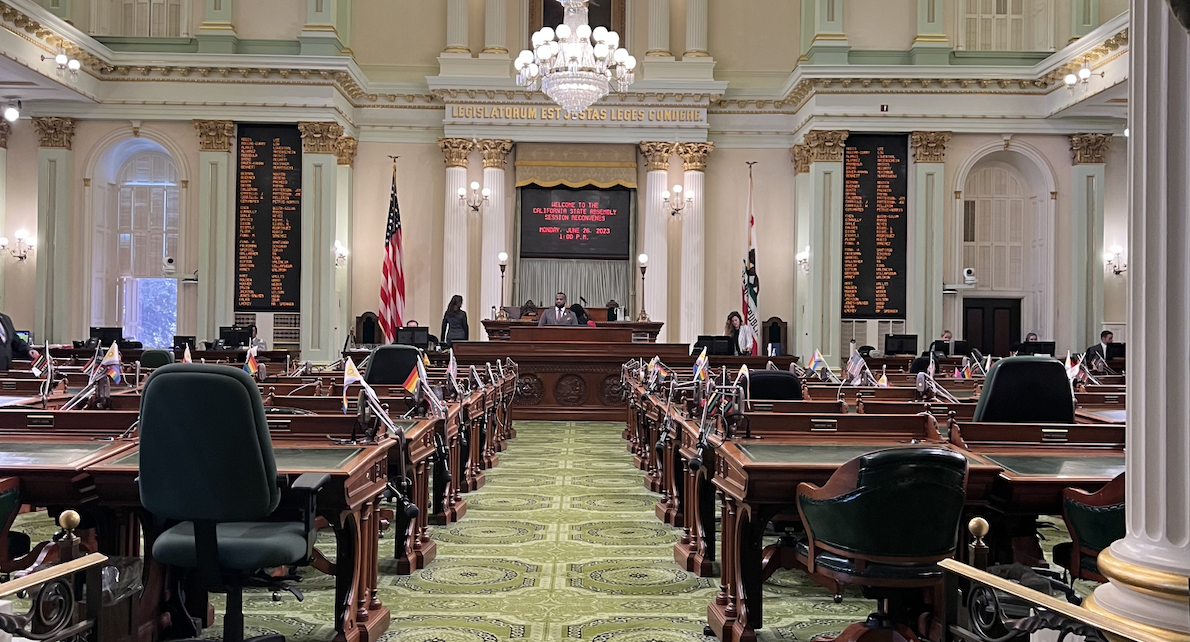
California State Senate Chambers. (Photo: Katy Grimes for California Globe)
Sacramento’s Gift to California HOAs: Capped Budgets and Crumbling Streets
The people who drafted this bill have probably never sat through a three-hour board meeting debating whether the pool heater gets replaced before summer
By Jay Rogers, May 20, 2026 3:32 pm
I’ve spent sixteen years on the Ladera Ranch Community Services board and coached youth football and rugby for years. Both roles share one practical lesson: arbitrary limits imposed from outside don’t lower costs. They shift them, and usually onto the people least equipped to absorb a surprise.
Senate Bill 1007, introduced by Senator Caroline Menjivar (D-San Fernando Valley) and now within a floor vote of passing the full Senate, would cap regular HOA assessment increases at the prior year’s inflation rate unless members vote to approve more. Menjivar’s office frames this as a consumer protection measure for the approximately 14 million Californians living under an HOA. The goal, affordability, is reasonable. The mechanism is not. Capping assessments at CPI doesn’t control costs. It controls the board’s ability to respond to them.
What Current Law Actually Does
Under the Davis-Stirling Common Interest Development Act, California HOAs can already raise regular assessments by up to 20% annually without a membership vote, provided the board can justify the increase against anticipated expenses. That flexibility exists because HOAs are nonprofit entities operating under fiduciary duty. They can’t pad budgets or generate profit. They collect exactly what’s needed to maintain common areas, roads, roofs, and insurance. SB 1007 replaces that judgment-based framework with a single-metric cap. Every community faces different pressures. A 40-year-old development with aging infrastructure and failing drainage doesn’t share the same budget math as a new complex with fresh roads and fresh pipes. Sacramento sees neither distinction.
The Insurance Problem Is Not Theoretical
HOA master policies have seen premium increases ranging from 200% to 500% in some California renewal cycles due to wildfire exposure, reinsurance market stress, and post-2020 construction inflation. Allstate raised statewide condo rates by an average of 30% in April 2025 alone, affecting roughly 78,000 policyholders. Replacement-cost estimates have climbed 30–50% since 2020 due to labor and materials inflation. A board staring at a $400,000 roof replacement doesn’t get to tell its contractor that CPI only moved 3%. Under SB 1007, the board’s remaining options are to defer the work or call a special vote that rarely achieves quorum. Neither resolves the roof.
I watched this exact dynamic during the supply chain disruptions after 2020. Boards with budget flexibility navigated it. Those without it passed the tab to homeowners as emergency special assessments, precisely the outcome SB 1007’s supporters claim to prevent. Good intentions met hard arithmetic, and homeowners paid twice.
A Federal Collision Course
Property values make this a direct threat to every HOA homeowner’s equity. Fannie Mae and Freddie Mac, which back roughly 70% of the conventional mortgage market, have steadily tightened underwriting standards for condominium communities since the 2021 Surfside, Florida collapse. Starting January 4, 2027, associations must allocate at least 15% of annual assessment income to replacement reserves, up from a prior 10% floor. A community that falls short risks losing warrantable status. That designation matters enormously: non-warrantable projects can’t qualify for conventional financing, which shrinks the buyer pool, compresses valuations, and effectively locks existing owners into an illiquid asset. SB 1007 makes it measurably harder to build and sustain the reserve levels that federal lending standards now require. These two policy trajectories are heading directly toward each other, and Sacramento appears unaware that one of them exists.
Volunteer Boards Are Already Stretched Thin
Volunteer directors are an endangered species. They negotiate insurance contracts, review reserve studies, manage vendor bids, absorb neighbor complaints, and carry personal liability exposure, all while having families and holding full-time jobs. Add the risk that artificial assessment caps will leave reserves underfunded and expose directors to breach-of-fiduciary-duty claims, and the recruiting problem becomes acute. I’ve watched capable board members resign when the role shifted from community steward to institutional scapegoat. Fewer qualified volunteers mean greater reliance on professional management companies whose fees, subject to the same inflationary pressures as everything else, don’t drop because Sacramento said so. The cycle feeds itself.
Quorum Paralysis Is Real
The Community Associations Institute, the leading national organization representing HOA professionals and volunteer board members, opposes SB 1007 on exactly these grounds. Achieving quorum for routine HOA business is already a persistent challenge in most communities. Converting every necessary budget adjustment into a formal membership voting campaign guarantees gridlock. Boards facing genuine cost increases will either defer maintenance indefinitely or attempt votes that never clear the threshold. Homeowners end up with higher long-term costs through compounding deferred repairs and emergency special assessments. The people who drafted this bill have probably never sat through a three-hour board meeting debating whether the pool heater gets replaced before summer.
Sacramento’s Pattern
California has a single-party governing majority with an unbroken record of preferring process over outcomes. SB 1007 fits the template. The bill assumes a statewide CPI figure can substitute for a reserve study, a bid sheet from a licensed contractor, and sixteen years of experience managing a specific community’s specific infrastructure. It can’t. The existing 20% flexibility acknowledged that local boards possess information Sacramento doesn’t. SB 1007 erases that acknowledgment. The bill passed the Senate Appropriations Committee 9–1 on April 28, 2026 and now sits on the Senate third-reading file. The pace suggests its authors believe they’ve already won the argument.
What Should Actually Happen
Arithmetic doesn’t negotiate, and neither should boards defending their communities against real cost pressures. The right path isn’t a cap, it’s accountability. Transparent annual reserve studies, publicly disclosed. Insurance market reforms that actually lower premiums rather than just restricting the board’s ability to respond to them. Lawsuit protections that reduce the liability costs embedded in every management contract and insurance policy. Those reforms lower the inputs. SB 1007 just suppresses the output and calls it affordability.
Homeowners should contact their state senators now and register opposition. The work of keeping community infrastructure sound is unglamorous, but someone has to do it. California has enough cautionary tales of central planning producing the opposite of what was promised. Crumbling infrastructure isn’t accidental. It’s the predictable result of good intentions meeting bad arithmetic, one well-meaning bill at a time.


- Sacramento Just Turned Off the Lights - September 1, 2026
- A Field Trip to One Faith Isn’t Comparative Religion - August 30, 2026
- Mello-Roos: The Special Tax That Follows the House - August 25, 2026
RELATED ARTICLES
-
 March 1, 2023
 -
 March 30, 2022
 -

As usual the government is sticking its nose into something that is already controlled. I live in a complex that has an HOA. A few years ago we discovered that our roofs were falling 10 years early. We needed to come up with $2000000 within the next couple of years. We had two ways to do, an assessment or raising dues by 20% over the next few years. The assessment would cost each homeowner about $390 per month for 4 years. We elected to raise the dues starting at 20%. I had to present this to the homeowners at the annual meeting. I explained that situation to them and did not get ANY BLOWBACK! Subsequently the second year we only had to raise the dues by 11% and the third year we may not have to raise them at all. When this emergency is over we can lower the dues to close to where they were. The dues increase amounted to about 200 per month.
Also the cost of your vendors can go up more than the cost of living, then what do you do but cut services?
The entire article fails to address the increasing costs to unit owners. Many have mortgage payments , insurance payments, automobile payments food and clothing costs etc. Many are barely making enough money to survive month to month and can’t absorb a 20% increase which is an increase of one hundred dollars a month and twelve hundred dollars a year in most instances.
Also all home owners have the same expenses without the ability just to increase fees.
Along with the unpredictable expense are the silly HOA regulations such as no Christmas, Halloween , decoration, parking restrictions etc.
First of all, you signed a contract to accept these rules. Secondly, I find that members that are upset the most never go to meetings and do not participate. If you want change, get onto your Board. At least from there you can see the struggle the Board has to meet the demands of the CC&Rs.