
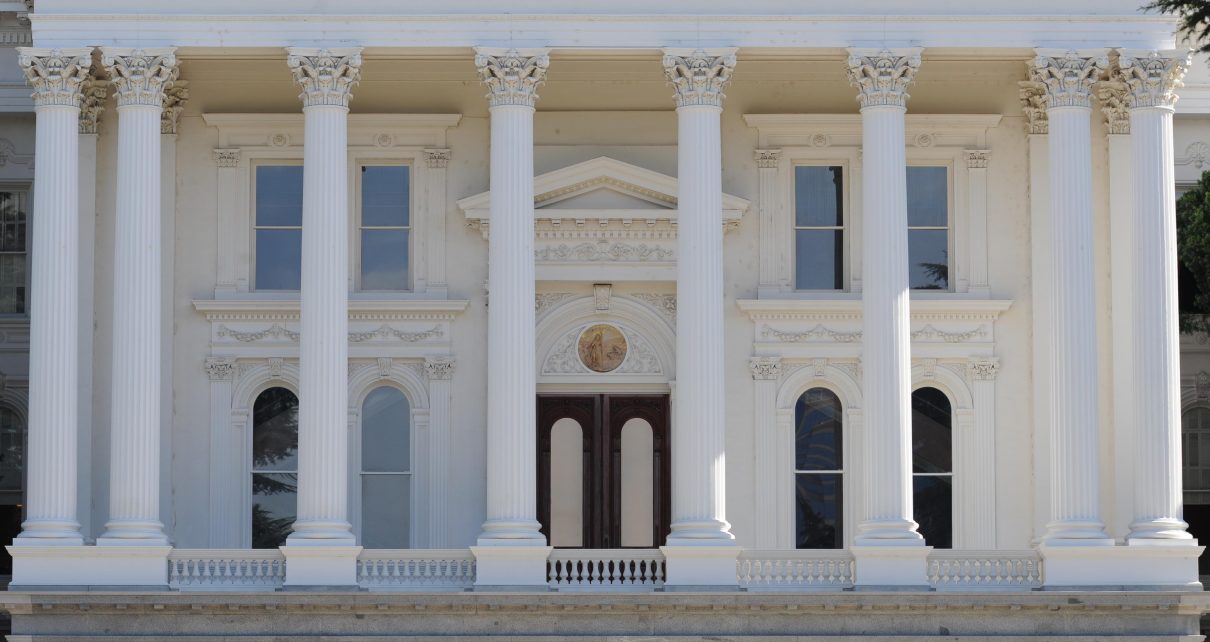
California State Capitol. (Photo: Kevin Sanders for California Globe)
Products of the Mind
Deals with products of the kind, which are particular kinds of personal property in California
By Chris Micheli, June 17, 2026 2:30 am
Division 2, Part 3, Title 2, Chapter 3 of the Civil Code deals with products of the kind, which are particular kinds of personal property in California.
Section 980 provides that the author of any original work of authorship that is not fixed in any tangible medium of expression has an exclusive ownership in the representation or expression thereof as against all persons except one who originally and independently creates the same or similar work.
A work is considered not fixed when it is not embodied in a tangible medium of expression or when its embodiment in a tangible medium of expression is not sufficiently permanent or stable to permit it to be perceived, reproduced, or otherwise communicated for a period of more than transitory duration, either directly or with the aid of a machine or device.
The inventor or proprietor of any invention or design, with or without delineation, or other graphical representation, has an exclusive ownership, and in the representation or expression thereof, which continues so long as the invention or design and the representations or expressions thereof made by him remain in his possession.
Section 981 states that an original work of authorship not fixed in any tangible medium of expression and in the creation of which several persons are jointly concerned, is owned by them in equal proportion. Unless otherwise agreed, an invention or design in the production of which several persons are jointly concerned is owned by them as specified.
Section 982 provides that the owner of any rights in any original works of authorship not fixed in any tangible medium of expression may transfer the ownership therein. The owner of any invention or design, or of any representation or expression thereof, may transfer his or her proprietary interest in it.
Section 983 provides that, if the owner of any invention or design intentionally makes it public, a copy or reproduction may be made public by any person, without responsiblily to the owner, so far as the law of this state is concerned.
Section 984 states that, if the owner of an invention or design does not make it public, any other person subsequently and originally producing the same thing has the same right as the prior inventor, which is exclusive to the same extent against all persons except the prior inventor, or those claiming under him.
Section 985 says that letters and other private communications in writing belong to the person to whom they are addressed and delivered. And, they cannot be published against the will of the writer, except by authority of law.
Section 986 provides that, whenever a work of fine art is sold and the seller resides in California or the sale takes place in California, the seller or the seller’s agent is required to pay to the artist of the work of fine art or to the artist’s agent 5 percent of the amount of the sale. The right of the artist to receive an amount equal to 5 percent of the amount of the sale may be waived only by a contract in writing providing for an amount in excess of 5 percent of the amount of such sale.
An artist may assign the right to collect the royalty payment provided by this section to another individual or entity. However, the assignment cannot have the effect of creating a waiver prohibited by this subdivision.
When a work of fine art is sold at an auction or by a gallery, dealer, broker, museum, or other person acting as the agent for the seller the agent is required to withhold 5 percent of the amount of the sale, locate the artist and pay the artist.
If a seller or the seller’s agent fails to pay an artist the amount equal to 5 percent of the sale of a work of fine art by the artist or fails to transfer the amount to the Arts Council, the artist may bring an action for damages within three years after the date of sale or one year after the discovery of the sale, whichever is longer. The prevailing party in any action brought under this paragraph is entitled to reasonable attorney fees, in an amount as determined by the court. This does not apply to any of seven specified conditions. The terms “artist,” “fine art,” and “art dealer” are defined.
Section 987 contains legislative findings and declarations. The following terms are defined: “artist,” “fine art,” “person,” “frame,” “restore,” “conserve,” and “commercial use.”
No person, except an artist who owns and possesses a work of fine art which the artist has created, is allowed to intentionally commit, or authorize the intentional commission of, any physical defacement, mutilation, alteration, or destruction of a work of fine art. No person who frames, conserves, or restores a work of fine art is permitted to commit, or authorize the commission of, any physical defacement, mutilation, alteration, or destruction of a work of fine art by any act constituting gross negligence.
The artist retains at all times the right to claim authorship, or, for a just and valid reason, to disclaim authorship of his or her work of fine art. To effectuate the rights created by this section, the artist may commence an action to recover or obtain any of five specified items.
If a work of fine art can be removed from a building scheduled for demolition without substantial physical defacement, mutilation, alteration, or destruction of the work, and the owner of the building has notified the owner of the work of fine art of the scheduled demolition or the owner of the building is the owner of the work of fine art, and the owner of the work of fine art elects not to remove the work of fine art, the rights and duties created under this section must apply, unless the owner of the building has diligently attempted without success to notify the artist, in writing of the intended action affecting the work of fine art, or unless he or she did provide notice and that person failed within 90 days either to remove the work or to pay for its removal.
Section 988 defines the terms “artist” and “work of art.” Whenever an exclusive or nonexclusive conveyance of any right to reproduce, prepare derivative works based on, distribute copies of, publicly perform, or publicly display a work of art is made by or on behalf of the artist who created it or the owner at the time of the conveyance, ownership of the physical work of art shall remain with and be reserved to the artist or owner, as the case may be, unless such right of ownership is expressly transferred by an instrument, note, memorandum, or other writing, signed by the artist, the owner, or their duly authorized agent.
Section 989 contains a legislative finding and declaration. It defines the terms “fine art,” “organization,” and “cost of removal.” An organization acting in the public interest may commence an action for injunctive relief to preserve or restore the integrity of a work of fine art from acts prohibited. In determining whether a work of fine art is of recognized quality and of substantial public interest the trier of fact is required to rely on the opinions of those described in law.


- Employee Notices - October 18, 2026
- Advice on Navigating the California Rulemaking Process - October 18, 2026
- Some Suggestions for Those New to the California Constitution - October 18, 2026
RELATED ARTICLES
-
 May 23, 2026
 -
 February 8, 2025
 -
 March 5, 2025