
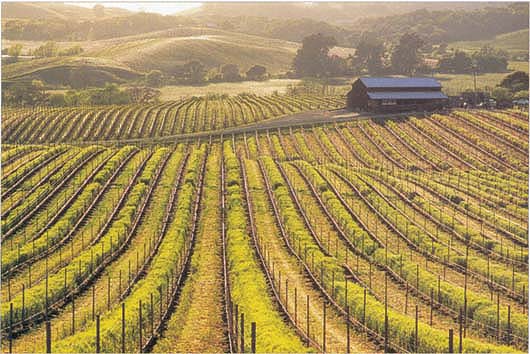
Napa Valley winery. (Photo: Univ. of California)
Napa County Is Unjustly Trying to Bankrupt a Family Winery
Napa’s counsel commented that winery owner should ‘welcome bankruptcy’
By Bridget Conlan, June 25, 2026 3:00 pm
Imagine you’ve spent decades building something — a family business, a home, a legacy. You got the required licenses and even received written confirmation from the local government that everything you were doing was legal. Then, one day, the county knocks on your door with a bill for nearly $4 million. And when you try to appeal, they move to freeze your bank accounts before the courts even finish weighing in.
That’s not a hypothetical. That’s what’s happening right now to Lindsay Hoopes.
Lindsay and her father, Spencer, have operated Hoopes Vineyard in Napa County for more than 40 years. Spencer, now 78 and permanently disabled after two organ transplants, purchased the property when Lindsay was a child. She grew up there, eventually took over operations, and built a thriving small winery doing exactly what small wineries do: hosting tastings, pouring wine, selling merchandise, running a wine club. The kind of thing you can see happening at wineries up and down the valley every single day.
Lindsay did her due diligence. She obtained a state ABC license authorizing tastings and direct-to-consumer sales. When she applied, Napa County confirmed in writing that her intended use was “allowed and approved.” The state Department of Alcoholic Beverage Control issued the license. The county did not object. And when the ABC later approved an expansion of the outdoor tasting area, the county again said nothing.
Then, in 2022, Napa County filed an enforcement action declaring those same activities — the tastings, the wine club, the merchandise — a “public nuisance.” Yet in more than 40 years of operation, the winery has never generated a single public complaint.
There’s another wrinkle worth noting: the first judge to look at this case, reviewed the same county code provisions and concluded there were no violations. No nuisance, no problem. A second judge reviewed the same ordinances and reached the opposite conclusion. When two experienced judges look at identical facts and land on entirely different outcomes, that alone should tell you we’re dealing with a genuinely hard legal question — one that deserves full appellate review before anyone’s life gets destroyed.
And yet, after an 11-day trial, a judgment of $3,960,013.05 was entered against Lindsay, the Hoopes Vineyard LLC, and her family partnership — jointly and severally. That means Lindsay is personally on the hook for the full amount. The fines alone total $1,525,000. Attorney fees for the expensive private outside lawyers hired by the county, which are charged back to the family, add another $2.25 million (more than the actual fines, for anyone keeping track). The total judgment is more than eight times the total lifetime revenue of the winery from all on-site activities (many of which Napa agrees are acceptable) and more than 20 times the gross revenue generated from the penalized activities.
Lindsay is being represented by Pacific Legal Foundation at no cost. We asked for a stay while the appeal is pending, and the trial court agreed the injunction portion of the judgment was too severe to enforce during the appeal. The court even acknowledged the injunction would effectively require the family to shut down. But the court refused to stay the monetary judgment, even after we demonstrated that no surety in the state would issue a bond for such an amount against a winery with no realistic capacity to pay it. Bankruptcy lawyers have confirmed that both entities would be forced into insolvency.
The appellate court granted a stay one day before the county could have enforced the judgment. That stay was in place for 51 days until last week, when the appellate court dissolved it without explanation before the parties had a chance to present their appellate arguments.
Nothing has changed regarding the merits of the case, but Napa County is now moving full speed ahead to collect $4 million. Napa County has already issued a writ of execution and signaled its intent to pursue full enforcement — freezing accounts, seizing assets, and going after Lindsay personally. The county’s own attorney conceded at the penalties hearing that Lindsay is “not particularly wealthy.”
In their single-minded vendetta to collect nearly $4 million from the mother of four small children, Napa’s counsel commented that Hoopes should “welcome bankruptcy,” apparently disregarding the irreparable damage it will cause to both Lindsay and her longstanding family business. That’s where we are. A family winery, licensed by the state, approved by the county, is facing financial annihilation — while the courts are still deciding whether any of this was ever lawful in the first place.
The Eighth Amendment’s Excessive Fines Clause exists precisely for situations like this. The Supreme Court has been clear: a punitive fine is unconstitutional if it’s disproportionate to the gravity of the offense. A nearly $4 million judgment against a small family winery that poured wine for paying guests — the same activity the county said was fine, the same activity hundreds of neighboring wineries engage in freely as the backbone of Napa County’s economy — fails that test by any honest measure.
But constitutional arguments take time. Appeals take time. And Napa County knows that. By moving aggressively to collect now, while the legal questions remain genuinely open, the county can effectively win the case before any appellate court ever rules. Lindsay’s business will be gone. Her family’s financial security will be gone. The appeal won’t be moot, but the court won’t be able to put things right. The court won’t be able to get the business or the property back. Money alone will not fix the damage wrought by Napa County’s haste.
We’re continuing to fight. But Lindsay Hoopes deserves more than a good legal argument. She deserves the chance to be heard before the government strips everything away.


- Napa County Is Unjustly Trying to Bankrupt a Family Winery - June 25, 2026



Amazing! This does not pass my smell test.
Question: who owns the land near or next to this winery.
Hope you can keep this in the public eye and that she is able to take it up through the courts if necessary.
Tomorrow is right, this really smells. Someone/Something is benefitting from this; we need to find out who. Also why did the county use “Outside Counsel” that makes no sense when they have plenty of in house council. There’s obviously more to this.
Two radically different judicial opinions on the same case reeks of POLITICS!