
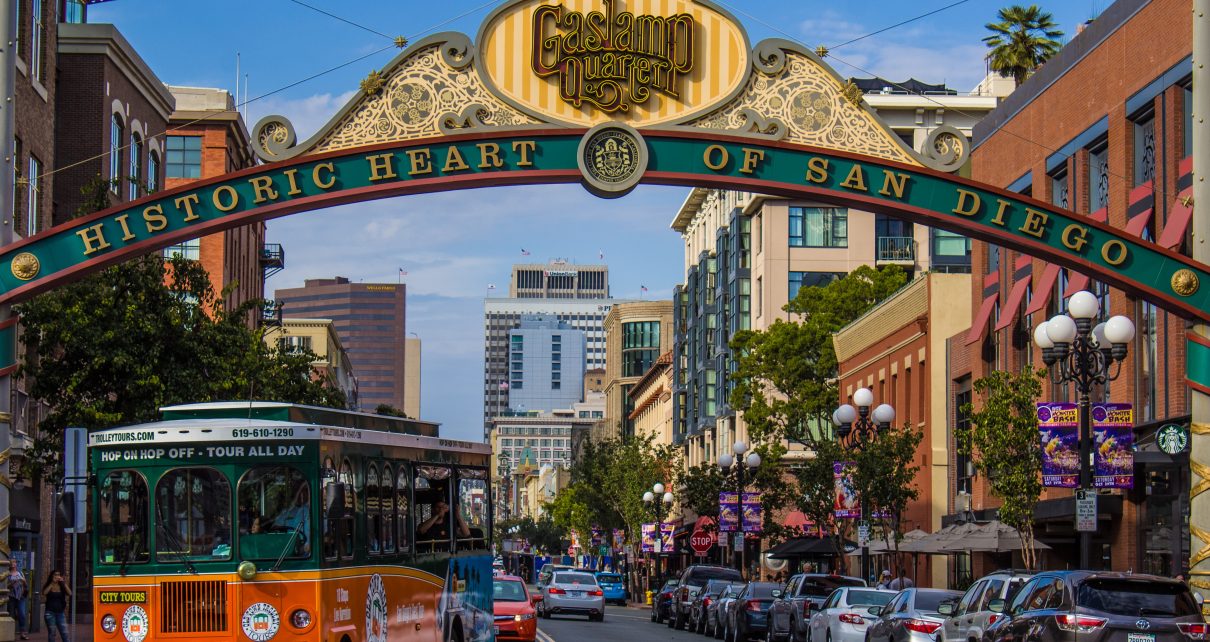
Downtown San Diego, California. Gaslamp District. (Photo: Johan Erkki, Shutterstock)
La Jolla’s Secession Drive Exposes San Diego’s Out-of-Control Bureaucracy
High-paid middle managers—program managers and program coordinators—surged 461%, from just 70 positions in fiscal year 2015 to 393 in recent years
By Megan Barth, July 27, 2026 4:20 pm
La Jolla’s push to break away from San Diego has laid bare a city government that has grown wildly out of control under complete Democratic rule. Former City Manager Jack McGrory, now chief negotiator for the Association for the City of La Jolla, is leading the charge to secede, citing what he calls a “disastrous system of government” that no longer serves residents.
McGrory, who ran San Diego from 1991 to 1997 and later served as COO of the Padres, was initially skeptical of secession. That changed as he watched the city’s trajectory. “The more I have watched the city of San Diego and what is really a disastrous system of government down there—nobody’s really in charge, nobody’s accountable. Dealing with the city is a nightmare,” he said. “It’s mindboggling what goes on down there.”
La Jolla generates substantial tax revenue yet receives inadequate services, including streets that McGrory describes as “nearly impassable” in San Diego.
Democratic Mayor Todd Gloria has held office since December 10, 2020—more than five and a half years—and won re-election in 2024. Democrats hold every elected seat at City Hall: the mayor plus all nine City Council members. The Council has been an all-Democratic 9–0 body since 2022, when the last Republican was termed out, delivering uninterrupted one-party control throughout Gloria’s tenure.
The numbers behind the secession drive are staggering.
High-paid middle managers—program managers and program coordinators—surged 461%, from just 70 positions in fiscal year 2015 to 393 in recent years. Overall city workforce growth lagged far behind at roughly 20 percent. These unclassified roles, which frequently carry total compensation of $200,000 to $250,000, have become a dominant layer of government.
Many positions focus on progressive priorities such as “homelessness strategies and solutions,” “race and equity training and program development,” and “immigrant affairs” initiatives including language access and civic engagement.
That bureaucratic expansion coincides with deep fiscal distress.
San Diego faces a $118 million structural deficit, following earlier shortfalls of $250–300 million. The unfunded pension liability stands near $3.5 billion, with an annual pension payment of $563 million. A $7.8 billion infrastructure funding gap looms.
Citywide homelessness spending has routinely exceeded $230 million a year and peaked at $315.9 million, with city programs alone accounting for $87.9 million to $105 million—yet the decline is starkly visible in the Gaslamp Quarter, hailed as “The Historic Heart of San Diego.”
Once a thriving center of nightlife and tourism, now contends with open drug use, public intoxication, human waste, litter, and shuttered businesses. Pepper-spray deployments more than doubled in 2025 to 361 uses, while assaults on officers also more than doubled. The popular Fifth Avenue pedestrian promenade was canceled after voters rejected a sales-tax increase and the cash-strapped city cut funding.
Gloria’s administration has prioritized expanding high-paid administrative positions in homelessness, race and equity, and immigrant affairs while core services and infrastructure have deteriorated. The result is a city that feels less safe, less functional, and less livable. La Jolla’s secession effort, led by a former insider who knows City Hall intimately, is the clearest signal yet that San Diego’s out-of-control bureaucracy under prolonged Democratic control has reached a breaking point.


- Aaron Ford’s Path to the Nevada Governor’s Mansion Runs Through ActBlue And Airports - September 22, 2026
- Poll: Majority of Democrats Would Cheer a Military Coup Against Trump; Nearly One-Third Support Assassination - September 22, 2026
- Tahoe Officials Face a Cluster of Criminal Cases Across the State Line - September 21, 2026
RELATED ARTICLES
-
-
 September 3, 2025
 -
Another city Progressive Democrats have Destroyed. It will NEVER end until these low info voting idiots that vote for what they think are Democrats (they are NOT Democrats) wake up. Which they will not wake up. Not as long as 47 is running things. Theres too many low info “Democrat” voters out there that have TDS. Have NO common sense (which is a symptom of TDS). Yea, we have problems in this state, most of the problems are caused by these progressive Democrats…please people, wake up and vote them out. Take a chance, what do you have to lose? You won’t tho.
yup. I used to deliver to the Target on “Sports arena” a few times a week. SO many homeless walking around. every other pedestrian is homeless. it’s really disgusting down there. looks pretty from the freeway though. lol
I got married in La Jolla. What a beautiful place, and I don’t blame the residents for desiring to keep it that way.
Here’s San Diego’s spending problem- homelessness and DEI are used to redistribute taxpayer funds, just like LA.
“Many positions focus on progressive priorities such as “homelessness strategies and solutions,” “race and equity training and program development,” and “immigrant affairs” initiatives including language access and civic engagement. “
La Jolla currently leans Democratic, with recent data showing a significant shift from its historical Republican stronghold status. Secession will not fix this. The residents will just vote for different Democrats who will destroy the city. La Jolla is doomed no matter what.
How would that vote total skew if vote fraud was taken out of the equation???
The mind races with the possibilities….
San Diego taxpayers were fleeced out of 28 MILLION DOLLARS to pay for Todd Gloria’s Gay Pride Plaza in Hillcrest, yet the same taxpayers are being denied bathrooms in Mission Bay. What the holy hell is that all about?