
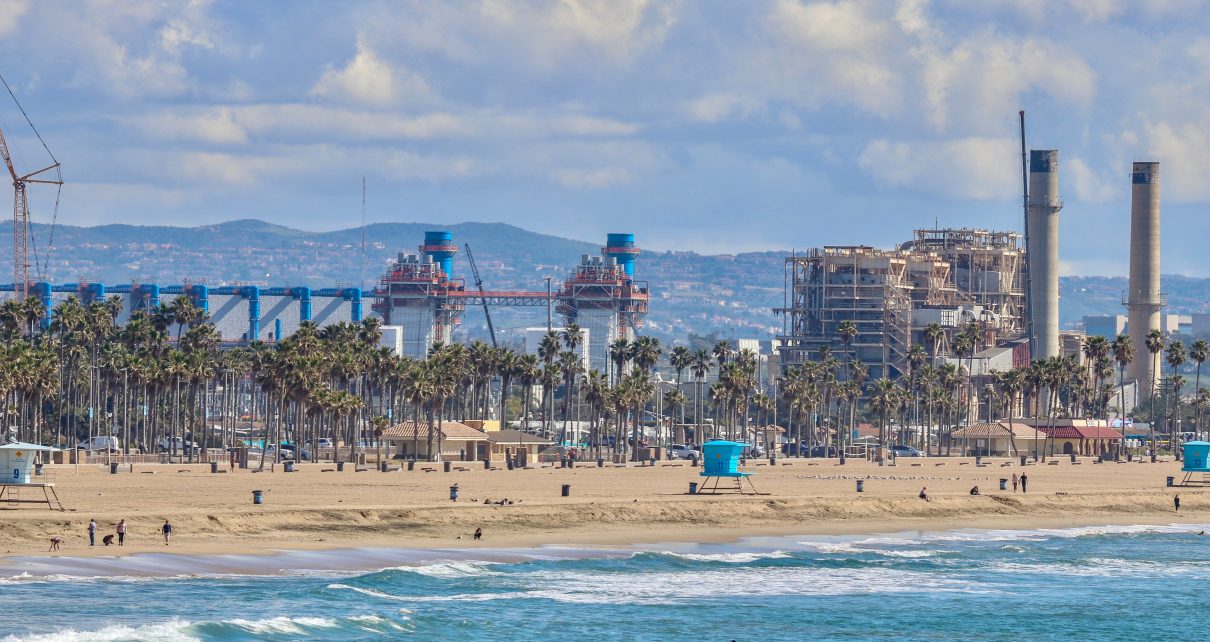
Southern California Desalination plant. (Photo: Shutterstock, KK Stock)
Ringside: Debunking the Allegedly Prohibitive Cost of Desalination
The ‘high’ costs are the result of policy choices
By Edward Ring, August 5, 2026 12:00 pm
 Earlier this summer a guest op-ed appeared in the Orange County Register, “Learning the right lesson from San Diego’s desal water surplus.” But the “lesson” presented was only partly accurate.
What the authors, both affiliated with the Property and Environment Research Center (PERC), got right was the need to change regulations that restrict the ability for farmers to sell their water allocations to cities. This is consistent with PERC’s mission, which is to promote “free market environmentalism,” property rights, and market based solutions to environmental challenges. But when it comes to the economics of desalination, these critics of the technology were way off. It does not cost too much to make economic sense. The high costs are the result of policy choices.
The “lesson” we should be taking from desalination projects and proposals so far in California is that current policies have grossly inflated the cost of desalinated seawater here for two reasons: the construction cost is inflated thanks to California’s regulatory and legal environment, and the operating cost is inflated because California has the highest electricity rates in the nation.
The most recent construction cost estimate for seawater desalination in California was in 2022, when the Coastal Commission rejected a $1.4 billion proposal to build a plant that would have produced 56,000 acre feet of fresh water per year. A construction bond priced at 4 percent per year for a term of 30 years would require a payment amounting to $1,446 per acre foot.
Compare this to construction costs elsewhere in the world. In Saudi Arabia, on a 45 acre site about 50 miles north of Jeddah on the Red Sea, the Rabigh 4 IWP Project delivers 177,000 acre feet of fresh water per year, and the total construction cost was $675 million. Under the same financing terms, that amounts to a payment of $220 per acre foot.
A fluke? Maybe not. In Israel, the just completed Sorek B BOT Desalination Facility, on a 23 acre site on the Mediterranean Sea about 10 miles south of Tel Aviv produces 164,000 acre feet of fresh water per year. It cost $600 million to construct. A 30 year bond at 4 percent could be serviced in this case at a cost of $211 per acre foot.
Moving on, the Mirfa 2 RO Water Desalination Company in the United Arab Emirates built a plant that desalinates 161,000 acre feet a year at a construction cost of $620 million. Keeping to the same financing terms, that’s $223 per acre foot.
Finally, in Singapore the newly commissioned Jurong Island Desalination Plant sits on 9 acres and produces 40,000 acre feet per year. It is fully automated, requiring “only 2-3 workers to man this highly automated plant.” Its construction cost was not disclosed, but the private bidder, Singapore Technologies Marine Consortium, has guaranteed a price of $875 (US) per acre foot. That covers financing, energy, labor, and profit.
It’s reasonable to expect California’s inherent costs to construct major infrastructure (materials, labor, and land), as opposed to inflated costs that are the result of political choices, to exceed the world standard. But it is not reasonable to expect those inherent construction costs to be five to seven times higher than everywhere else on earth. It is also not reasonable to suggest other sites on earth have “simpler geography.” Unlike anywhere in the Middle East, California has strong offshore currents to disburse brine. And California has multiple preexisting coastal sites where power plants face decommissioning. These sites are close to consumers, and already have water intakes that can be modified, as well as high voltage connections.
Which brings us to the other source of seawater desalination’s alleged high cost, which is electricity. The current electricity requirement for desalination to produce fresh water is 3,500 kilowatt-hours per acre foot. The electricity requirement will drop further as new desalination technologies mature. But at that rate, and priced at California’s commercial rate for electricity of $0.26 per kilowatt-hour, electricity costs add another $910 per acre foot. If Californians paid the national average commercial price for electricity of $0.13 per kilowatt-hour, the electricity cost would drop to $455 per acre foot.
So let’s imagine that California actually mustered the political and economic wherewithal to construct a desalination plant for only twice what people elsewhere in the world spend, and at the same time succeeded in driving the cost of electricity down to the national average. If so, the cost to finance new construction and pay for the requisite electricity would come in easily below $1,000 per acre foot. As it is, the wholesale price for water charged by the Metropolitan Water District of Southern California is $1,528 per acre foot, and that price is officially forecast to escalate at 8.5 percent per year well into the 2030s.
In stark contrast to what critics allege, desalination has the potential to be the cheapest source of water to urban consumers. Advances in construction robotics along with new modular designs promise to lower construction cost for desalination, and advances across multiple energy technologies make dramatically lower electricity rates inevitable. Nearly 40 million acre feet of fresh water is produced every year worldwide using seawater desalination. California should be a leader in this space.
Making it easier for farmers to sell water to cities makes obvious sense. But every element of that transfer, from aqueducts and pipes to reservoirs and pumping stations, also come with construction and operating costs, at least partially financed with government subsidies. The scholars at PERC are justly critical of subsidies, but the only way to be consistent is to examine the subsidies involved in all major water infrastructure, including conveyances.
Perhaps those who criticize desalination on allegedly economic grounds should examine in more detail why the costs of construction and the cost of electricity is so grotesquely inflated in California, and support a policy agenda to fix that problem. They would be doing California, and the entire nation, a big favor.


- Ringside – Geothermal Energy: A Huge Wildcard - October 1, 2026
- Ringside: El Nino Emergency Planning Must Include Dredging the Delta - September 24, 2026
- Ringside: The Energy and Water Footprint of AI - September 17, 2026
RELATED ARTICLES
-
-
October 30, 2025
-
Quote – The ‘high’ costs are the result of policy choices
This sums up All of Kalifornia’s economic problems.
Graft and corruption for the Dem Party is not a line item in the budget, but it’s included.