
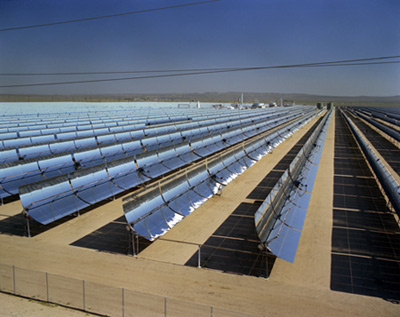
Solar electricity production. (Photo: energy.ca.gov)
Ringside: Iron Air Batteries – Niche, or Next Big Thing?
Iron air batteries offer long-duration electricity storage and at $33 per kilowatt-hour of charge, they cost far less than lithium ion batteries
By Edward Ring, August 19, 2026 2:52 pm
 Iron air batteries appear poised to play, at the least, an important niche role in the emerging electric age. A very recent example of this is the $750 million equity financing that Form Energy secured this week, raising the total investment in that iron air battery manufacturer to over $2 billion. Iron air batteries offer long-duration electricity storage and at $33 per kilowatt-hour of charge, they cost far less than lithium ion batteries.
Let’s imagine California were to fulfill its electrification goals by relying exclusively on solar power and iron air batteries. Could these batteries cost-effectively store summertime solar electricity surpluses to cover wintertime solar electricity deficits? How would that look?
With a discharge cycle of up to 100 hours and a capacity of 3 megawatts per acre, iron air batteries can store 300 megawatt-hours per acre. That’s more than twice the storage density of lithium ion batteries, which at a capacity of 30 megawatts per acre but only 4 hours of discharge capacity, only store 120 megawatt-hours per acre.
The comparisons are interesting, because these batteries have very different strengths. Lithium ion batteries rapidly discharge electricity, making it useful for mobile applications and, at the utility scale, to store photovoltaic generated surplus electricity during the day to discharge at night.
Iron air batteries, by contrast, because they can store 300 megawatt-hours per acre on a charge, and can hold their charge for months, are, at least from an engineering standpoint, capable of storing solar generated electricity on a seasonal basis. But how much electricity would they have to store?
In California, the yield of a utility scale photovoltaic farm averages 25 percent. That is, if a solar farm can output one megawatt in full sun, on the average day it will produce 6 megawatt-hours (6/24 = 25%). But in winter’s fewer hours of daylight, that yield shrinks to around 15 percent, and in summer, it rises to around 35 percent.
California’s official goal is to generate 500,000 gigawatt-hours (GWh) per year. Currently the state consumes around 280,000 GWh per year, of which around 220,000 GWh are produced in-state. What if the entire 500,000 GWh came from photovoltaics, and iron air batteries absorbed the summertime surplus electricity to discharge during the winter deficits?
Assuming electricity consumption is level year-round, statewide photovoltaic output would have to average 1,370 GWh per day. Dividing the year into four segments for simplicity’s sake, this hypothetical photovoltaic output would average 822 GWh per day in winter (15% yield), 1,918 GWh per day in summer (35% yield), and 1,370 GWh per day in spring and fall (25%) yield.
Dividing 500,000 GWh per year yields a requirement of 125,000 per season. Extrapolating from the previous assumptions, California’s photovoltaics would produce 75,000 GWh in winter, resulting in a 50,000 GWh deficit, and 175,000 GWh in summer, resulting in a 50,000 GWh surplus. Could iron air batteries store 50,000 GWh?
Theoretically at least, the answer is yes. They can store electricity for months. And at 300 megawatt-hours per acre, it would “only” take 166,667 acres, or 260 square miles, to hold them all.
As for the photovoltaics required to produce 500,000 GWh per year? At five acres per megawatt of output and a 25 percent yield, they would require another 1,784 square miles, 1.14 million acres, or, for visualization’s sake, a gargantuan square measuring 42 miles by 42 miles, filled with PV panels.
Don’t laugh. California’s big. The state is 156,000 square miles not including lakes, and the panels would be distributed. For example, a 2016 NREL study estimated usable rooftop space in California at nearly one million square meters, which is 375 square miles. Panels on rooftops could be more concentrated, delivering more energy per square foot, since the inverters, transformers, and distribution boxes could be sited on adjacent ground. And the output of photovoltaics, rated today at around 20 watts per square foot, is going to improve.
But how much would all this cost?
Photovoltaics installed, including balance of plant hardware, cost under $1 million per megawatt of capacity. At a 25 percent average year-round yield, producing 500,000 GWh per year would require installing a collective photovoltaic output capacity of 228,000 megawatts in full sun, which is a $228 billion investment.
That’s actually not bad, depending on what comparisons you make. Using official state and federal estimates, the 87,000 GWh per year, best case, that Californians will get from the planned floating offshore wind farms will cost, before overruns, operations, maintenance, or battery storage, $232 billion. With proven cost metrics, photovoltaics are at least six times cheaper than floating offshore wind.
As for purchasing 50,000 GWh of iron air battery storage capacity, Google recently bought an iron air battery system from Form Energy at $33 per kWh. That’s not encouraging. To store 50,000 GWh at that price would require an investment of $1.65 trillion. With longer duration storage and cheaper cost per kilowatt-hour than lithium, iron air batteries are good backup power solutions for data centers. They also can smooth daily fluctuations in solar electricity generation. They’re not a solution for seasonal fluctuation.
Exclusive reliance on solar, wind, and batteries should remain hypothetical. Supposedly the cure for losing summer sun is to rely on winter wind, supplemented with long duration storage. But why not just overbuild solar? The massive summer surpluses could be used to synthesize pipeline-grade fuel from air and water, or to desalinate seawater into fresh water. And we would be spared the expense of floating offshore wind, and batteries that can’t possibly justify their cost if they’re only cycled once per year.
Better yet, why not adhere to an all-of-the-above energy future, governed by what energy technologies compete most effectively on an unsubsidized playing field?


- Ringside: Induced Demand is a Prerequisite for Abundance - October 14, 2026
- Ringside: Observations as a New Water Year Begins - October 8, 2026
- Ringside – Geothermal Energy: A Huge Wildcard - October 1, 2026
RELATED ARTICLES
-
 August 11, 2020
 -
 June 19, 2025
 -
Maybe the author can make sense of the third paragraph?
It is true that the state is very large but the usable land is mostly already in use for better things like food production. No one is going to build gigantic battery farms in the mountains or land that is otherwise useless or cost prohibitive to level.
This is explained better than previous articles.
However, to overbuild solar with wind towers would be counter productive because it would at least partially shade solar panels. Also, there would need to be space dedicated to get large cranes and other equipment in to build and maintain the towers and every now and then a blade breaks off a tower and that would cause a lot of damage to the solar plant.
Please explain what the human and environmental costs for sourcing the raw materials required for solar and wind. For example, child labor under unsafe and brutal conditions in africa or the toxic material generated in the process of sourcing, manufacturing and end life disposal of these products.
And lastly, no construction of these facilities on farm land. The far left that often pushes alternative energy are either too stupid to contemplate empty store shelves or it’s part of the plan to create scarcity to increase reliance on government control. How many ukrainians did Stalin starve to death to that end?
A trained monkey could install residential rooftop solar, but it does require at least rudimentry craft skills and pride of workmanship to do right.
However, a solar farm is an entirely different ball of yarn.
I’ve seen several 12kv circuits of direct burial cable placed on sharp rocks rather than shading or duct installation at one solar farm, which is probably due to cheap owners trying to cut construction costs with cable laying all over other circuits without knowing which cable belongs to which cicuit – which increases damage in case of a fault and unecessary hazard while digging to expose damaged cable, unless the whole plant is shut down.
The contractor will install as specified and so long as it lasts a year and a day the contractor is clear in any case.
The owner will be hit real hard financially when those cables star failing. Those were layed out on the ground and covered with soil from other parts of the project rather than run in trenches. With tractors running over the whole works, no less.
The best bet in my estimation would be to place small modular nuclear generation scattered through where the load is, reducing the need for transmission lines traversing fire hazardous terrain to feed large population centers.
With no alternative generation swallowing up vast swaths of desert and farmland.
And, no batteries needed.
I was reading today about porrtable micro 1 megawatt e (have no idea what the e stands for) nuclear reactors that can fit in the back of pickup, is enriched to 4.5 percent (far, far below weapons grade) and would need refueling every 5 years. I don’t lnow the delivered, in place cost of the reactor, I think the quoted refueling was in the neighborhood of 1.3 mil.
Any reactors would have to be securely protected behind and under reiforced concrete, you can’t just leave something like that on a street corner behind chain link fence with “no trespassing” signs attached.