
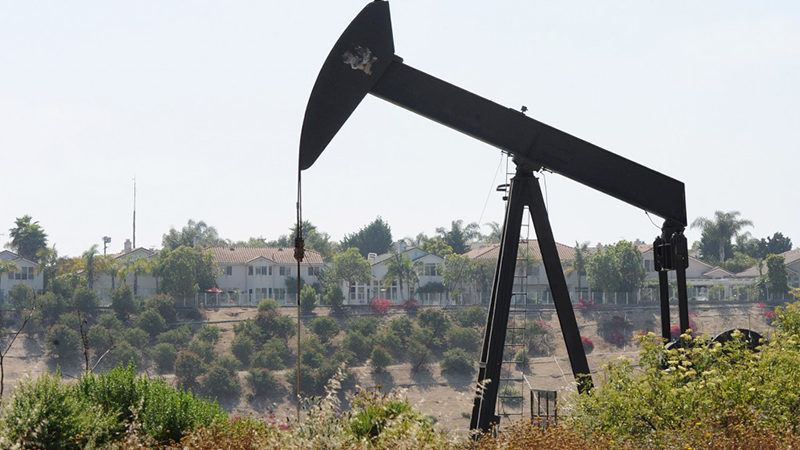
Oil pumpjack (Photo: ioes.ucla.edu)
Kern County Tanker Convoys: Fact or Fiction?
California went from eleven refineries in 2019 to seven today; all five closed refineries were former consumers of Kern County oil
By Michael Mische, October 2, 2026 1:39 pm
Recently, a video titled “Live Look at Kern County, California as PBF Refinery Refuses to Buy Barrels from the San Pablo Pipeline” has circulated on social media. The video shows a convoy of crude oil and gasoline tanker trucks racing across the plains of what is implied to be Kern County, California. The footage is stunning, and the message is provocative and attention-grabbing.
I received the video and was asked to determine whether it is a factual representation of the “Kern Convoy” or a fictional exaggeration. Well, it’s a bit of both. Let’s examine the facts.

It’s Fiction. Upon closer examination, the video is false and, regrettably, misleading. Rather than being in Kern County, the tanker trucks shown are racing across the Iraqi desert, delivering crude oil and gasoline to Syria for export because Iraq can’t use the Strait of Hormuz. Iraq is reportedly using 1,000 to 5,000 trucks daily to move its crude and finished fuel products
Let’s discuss the facts. Since the Iranian action began on February 28, 2026, Iraqi oil exports have plummeted by 70%. In 2025, Iraq was California’s second-largest source of foreign oil. Iraq is about 7,400 miles from Bakersfield, roughly a 22-hour flight, and is hardly comparable to Kern County. Today, rather than producing its own oil, California’s stated policy is to be “predominantly an import state,” as noted by CEC Vice Chair Siva Gunda. In 2025, California imported over 63% of its oil needs from foreign sources, despite having one of the largest oil reserves in the U.S.
Kern County crude producers, once the premier standard among U.S. producers, are burdened by high production costs, a torturous and costly regulatory environment, and a closed pipeline to the Bay Area. California policies and regulations, the strictest and most expensive in the world, have intensified under the Newsom Administration, driving production to a 50-year low. According to the California Independent Petroleum Association, CIPA, 16 of the 20 major legislative actions regulating oil production in California were enacted during the Newsom Administration. Since 2019, pre-SB 237 drilling permits have plummeted by 90%, the state excise tax has skyrocketed by 52%, and California has become the most dependent of all 50 states on foreign oil.
The once highly valued San Pablo Bay Pipeline (SPB), with a 210,000-barrels-per-day capacity, has been effectively idled (functionally closed) since December 2025 due to low Kern oil production and the loss of one of its primary customers, the Valero Refinery in Benicia. For decades, Northern California had multiple refineries connected to the SPB pipeline. However, Valero voluntarily closed its Benicia, California, refinery in 2026, and Marathon’s Martinez complex converted to renewable feedstocks in 2022, reducing Bay Area demand for crude oil. These closures and conversions led to a substantial loss of customer volume and revenue for the SPB pipeline.
The two remaining operating petroleum refineries in Northern California, Chevron and PBF, have deep-water terminals that can receive oil via maritime tankers, providing alternatives to the SBP pipeline. The PBF Martinez Refinery previously received crude oil from the SPB and retains connectivity if the line is ever restored, while Chevron Richmond processes only imported crudes. The Chevron and PBF refineries in Southern California are designed to process California crude oil as well as imports, and they run both types of crude today. In fact, PBF is perhaps the largest purchaser of indigenous California crude oils from across the state.
PBF Logistics operates its own pipeline, the M70, which is configured to transport Kern County crude to supply its Torrance Refinery. The M70 apparently has capacity for additional crude oil, but current in-state onshore production is too low to fill the line. PBF could conceivably consume more Kern oil if in-state production increases and if it maintains price parity with foreign sources. New supplies could first flow into the M70 to fill the operating line; then, if Kern production increases further, the SPB could be resurrected.
The SPB was idled in December and later sold as part of the Crimson California Pipeline system to the California Resources Corporation (CRC) for $63 million. CRC accounts for about 80% of California’s in-state crude production, which is similar in quality and yield to Western Canadian crudes. Both crude types require complex refineries and incur additional costs to convert heavy crudes into CARB-compliant fuels.
But the situation was more complicated than the SPB pipeline’s demise alone. The SPB pipeline’s precarious status was widely known within the California oil and gas industry. Throughout its death spiral, Kern producers did little to insulate themselves or connect to other pipelines, such as the M70 or Plains Line 2000, even as the SPB faced closure. The SPB’s closure, combined with a lack of connectivity to other pipelines and refinery closures, forced surviving Kern County producers to use tanker trucks to transport their product to refiners, increasing costs and further straining their economics in a highly competitive global market.
What’s the Reality? Over 40 years, in-state crude production has fallen by 63%, refinery production has plummeted by 36%, while the state’s population has expanded by 24% and the number of vehicles has climbed 38%. Today, after years of state-imposed field restrictions and extraordinary regulatory costs, in-state crude oil is only 27% of its 43-year high. Refining was subsequently affected, and the state went from eleven refineries in 2019 to seven today. All five closed refineries were former consumers of Kern County oil. Under the Newsom Administration, in-state production of CARB gasoline has fallen 20% since 2019, and AAA prices have surged by 91%.
The SPB pipeline shut down because too little crude oil flowed through it to remain economically viable. SPB’s idling was inevitable, and the CEC, the Legislature, and Governor Newsom were notified. Nonetheless, they did little to support its continued operation.
The loss of refineries, restrictions on in-state oil production, and the idling of the critical SPB pipeline have necessitated Kern truck convoys. The Kern Tanker Truck Convoy stems from state-mandated costs, regulations, and policies that have significantly and adversely affected California’s oil production and refinery industry. All of which add costs and increase greenhouse gas emissions.
In the case of the Kern Tanker Truck Convoy, the responsibility rests squarely with the Legislature, the Governor, and the California Energy Commission, not the producers or refiners.


RELATED ARTICLES
-
-
-
 February 27, 2020