
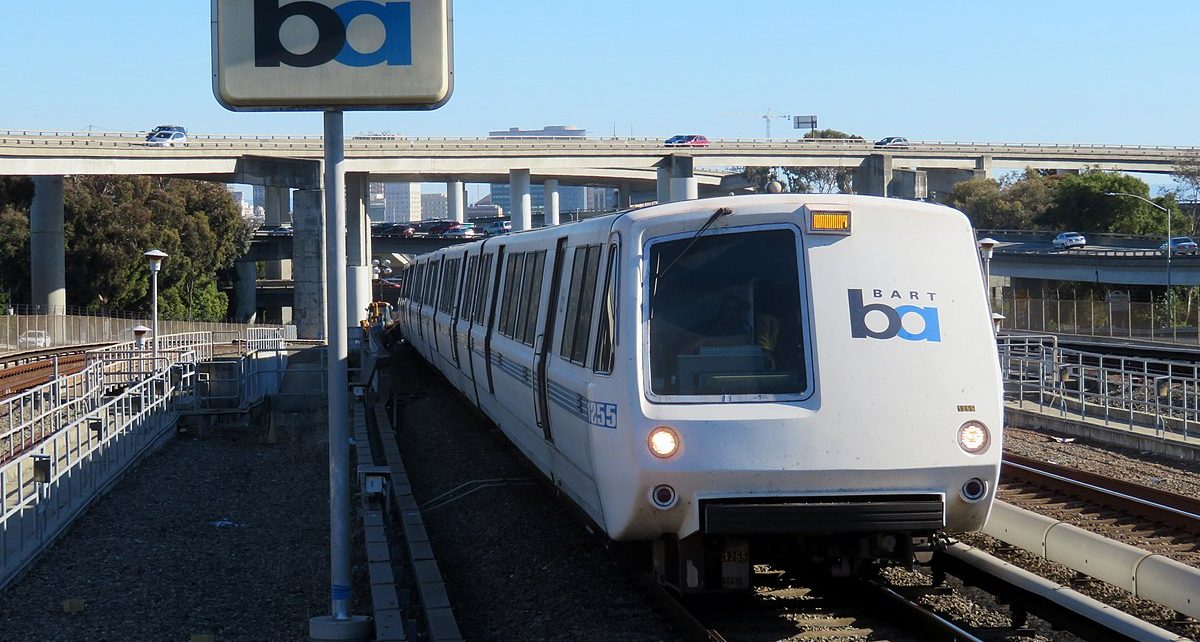
A BART train approaching MacArthur station in June. (Photo: BART)
The Transit Watchdogs Couldn’t Even Get BART’s Operating Expenses Right – What Else Did They Get Wrong?
The financial oversight system promised to Bay Area voters by Measure RTM’s architects has already failed a basic test
By Debora Allen, November 2, 2026 3:00 pm
Its first major review used the wrong financial numbers, materially understated BART’s operating expense growth and credited the agency with hundreds of millions in questionable “cost savings.” The report was then approved by the very committee appointed to oversee the work.
And this happened before a single dollar of the proposed new sales tax has been collected.
How wrong were the numbers? The consultant’s chart depicts approximately 15% growth in the Bay Area Rapid Transit’s (BART) operating expenses over five years. BART’s own financial reports, using consistent accounting definitions, show approximately 35% growth, a finding corroborated by the operating expense trends reported to the National Transit Database.
The accompanying chart compares all three sources. Although BART’s internal operating expenses and NTD figures use different accounting classifications, both show nearly identical growth rates of approximately 35%. The consultant’s figures tell a substantially different story.

That’s not a rounding error. The discrepancy dramatically changes the picture of BART’s spending record.
And this is the financial oversight process Bay Area voters have repeatedly been assured they can trust.
The Bay Area Council, SPUR, Seamless Bay Area and other Measure RTM advocates have promoted financial oversight as a cornerstone of their proposed regional transit tax, projected to raise nearly $17 billion over 14 years. They promise independent financial reviews, transparency and accountability to ensure transit agencies spend public money efficiently.
That framework comes from Senate Bill 63, authored by state Senators Scott Wiener and Jesse Arreguín. The 2025 law required the Metropolitan Transportation Commission (MTC) to arrange a two-phase Financial Efficiency Review (FER) of BART, AC Transit, Caltrain and SFMTA/Muni, and to establish an oversight committee to oversee the review and approve its reports.
MTC hired Nelson\Nygaard, a nationally recognized transit consulting firm to conduct the review in “consultation with” the transit agencies. Phase One examined actions the agencies described as cost savings between 2020 and 2025 and identified opportunities to improve efficiency, service and revenue.
The so-called independent oversight committee included board leaders from the agencies under examination, MTC leadership and MTC-appointed transit financial experts—a structure that falls far short of independent.
On May 22, the committee approved Nelson\Nygaard’s Phase One report. MTC publicized its findings, highlighting more than $1 billion in reported savings across the four agencies.
Those findings also entered the public campaign for Measure RTM. SPUR, a sponsor of the measure, published an article touting the review as central to SB 63’s accountability framework and pointing to its findings as evidence that transit operators were controlling costs. Bay Area Council CEO Libby Schaaf told the San Francisco Chronicle she had never seen that level of accountability measures before. A Yes on RTM campaign spokesperson described the review’s approval as a step toward building public confidence.
The report wasn’t gathering dust on a government shelf. It became part of the promise of Measure RTM that transit agencies were being held accountable.
Now consider what Nelson\Nygaard actually reported about BART. On page 25, the consultant said inflation-adjusted operating costs had remained stable. On page 27, its table showed BART’s operating expenses declining 7% in FY2025.
BART’s actual numbers tell another story. Operating expenses rose approximately 14% after inflation between FY2020 and FY2025. In FY2025 alone, they increased 4.5%, rather than falling 7%.
How did a major transit consultant arrive at the opposite trend?
Figure 7 of the consultant’s report supplies the explanation. For FY2020 through FY2024, Nelson\Nygaard drew from another financial analysis that included total uses of funds beyond operating expenses, including capital allocations and debt service. For FY2025, it switched to BART’s actual operating expenses as reported in its annual budget reconciliation presentation. It combined incompatible measures in one chart, then drew conclusions from the result.
This is accounting 101. Operating expenses, debt service and capital allocations are not interchangeable. Yet the discrepancy made it through the consultant’s review and the supposedly rigorous oversight process.
After I questioned Figure 7, a Nelson\Nygaard representative confirmed the two data sources. I then documented the mismatch and requested a conversation about correcting it. As of this writing, I have received no response.
Was this simply an error? Why use incompatible figures when operating expense data were available in BART’s public financial reports and the National Transit Database—sources the consultant referenced elsewhere? And why didn’t the oversight process catch it?
BART Board President Melissa Hernandez was appointed as a voting member of the oversight committee, although meeting records show she was absent from the April draft presentation and was not on the May approval roster. Committee member Lou Thompson specifically requested additional operating-cost data available from the National Transit Database.
Whether the discrepancy arose from error, inadequate verification or something else remains unanswered. So does the question of why figures that portrayed BART’s spending more favorably survived the review process.
And there’s more.
The report credited BART with $516 million in “cost savings,” combining smaller actual reductions with much larger “avoided spending” and “postponed” debt payments. Examples include $102 million for canceling a planned service expansion, $51 million for eliminating a planned increase in police staffing and $124 million attributed to temporary pandemic-era service reductions in FY2020 and FY2021 that were subsequently reversed as BART restored service. These are different kinds of financial effects, yet they are reported together as cherry-picked cost savings, without the context of BART’s overall operating expense increases.
The report also counted $40 million in eliminated pension trust contributions and $5.6 million in deferred retiree healthcare payments as cost savings. In reality, BART stopped setting aside money intended to help pay down existing employee-benefit liabilities, shifting the funding burden to future taxpayers and increasing the long-term cost.
Those obligations didn’t disappear. BART simply postponed funding them, leaving future taxpayers to shoulder the costs. Calling that financial efficiency turns the meaning of savings upside down.
And I’ve only conducted a detailed examination of BART’s portion of this report. Some findings concerning AC Transit, Caltrain and Muni also raise questions that warrant further scrutiny. If this is what a close examination of one agency revealed, what else might be uncovered in the other three?
SB 63 itself declares that financial efficiency and transparency are imperative to building public confidence in transit. But confidence is not earned by promising oversight. It is earned when the oversight catches discrepancies, demands accurate reporting and insists on answers.
If this is the level of scrutiny before Measure RTM has even passed, what assurance is there that billions in potential new tax revenues will receive more rigorous oversight?


Known as the “lightning rod of the BART board,” she championed transparency, accountability, and spending efficiency for 8 years, often called the “lone voice of common sense”.
Debora currently serves on the Contra Costa Taxpayers Association board of directors, and works in the construction industry as a business and accounting consultant.
RELATED ARTICLES
-
 October 13, 2020
-
 August 3, 2022
-
 September 11, 2024