
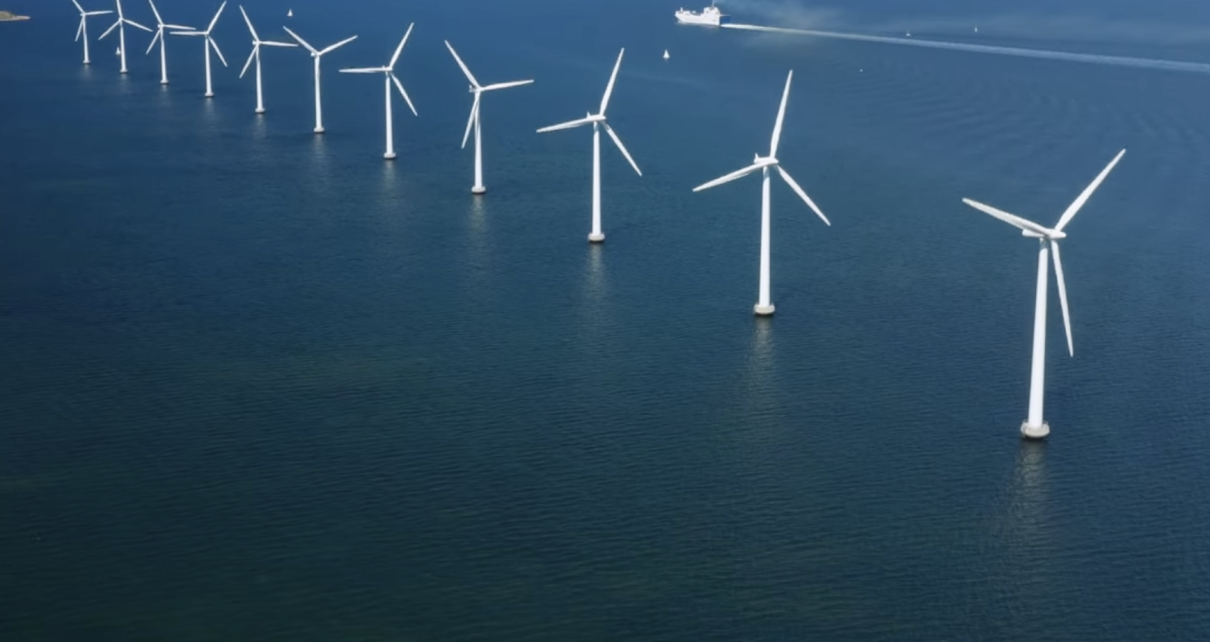
Offshore Wind farm. (Photo: Energy.ca.gov)
Ringside – Calculating the Extreme Cost of Floating Offshore Wind
Today the average residential rate for electricity in California is 72% higher than the national average
By Edward Ring, November 5, 2026 6:00 am
Floating offshore wind is an economic and environmental abomination. That the California Coastal Commission, much less the Sierra Club or Greenpeace, cannot oppose this catastrophe in waiting is incredible. Their credibility as environmental watchdogs is zero.
With political winds shifting yet again, what was stalled by the Trump administration is bound to acquire new momentum. Floating offshore wind is back, and of all the “net-zero” justified schemes to fleece California consumers, it is among the worst.
Last month the UC Santa Barbara Community Labor Center released the results of a public opinion poll wherein a majority of respondents expressed support for floating offshore wind. But here’s a question that might have yielded a different result:
“If you learned that the electricity from floating offshore wind would cost significantly more than you already pay for electricity, would you still support it?”
Today the average residential rate for electricity in California is $0.35 per kilowatt-hour (kWh), roughly 72 percent higher than the national average of $0.18/kWh. How would floating offshore wind compare?
To begin with, California’s official “Offshore Wind Energy Strategic Plan” calls for developing 25 gigawatts of capacity. But capacity is not the same as generation. For example, in 2025 California’s onshore wind turbines had a cumulative capacity of 6.3 gigawatts. If the wind was blowing 100 percent of the time and none of the turbines were offline for maintenance, they would have generated 55,451 gigawatt-hours. As it is, they generated 15,172 gigawatt-hours, meaning their yield was 27 percent.
Proponents claim that offshore wind is far more constant than onshore, greatly improving the generation from these turbines. The most common benchmark estimate for yield, or “capacity factor,” for floating offshore wind in California is 40 percent, which means a 25 gigawatt capacity would generate 87,600 gigawatt-hours per year. So what would it cost to build all this and connect it to the grid?
In 2024 the National Renewable Energy Laboratory (NREL) published the “Cost of Wind Energy Review.” In that report, on page 68, there is a table “Floating Offshore Wind CapEx Breakdown,” where they claim construction and installation costs for floating offshore wind would be $7.3 million per megawatt of capacity. It isn’t clear if that estimate takes into account turbines tethered in water 4,000 feet deep, 20 miles offshore, nor is it clear that estimate takes into account the fact that infrastructure projects generally cost more in California than in most other states. So while basic arithmetic suggests an installed cost of $183.7 billion, that is probably low.
Port upgrades are necessary to deploy and maintain floating offshore wind, and those cost estimates can be found in the California Energy Commission’s “AB525 Offshore Wind Energy Strategic Plan Volume I, Overview,” released in June 2024. In the report, on page 25, in the verbiage under Table 6-1, they estimate $12 billion in port upgrades will be necessary specifically to support construction and ongoing operations for floating offshore wind. This must be added to the total cost.
Also necessary are upgrades to transmission lines, and that estimate can be found in the July 2024 “ISO 20-Year Transmission Outlook Update,” dated July 31, 2024. On page 68, table “Table ES-1: Cost estimate of transmission development to integrate resources of 2045 Scenario,” they estimate an additional cost of $36.5 billion for “transmission line installations, upgrades, substations, and grid interconnections for 25 GW.”
Altogether this totals to a construction cost of $232.2 billion. And while this money won’t be spent all at once, that does not mean the per gigawatt-hour price will go down. Doing the job incrementally may save billions in any given year, but it won’t lower the unit price for the energy that is generated. If anything, a slow build will raise unit prices.
So now let’s work up a price per kilowatt-hour, starting with the financing cost.
A construction bond for a large-scale infrastructure project today carries an interest rate of around 4.5 percent, and a term of 25 years. We might extend the term, but doing that would require an assumption that these turbines are going to have an operating life in excess of 25 years. That is unlikely. As it is, the payment on $232.2 billion at 4.5 percent and 25 years is $15.7 billion per year. Divide that by 87,600 gigawatt-hours (87.6 billion kWh) and you get $0.18 per kilowatt-hour. That is just to pay the construction bond.
When it comes to the price of electricity in California, the financing cost is only the beginning. We have to add costs to operate and maintain these wind turbines. At the planned scale of 12 megawatts capacity per turbine, you are looking at maintenance for over 2,000 floating turbines, each of them approximately 800 feet tall, in water nearly a mile deep, with substations and high voltage lines that have to connect them to the onshore grid 20 miles distant. There isn’t a lot of data on how much that will cost, but according to NREL, it will add 3.1¢ per kilowatt-hour.
Data from PG&E, California’s largest electricity utility, documents that the supply of electricity onto the grid only represents about one-third of the retail cost. Extrapolating from a January 2026 PG&E report “Bundled residential electric average rate breakout,” we can add the following charges per kilowatt-hour:
3.6¢, existing long-distance transmission,
8.6¢, last mile distribution,
5.3¢, wildfire related charges,
2.4¢, public purpose programs,
1.5¢, other (service, metering, billing, etc.),
2.5¢, taxes and insurance,
Total additional costs, $0.239 per kilowatt-hour.
None of these additional costs are going to go away simply because the source of the electricity is floating offshore wind. The energy supply portion of PG&E’s rate for electricity prior to these additional costs is around $0.11/kWh. While that price includes storage assets to buffer the intermittency of existing renewables, it doesn’t account for the expansion required to accommodate another 25 gigawatts of intermittent power.
Just the financing costs to build floating offshore wind will be $0.18/kWh, plus another $0.031/kWh for operations and maintenance.
This means the retail price for floating offshore wind generated electricity, very best case, will be $0.45 per kilowatt-hour.
The calculations here are based on data from official sources and represent the most credible information available on what floating offshore wind electricity is going to cost. These estimates understate the true cost, since they don’t take into account likely cost overruns and investment in additional battery storage. Also, if anything, they overestimate the probable service life of these systems.
Despite polling allegedly in its favor, floating offshore wind does not make economic sense.


- Ringside – Calculating the Extreme Cost of Floating Offshore Wind - November 5, 2026
- Ringside: Practical Steps to Climate Resilience - October 28, 2026
- Ringside: Save Our Lawns, Reform AB 1572 - October 21, 2026
RELATED ARTICLES
-
-
March 28, 2024
-
August 15, 2024