
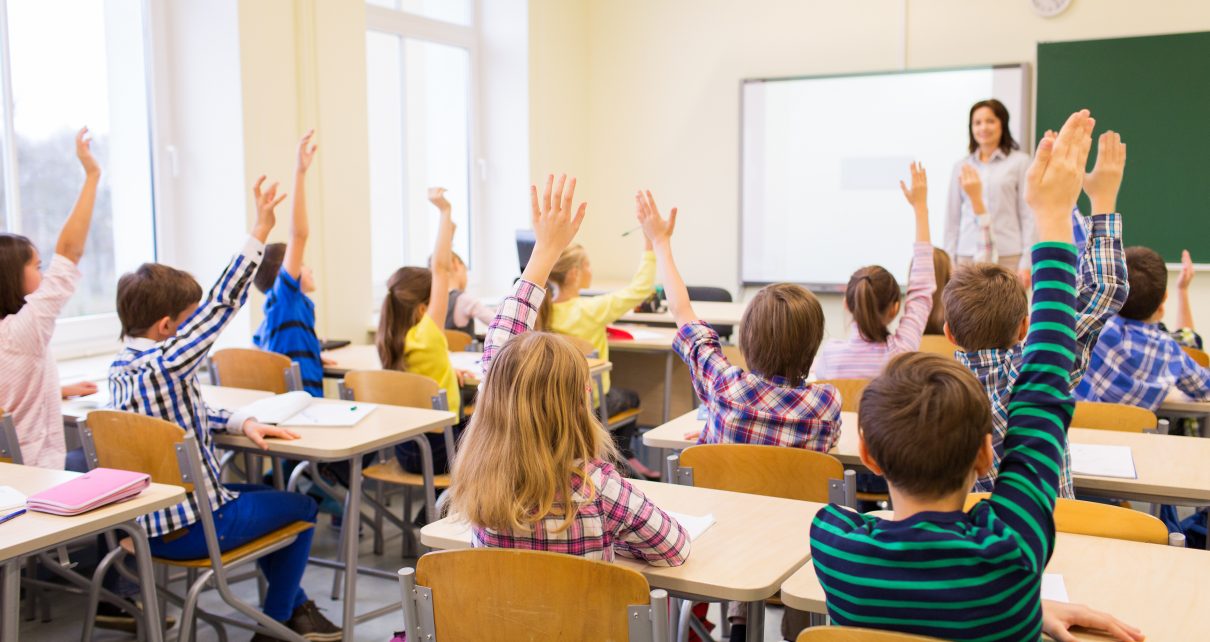
Kids in a classroom. (Photo: Shutterstock/Syda Productions)
Stop Grading the Children and Start Grading the System
Taxpayers are entitled to ask what their money is accomplishing
By Maureen Steele, November 12, 2026 7:00 am
If a school system can keep a child for thirteen years and send that child into adulthood unable to read confidently, manage money, or recognize a dishonest argument, the adults running it should have considerably more explaining to do than the child.
Instead, the child gets the permanent record.
The institution gets another strategic plan.
I am 56 years old, and someone trying to teach me algebra can still make me cry. High school math damaged my GPA and my confidence. I went on to build a life around writing, research, and ideas, but the feeling of being inadequate outlasted the equations.
Schools are remarkably efficient at telling children where they fall short. I would like to see that scrutiny applied upward.
Start with the federal government’s own 2024 Nation’s Report Card: 40 percent of fourth graders scored below NAEP (National Assessment of Educational Progress) Basic in reading. Reading scores declined in both fourth and eighth grade compared with 2022.
That does not mean 40 percent cannot read a word. It means an alarming share fell below the assessment’s basic achievement benchmark. The actual finding is damning enough without embellishment.
Meanwhile, Census Bureau figures put public-school current spending at $17,619 per pupil in fiscal 2024, up 6.6 percent from the previous year in dollars unadjusted for inflation. Total expenditures reached $983.7 billion.
Those figures do not prove money cannot help. They establish that taxpayers are entitled to ask what their money is accomplishing.
The U.S. Department of Education belongs in that examination. So do state education departments, legislatures, school boards, and district administrators. The federal department does not set local curricula or graduation requirements. States and districts cannot hide behind Washington, and Washington should have to defend the effectiveness of the programs it funds.
Responsibility distributed across several levels of government should not become responsibility accepted by none.
Families, meanwhile, are making other arrangements.
National public-school enrollment fell from approximately 50.80 million in fall 2019 to 49.39 million in fall 2024: about 1.41 million fewer students, a 2.8 percent decline.
That is a net enrollment change, not a headcount of angry parents withdrawing children. Smaller child populations, migration, and other factors also affect those totals. But the growth of alternatives deserves attention on its own.
According to federal survey findings, 5.2 percent of children ages five through seventeen with a K–12 grade equivalent received instruction at home in 2022–23, through homeschooling or full-time virtual education, compared with 3.7 percent in 2018–19.
The 2022–23 figures included 3.4 percent homeschooled and 2.5 percent in full-time virtual education. Those categories overlap. Some online students remain enrolled in public schools. We should not count every laptop at a kitchen table as a departure from public education.
But consider this: 83 percent of homeschooling parents cited concern about the environment of other schools as a reason for homeschooling.
That is a statement the education establishment ought to sit with.
More recent Johns Hopkins research found homeschooling increased in seventeen of twenty-two states reporting 2025–26 data. Growth across those states slowed to 1.5 percent, but participation continued rising overall. The researchers note that these counts can include cooperatives, microschools, and hybrid arrangements legally classified as homeschooling.
Parents are finding ways to organize education differently.
Why should redesign require leaving?
Keep daily reading, writing, and frequent mathematics practice. Then allow sustained work: a science morning, a history investigation, a workshop building something that actually functions. Stop assuming that touching seven subjects in a day is inherently better than understanding three.
By middle school, give students substantial opportunities to develop strengths. Mechanics. Music. Writing. Agriculture. Engineering. Art. Teach practical competence alongside academic knowledge, with routes into advanced study and freedom to change direction.
A child struggling with an essay still deserves writing instruction. That child also deserves an opportunity to demonstrate intelligence somewhere beyond the struggle.
And teach children to question claims, including the teacher’s. Require evidence. Reward sound reasoning. Make intellectual independence a visible educational goal.
Would redesign be effortless? No. Would it automatically cost less? We would have to demonstrate that. Shorter lessons do not eliminate transportation, disability services, meals, or families’ need for supervision.
But we can test different schedules and approaches, publish the results and costs, and expand what works. Bureaucratic inconvenience is a poor reason to refuse.
People look at persistent failure and suspect the system wants a population that cannot think. I cannot establish that intention. I can demand an answer about the outcome.
A system does not need a secret plan to do lasting harm. Continuing a failing practice after the damage becomes visible is enough to warrant accountability.
Children should not have to surrender their confidence while adults defend the schedule: Put the institutions on the report card. And this time, make them answer for the grade.


- Stop Grading the Children and Start Grading the System - November 12, 2026
- The Man Who Hasn’t Paid Federal Income Tax Since 1993 - October 14, 2026
- The Paradox of Protecting Children - September 24, 2026
RELATED ARTICLES
-
 April 9, 2019
-
 January 17, 2022
-