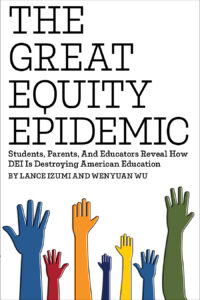
The Great Equity Epidemic
What if the policies promising ‘equity’ in America’s schools are actually hurting the very students they claim to help?
By Katy Grimes, November 20, 2026 6:30 am
The Great Equity Epidemic by chronicles resolute Americans challenging controversial DEI and “Equity” policies in K-12 and higher education.
California’s high school graduates can’t read at grade level, and many can’t even read at middle school level. A quarter of California’s students can’t even do basic math. Yet they are “graduating” with high GPAs unheard of in previous years – perhaps to compensate?
This book collects first-hand accounts of students, parents, teachers, school-board members, and professors who pushed back against what the authors describe as “equity” policies in K-12 and higher education. These policies, in the authors’ view, prioritize equal outcomes over equal opportunity, leading to lowered academic standards, reduced recognition for high achievers, weakened discipline, race-based treatment of students, and the injection of political ideology into classrooms, according to Pacific Research Institute.
The Great Equity Epidemic however, is not just another book about what has gone wrong in public education – it’s about real people who fought back-and won.
In a National Review op-ed, Izumi, the Senior Director of PRI’s Center for Education, explains in more detail:
Diversity, equity, and inclusion (DEI) policies, have become embedded in American education despite President Trump’s efforts to eliminate them and some schools’ attempts to rebrand them. A 2025 investigation found that nearly 24,000 schools in 46 states and the District of Columbia were implementing DEI through policies, strategic plans, or practices, affecting more than 14.6 million students.
Equity in education has come to mean something very different from equal opportunity. Rather than giving every student the same opportunity to succeed based on merit and hard work, equity increasingly focuses on producing equal outcomes, even when doing so means changing grading, discipline, curriculum, and academic expectations.
Izumi and Wu examine:
Grading-for-equity practices and declining academic rigor.
Reduced opportunities and recognition for high-achieving students.
DEI-driven classroom instruction and ideological content.
Politicized school discipline and safety policies.
Threats to academic freedom for teachers and professors.
Featured stories include:
- A mother who challenged bullying of her son after he objected to DEI instruction.
- A father (descended from a Black Civil War soldier) who opposed his district’s equity programs.
- A school-board member who faced intense opposition, built a coalition, and helped overturn her district’s equity policies.
- A college professor who spoke out against institutional equity policies, lost his job, and took the fight to court.
“Consider equity-based grading, which can include giving students partial credit for work they never submit, eliminating penalties for late assignments, allowing repeated test retakes, and eliminating D’s and F’s from the grading scale,” Izumi writes. He tells the story of “Josh”, a high school student at a supposedly “good” school who reported that he had a science class where they had unlimited test retakes “due to equity.” Josh had a math class with equity grading. He had a history class where you could redo any paper for full credit.
“’Across the board,’ Josh said, ‘most of the classes have unlimited late work acceptance because it’s seen as unfair to hold students accountable to deadlines because, suppose, a student is from a low-income family and they have a hard time getting home, they shouldn’t have to do any work.’”
Izumi stresses that equality means equal opportunity for individuals to excel based on talent, effort, and merit, while allowing for different outcomes. Equity, in the policies he describes, means engineered equal outcomes regardless of effort or ability. Izumi says this framing lets advocates “dumb down” education, indoctrinate, and politicize classrooms while sounding neutral or fair.
“Grades and diplomas should tell a student and his family that the student can read, write, and do the math expected of them as they advance from one grade level to another and when they graduate from high school,” Izumi says. “If a district wants more students to get higher grades and obtain their diplomas, it should help students do the real work necessary to earn them.”
Izumi asks: “Here is the question for schools: Are your grading systems, curriculum, staff training, and other programs helping students master reading, writing, math, and the other knowledge they will need later in life? Or are they primarily improving the district’s statistics, changing demographic outcomes, and promoting a particular ideology?”
Read The Great Equity Epidemic: Students, Parents, and Educators Reveal How DEI Is Destroying American Education, published by the Pacific Research Institute, 2026), at Pacific Research.


A California native and Navy mom, Katy lives in Sacramento, CA.
- Federal Judge Blocks California’s Entire ‘No Secret Police Act’ in Major Win for Trump DOJ - November 20, 2026
- The Great Equity Epidemic - November 20, 2026
- Fairfield Votes to Give Chinese Company 10% of Water Supply for Planned $200 Million Beverage Plant at Former Budweiser Site - November 19, 2026
RELATED ARTICLES
-
 July 14, 2022
-
 August 21, 2022
-