
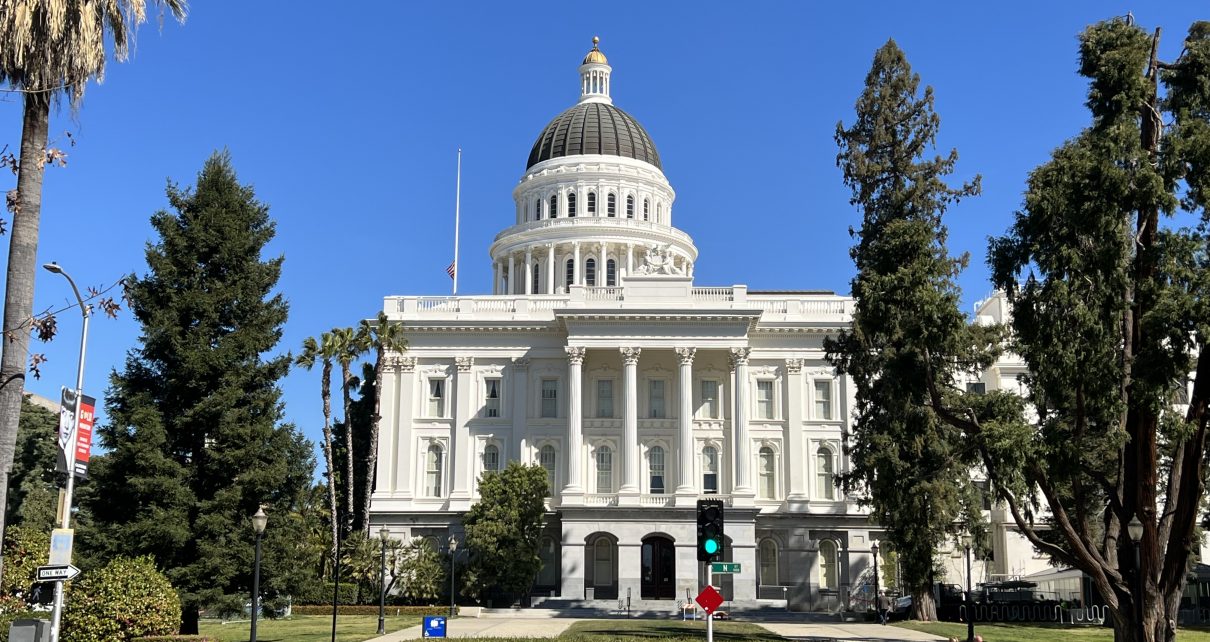
California State Capitol. (Photo: Kevin Sanders for California Globe).
Adoption of Unmarried Minors
Tribal customary adoption, and as applied to Indian Children who are dependents of the court, does not apply to this part
By Chris Micheli, December 28, 2025 3:51 pm
Division 13, Part 2, Chapter 1 contains general provisions related to the adoption of unmarried minors in this state. Section 8600 allows an unmarried minor to be adopted by an adult as provided in this part.
Section 8600.5 states that tribal customary adoption, and as applied to Indian Children who are dependents of the court, does not apply to this part.
Section 8601 requires a prospective adoptive parent or parents to be at least 10 years older than the child. If the court is satisfied that the adoption of a child by a stepparent, or by a sister, brother, aunt, uncle, or first cousin and, if that person is married, by that person and that person’s spouse, is in the best interest of the parties and is in the public interest, it may approve the adoption without regard to the ages of the child and the prospective adoptive parent or parents.
Section 8601.5 authorizes a court to issue an order of adoption and declare that it is to be entered nunc pro tunc when it will serve public policy and the best interests of the child, such as cases where adoption finalization has been delayed beyond the child’s 18th birthday due to factors beyond the control of the prospective adoptive family and the proposed adoptee.
The request for nunc pro tunc entry of the order must be stated in the adoption request or an amendment thereto, and set forth specific facts in support. The nunc pro tunc date must not precede the date upon which the parental rights of the birth parent or parents were initially terminated, whether voluntarily or involuntarily.
Section 8602 requires the consent of a child, if over the age of 12 years, for the child’s adoption.
Section 8603 provides that a married person, not lawfully separated from the person’s spouse, cannot adopt a child without the consent of the spouse, provided that the spouse is capable of giving that consent. The court may dispense with the consent of a spouse who cannot be located after diligent search, or a spouse determined by the court to lack the capacity to consent.
Section 8604 specifies that a child having a presumed father cannot be adopted without the consent of the child’s birth parents, if living. The consent of a presumed father is not required for the child’s adoption unless the person became a presumed father before the mother’s relinquishment or consent becomes irrevocable or before the mother’s parental rights have been terminated.
If one birth parent has been awarded custody by judicial order, or has custody by agreement of both parents, and the other birth parent for a period of one year willfully fails to communicate with, and to pay for, the care, support, and education of the child when able to do so, then the birth parent having sole custody may consent to the adoption, but only after the birth parent not having custody has been served with a copy of a citation in the manner provided by law for the service of a summons in a civil action that requires the birth parent not having custody to appear at the time and place set for the appearance in court.
A temporary custody order issued pursuant to this subdivision is required to include all three of the specified items. A temporary custody order issued may be voided upon the birth mother’s request to have the child returned to the birth mother’s care and custody.
Section 8605 requires, if a child not having a presumed father, that the child’s mother, if living, must consent before adoption.
Section 8606 specifies that the consent of a birth parent is not necessary in five specified cases.
Section 8606.5 provides that consent to adoption given by an Indian child’s parent is not valid unless both of the specified actions occur. The parent of an Indian child may withdraw consent to adoption for any reason at any time prior to the entry of a final decree of adoption and the child shall be returned to the parent.
Section 8607 provides that all forms adopted by the department authorizing the release of an infant from a health facility to the custody of persons other than the person entitled to custody of the child and authorizing these other persons to obtain medical care for the infant is required to contain a statement in boldface type delineating the various types of adoptions available, the birth parents’ rights in regard to revocation of consent to adoption, and a statement regarding the authority of the court to declare the child abandoned by the birth parent or parents.
Section 8609 specifies that any person or organization that advertises in any periodical or newspaper, by radio, or other public medium, that the person or organization will place children for adoption, or accept, supply, provide, or obtain children for adoption, or that causes any advertisement to be published in or by any public medium soliciting, requesting, or asking for any child or children for adoption, is guilty of a misdemeanor, unless one of the two specified conditions apply.
In addition, any person, organization, association, or corporation that seeks to place any child for adoption is guilty of a misdemeanor, unless one of the three specified conditions applies. Any person or organization that performs any of the functions of an adoption agency or holds itself out as performing any of the functions of an adoption agency is deemed an unlicensed adoption agency.
Section 8609.5 states that an adoption request for the adoption or readoption of a nondependent minor may be filed with the court in the county in which one of the seven specified circumstances applies.
Section 8610 requires the petitioners in a proceeding for adoption of a child to file with the court a full accounting report of all disbursements of anything of value made or agreed to be made by them or on their behalf in connection with the birth of the child, the placement of the child with the petitioners, any medical or hospital care received by the child’s birth mother or by the child in connection with the child’s birth, any other expenses of either birth parent, or the adoption.
Section 8611 requires all court hearings in an adoption proceeding to be held in private, and the court is required to exclude all persons except the officers of the court, the parties, their witnesses, counsel, and representatives of the agencies present to perform their official duties under the law governing adoptions.
Section 8612 requires the court to examine all persons appearing before it pursuant to this part. The examination of each person shall be conducted separately but within the physical presence of every other person unless the court, in its discretion, orders otherwise.
Section 8613 specifies that, if the prospective adoptive parent is commissioned or enlisted in the military service, or in the American Red Cross, or in any other recognized charitable or religious organization, so that it is impossible or impracticable, because of the prospective adoptive parent’s absence from this state to make an appearance in person, and the circumstances are established by satisfactory evidence, the appearance may be made for the prospective adoptive parent by counsel, commissioned and empowered in writing for that purpose. The power of attorney may be incorporated in the adoption petition.
Section 8613.5 provides that, if it is impossible or impracticable for either prospective adoptive parent to make an appearance in person, and the circumstances are established by clear and convincing documentary evidence, the court may take either of two specified actions.
Section 8613.7 requires the court to provide to any petitioner for adoption pursuant to this part a notice informing the petitioner that they may be eligible for reduced-cost coverage through the California Health Benefit Exchange.
Section 8614 allows a superior court clerk, upon the request of the adoptive parents or the adopted child, to may issue a certificate of adoption that states the date and place of adoption, the birthday of the child, the names of the adoptive parents, and the name the child has taken.
Section 8615 allows an action to be brought in the county in which the petitioner resides for the purpose of obtaining for a child adopted by the petitioner a new birth certificate specifying that a deceased spouse of the petitioner who was in the home at the time of the initial placement of the child is a parent of the child.
Section 8616 requires, after adoption, the adopted child and the adoptive parents to sustain towards each other the legal relationship of parent and child and have all the rights and are subject to all the duties of that relationship.
Section 8616.5 contains legislative findings and declarations regarding adoptive children and contacts. The terms of a postadoption contact agreement executed under this section must be limited to three specified items. Also, the terms of a postadoption contact agreement with birth relatives, including siblings, other than the child’s birth parent or parents must be limited to the sharing of information about the child, unless the child has a preexisting relationship with the birth relative.
A postadoption contact agreement is required to contain three specified warnings in bold type. A postadoption contact agreement may be modified or terminated only if either of the two specified actions occur, including the court making three main findings.
The court is prohibited from setting aside a decree of adoption, rescinding a relinquishment, or modifying an order to terminate parental rights or any other prior court order because of the failure of a birth parent, adoptive parent, birth relative, including a sibling, an Indian tribe, or the child to comply with any of the original terms of, or subsequent modifications to, the postadoption contact agreement, except in two specified circumstances. The term “sibling” is defined.
Section 8617 specifies that the existing parent or parents of an adopted child are, from the time of the adoption, relieved of all parental duties towards, and all responsibility for, the adopted child, and have no right over the child.
Section 8618 provides that a child adopted pursuant to this part may take the family name of the adoptive parent.
Section 8619 requires the department to adopt rules and regulations it determines are reasonably necessary to ensure that the birth parent or parents of Indian ancestry, seeking to relinquish a child for adoption, provide sufficient information to the department, county adoption agency, or licensed adoption agency so that a certificate of degree of Indian blood can be obtained from the Bureau of Indian Affairs.
The department is required to immediately request a certificate of degree of Indian blood from the Bureau of Indian Affairs upon obtaining the information. A copy of all documents pertaining to the degree of Indian blood and tribal enrollment, including a copy of the certificate of degree of Indian blood, become a permanent record in the adoption files and be housed in a central location and made available to authorized personnel from the Bureau of Indian Affairs when required to determine the adopted person’s eligibility to receive services or benefits because of the adopted person’s status as an Indian.
Section 8619.5 specifies that whenever a final decree of adoption of an Indian child has been vacated or set aside or the adoptive parent voluntary consents to termination of parental rights to the child, a biological parent or prior Indian custodian may petition for return of custody and the court must grant that petition unless there is a showing that the return of custody is not in the best interest of the child.
Section 8620 states that, if a parent is seeking to relinquish a child or execute an adoption placement agreement, the department, county adoption agency, licensed adoption agency, or adoption service provider, as applicable, is required to ask the child and the child’s parent or custodian whether the child is, or may be, a member of, or eligible for membership in an Indian tribe or whether the child has been identified as a member of an Indian organization.
If there is any oral or written information that indicates that the child is, or may be, an Indian child, the department, county adoption agency, licensed adoption agency, or adoption service provider, as applicable, is required to obtain five specified items of information.
The department, county adoption agency, licensed adoption agency, attorney for the prospective adoptive parents, or adoption service provider is required to send a notice, which includes information obtained and a request for confirmation of the child’s Indian status, to any parent and any custodian of the child, and to any Indian tribe of which the child is, or may be, a member or eligible for membership.
The notice sent has to describe the nature of the proceeding and advise the recipient of the Indian tribe’s right to intervene in the proceeding on its own behalf or on behalf of a tribal member relative of the child. The department was required to adopt regulations to ensure that if a child who is being voluntarily relinquished for adoption is an Indian child, the parent of the child is to be advised of the right to withdraw consent and thereby rescind the relinquishment of an Indian child for any reason at any time prior to entry of a final decree of termination of parental rights or adoption.
In addition, there is a legislative finding and declaration that some adoptive children may benefit from either direct or indirect contact with an Indian tribe. With respect to giving notice to Indian tribes in the case of voluntary placements of Indian children pursuant to this section, a person, other than a birth parent of the child, is subject to a civil penalty if that person knowingly and willfully engages in any of four specifies activities.
Section 8621 required the department to adopt regulations regarding the provision of adoption services by the department, county adoption agencies, licensed adoption agencies, and other adoption service providers authorized pursuant to this division and monitor the provision of those services by county adoption agencies, licensed adoption agencies, and other adoption service providers as provided by law.
Section 8622 requires a licensed private adoption agency whose services are limited to a particular target population to inform all birth parents and prospective adoptive parents of its service limitations before commencing any services, signing any documents or agreements, or accepting any fees.
Section 8623 prohibits all adoption facilitators registered with the department on its statewide registry to continue their operation in this state after December 31, 2023.
Section 8624 states that a person aggrieved may bring a civil action for damages, rescission, injunctive relief, or any other civil or equitable remedy. Operation of an unlicensed adoption agency is an act of unfair competition and an unfair business practice.
In a civil action under this section, a prevailing party may recover reasonable attorney’s fees and costs. The Attorney General, a district attorney, or a city attorney may bring a civil action for injunctive relief, restitution, or other equitable relief against an unlicensed adoption agency. Any other interested person who, based upon information or belief, may bring a civil action for injunctive relief on behalf of the general public. This section authorizes a referral by the department to the appropriate law enforcement entities consistent with these provisions.
Section 8625 requires the department to create a section on its internet website dedicated to educating the public on unlicensed adoption agencies. The section has to include both of the two specified provisions.
In addition, the department must individually notify each adoption facilitator on the registry that operations must cease. The notice also requires each adoption facilitator to comply with both of the specified requirements.


- Objections to Taking in Eminent Domain - March 6, 2026
- Arbitration Overview in California - March 6, 2026
- General Provisions on Dismissals for Delay - March 5, 2026
RELATED ARTICLES
-
 November 30, 2025
 -
 December 10, 2025
 -
 July 31, 2025