
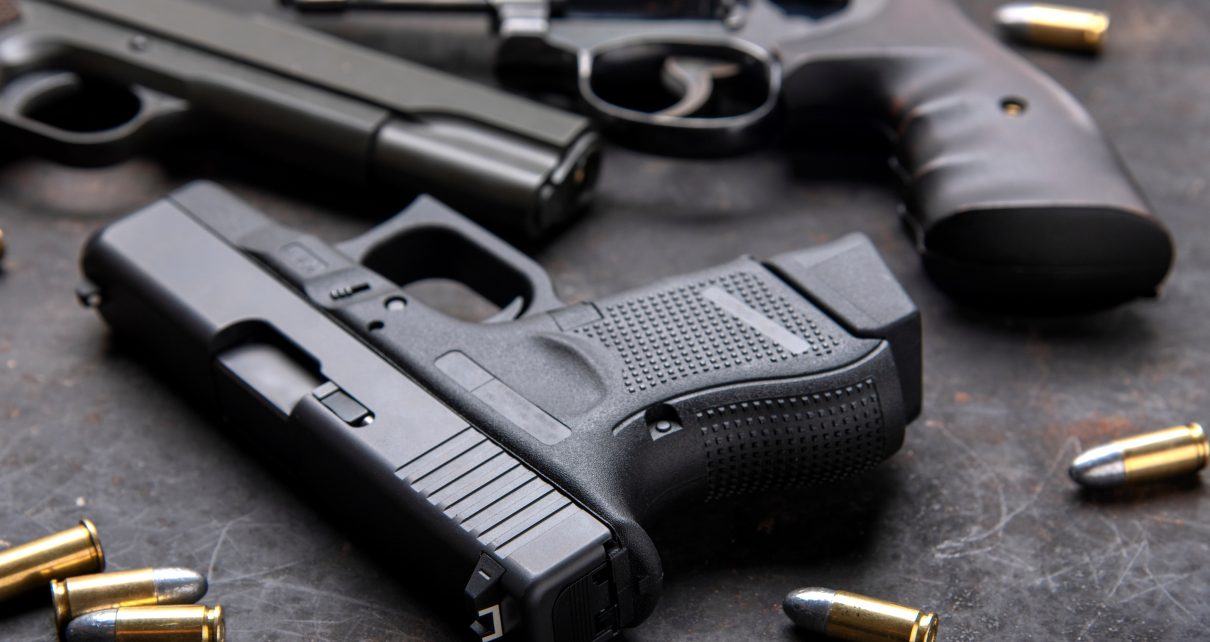
Guns and ammo. (Photo: Kiattipong/ShutterStock)
Big Brother Behind the Counter: The Ninth Circuit Blesses California’s Gun-Store Listening Law
People who know they are being recorded speak less, hedge more, and change the subject
By J. Mitchell Sances, September 30, 2026 7:35 pm
There is a particular genius to California’s method of governing those pesky conservative citizens. It rarely announces the real objective. It wraps the intent in “safety,” drafts a statute thick enough to look technical, and then waits for a friendly court to declare that nothing of constitutional importance has happened. That is the story of Richards v. Newsom, the August 27, 2026, Ninth Circuit decision that left standing California Penal Code section 26806: the law that forces every federally licensed firearms dealer in the state to run 24-hour video and audio surveillance of the premises, store the recordings for at least a year, and post a sign warning customers that their images and conversations “MAY BE RECORDED.”
The panel split 2-1. Judges Lucy Koh and Ana de Alba, both Biden appointees, found no First, Fourth, or Fifth Amendment problem. Judge Kenneth K. Lee dissented, and he was right to do so. The majority treated a mandatory, year-long archive of private conversation as if it were a fire extinguisher on the wall. It is not. It is a listening post aimed at the one commercial space in California where law-abiding conservatives still gather in numbers to talk about the Second Amendment, legislation, and the civic work of remaining free in a state that would rather they did not.
The law in question was enacted by Senate Bill 1384 and took effect January 1, 2024. This is not a modest security-camera rule. Dealers must record interior views of every entry and exit, every area where firearms are displayed, and every point of sale “sufficient to identify the parties involved in the transaction.” Interior systems must capture audio. The cameras run continuously, at least fifteen frames per second, every hour of every day. The files must be kept a year. Customers must walk past a mandated warning: “THESE PREMISES ARE UNDER VIDEO AND AUDIO SURVEILLANCE. YOUR IMAGE AND CONVERSATIONS MAY BE RECORDED.”
The state claims the law is to curb straw purchases and dealer theft. Video of who walked in, who stood at the counter, and who left with a box can serve that purpose. Audio of every word spoken at the counter for twelve months cannot. Judge Lee said so with the clarity the two progressive judges refused: “There is no rational reason to audiotape every single conversation between a firearms dealer and a potential customer. Audio-recording of conversations at a gun store will not help law enforcement nab a thief.” He continued: “video-recording may help identify criminal suspects—but audio-recording almost certainly does not.”
If the point were inventory and identification, Sacramento would have stopped at video, as other regulated businesses often do. It did not. It wanted the conversations. However, people do not speak freely into a state microphone. The First Amendment is not a seminar abstraction. It is the practical liberty to say what one thinks without calculating whether a year from now some official will replay the tape. People who know they are being recorded speak less, hedge more, and change the subject. That is not speculation. It is how human beings behave. Judge Lee put the constitutional point directly: “California’s surveillance law, however, will likely impede the exchange of this core First Amendment speech because people are wary of speaking freely if they know that they are being audiotaped, especially if the government may potentially listen to these conversations up to a year later. The First Amendment shrivels under the constant surveillance of even a benevolent Big Brother.” And again: “The knowledge that every word uttered will be captured—and saved for at least a year at the government’s behest—will almost certainly inhibit political discussion.”
Gun stores are not appliance showrooms. In California they function, as the plaintiffs alleged and the dissent accepted, as one of the last indoor public squares left to people who still believe the right to keep and bear arms is a right and not a privilege Sacramento doles out. They are where people compare notes on pending bills, training, ranges, civic groups, and the next election. They are where conservative Californians, already treated as a suspect class by the Capitol, plan the ordinary work of association. Recording that room for a year does not merely “monitor a closely regulated industry.” It changes what can be said in it. That is the chilling effect in plain English. The majority waved it away as “subjective fear.” Ordinary people do not need a footnote from Laird v. Tatum to know that a sign announcing the state may keep their words for a year is not an invitation to candor.
The tape access rules written into the law are the second half of the insult. The statute tells dealers they “shall allow access to the system” to an agent conducting an inspection “for the purpose of inspecting the system for compliance with this section, and only if a warrant or court order would not generally be required for that access.” The majority treated this as a tidy, warrant-friendly scheme: the recordings themselves, it said, are not simply handed over on demand. Judge Lee read the same text and saw the obvious loophole. If an agent may inspect the system without a warrant, what stops that agent from sitting down and listening to hours of stored conversation “under the guise of making sure the videorecording system works”? Nothing in the statute, he argued, supplies a real limit.
For home-based dealers the problem is worse. Lee warned that “a government agent without a warrant can enter a home-based FFL’s house unannounced at any time or any day—whether it be at 11:00 p.m. on a Tuesday or on Christmas morning—to ensure compliance with the recording requirement.” That is a Fourth Amendment argument, not a policy preference. Warrantless, unbounded inspection authority over a home that also happens to be a licensed business is not a “reasonable” administrative peek. It is the state walking in because it can.
Then there is the question Sacramento never answers honestly. If the purpose is community safety and the investigation of gun crime, why is the same political class so reluctant to prosecute the gun crimes it already has on the books? California has spent a decade recasting theft, drug possession, and a long list of “nonviolent” offenses as management problems rather than crimes. Progressive district attorneys have treated sentencing enhancements, including firearm enhancements, as optional ideology rather than law. Straw purchasing and dealer theft are real. So is the everyday illegal carrying and use of guns by people who will never set foot in a licensed shop. The state that will not reliably punish the latter now demands a year of audio from the former. That mismatch is the tell. A government serious about straw purchases would prosecute straw purchasers. A government serious about stolen guns would treat fences and thieves as priorities instead of writing press releases about “commonsense safety measures.” Attorney General Rob Bonta celebrated the Ninth Circuit ruling as confirmation that California may take “action to make our communities safer.” The safer community he has in mind is apparently one in which the law-abiding customer at the counter watches his words.
Judge Lee’s summary of the statute’s reach is the sentence that should have ended the case: “California’s surveillance law is unprecedented in its sweeping and shocking scope. Neither the federal government nor the other 49 states have ever enacted such an intrusive audio-recording requirement for any business activity.” Video of a till is ordinary. Compelled audio of political talk among citizens exercising a constitutional right, stored on command of a hostile state government, is downright Orwellian. The Ninth Circuit majority could not see a search when the cameras rolled, could not see speech when the microphones ran, and could not see a problem in telling Californians to discuss their rights under a posted warning. That is not judicial modesty. It is judicial permission. The point of the law was never only to catch a thief on tape. It was to make the gun store a worse place to talk. On that measure, Sacramento got what it wanted. The Constitution, for the moment, did not.

- Netflix’s ‘14th’ Filmmakers Urge Americans to ‘Fight’ While Lecturing on Autocracy - October 19, 2026
- Private Initiative Steps Up While Sacramento and City Hall Stall: Caruso, Skydance, and the Bay Theater’s Return to the Palisades - October 15, 2026
- Newsom’s Latest Medical Laws: California Defies Other States and Medical Realities - October 13, 2026
RELATED ARTICLES
-
 January 3, 2026
 -
 December 13, 2019
 -

This is a CA attempt to undermine the 2nd amendment period!