
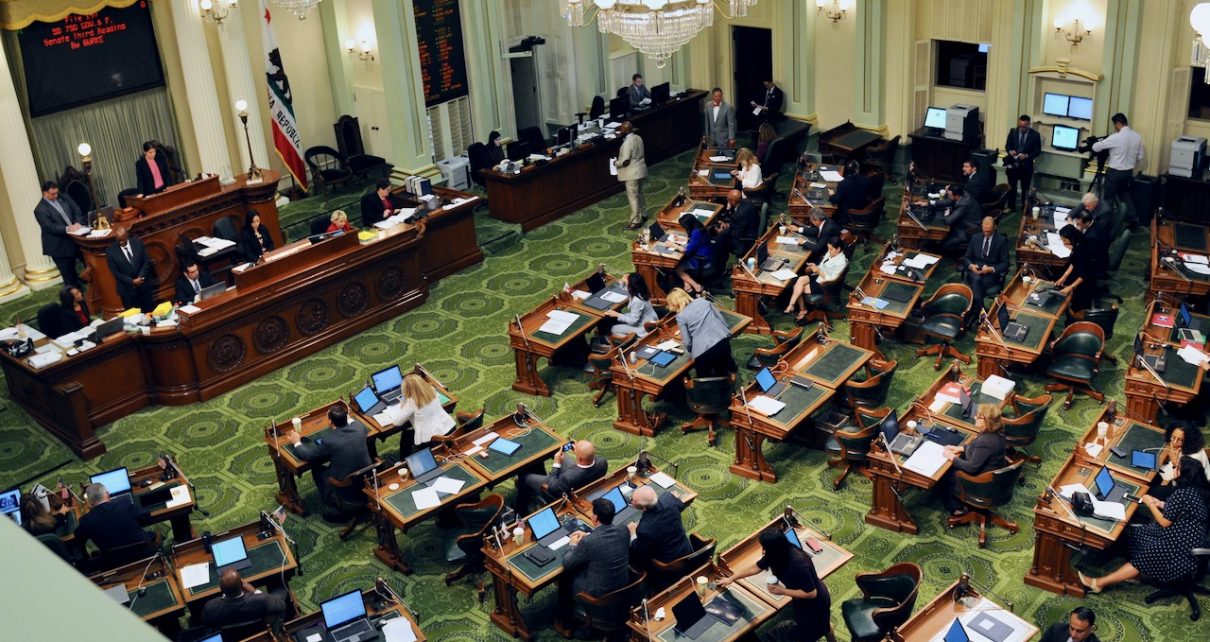
California State Assembly Chamber. (Photo: Kevin Sanders for California Globe)
Exploring Gut-and-Amend Bills in the California Legislature
Lawmakers take a bill that has already cleared key deadlines, strip out its entire original text, and replace it with completely new, often unrelated policy language
By Chris Micheli, November 18, 2026 2:28 am
A “gut-and-amend” maneuver is a legislative procedure where, in its most controversial form, lawmakers take a bill that has already cleared key deadlines or passed its house of origin, strip out (“gut”) its entire original text, and replace (“amend”) it with completely new, often unrelated policy language.
While variations exist across state legislatures (most prominently in California), the practice operates within a strict framework of procedural rules, constitutional limits, and chamber-specific enforcement standards.
Late-session gut-and-amend maneuvers are engineered specifically to bypass standard legislative bottlenecks, such as bill introduction cutoffs and policy committee hearing deadlines. Under the Joint Rules, several rules govern how these bills move:
Bypassing Deadlines (Joint Rule 61). The Legislature sets strict calendars for introducing bills, passing policy committees, and clearing fiscal committees. By taking an active “vehicle,” lawmakers bypass the initial introduction deadline and avoid early committee hurdles in the house of origin.
Fiscal Re-referral (Joint Rule 10.5). If a gutted-and-amended bill newly appropriates money, causes a substantial state expenditure, or impacts state revenue, Legislative Counsel flags it as a fiscal bill. Under Joint Rule 10.5, the measure must be re-referred to the Appropriations (fiscal) Committee unless the house suspends the rule via Rules Committee approval and a two-thirds floor vote.
Re-introduction Bans (Joint Rule 54(c)). Legislators generally cannot re-introduce a bill with the same substantive effect as one already defeated in the same session. Gut-and-amend tactics sometimes skirt this by reviving stalled policy concepts inside a different active bill number, unless a formal point of order is raised and sustained.
Waiving Joint Rules (Joint Rule 33). When a late-session gut-and-amend occurs after committee deadlines have expired, leadership must often suspend Joint Rule 61. Suspending a Joint Rule typically requires a two-thirds vote of the chamber or unanimous consent.
Mandatory Public Review Windows (e.g., Prop. 54). In California, constitutional transparency mandates (such as Proposition 54) require any amended bill to be in print and posted online for at least 72 hours before either house may vote on it. This acts as the primary hard clock limiting last-minute, final-night gut-and-amend surprises.
Most state constitutions—roughly 40 states—impose a single-subject rule on legislation (for example, Article IV, Section 9 of the California Constitution).
A statute may embrace only one subject, and that subject must be clearly expressed in the bill’s title. When a bill is gutted and amended, its title is simultaneously amended to reflect the new policy. Because the old text is completely removed, rather than combined with the new text, the resulting bill still technically contains only one subject.
Courts generally interpret the single-subject rule liberally. As long as the final enacted text is “reasonably germane” to a single general purpose and matches its final amended title, courts rarely invalidate a law simply because its subject changed mid-session.
The primary obstacle to a gut-and-amend maneuver is not the state Constitution, but internal chamber rules regarding germaneness, which is the requirement that an amendment must logically relate to the subject of the underlying bill.
Even when a gut-and-amend blatantly violates chamber germaneness rules, it routinely passes due to legislative custom and majority control: For example, presiding officers do not automatically block non-germane bills. Instead, a member must formally raise a point of order. Because Members across party lines rely on the tool at the end of session, an informal truce often keeps Members from challenging one another.
If a germaneness challenge is raised, the ruling of the Chair or Rules Committee can be appealed to the full floor. Ultimately, a simple majority of the chamber decides whether a bill is germane. If leadership wants the bill passed, the majority will simply vote that the amendment is in order.


- Exploring Gut-and-Amend Bills in the California Legislature - November 18, 2026
- The Anatomy of a Rulemaking File - November 17, 2026
- Challenging ‘Underground Regulations’ at OAL - November 17, 2026
RELATED ARTICLES
-
 May 17, 2019
-
 January 5, 2024
-
 September 25, 2024