

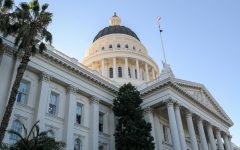
California State Capitol. (Photo: Katy Grimes for California Globe)
Office of Administrative Hearings Procedures – Part 1
Chapter 1 deals with general APA hearing procedures
By Chris Micheli, August 24, 2026 2:30 am
Division 2 of Title 1 deals with the Office of Administrative Hearings, which contains five chapters. Chapter 1 deals with general APA hearing procedures. Section 1000 is a purpose statements that specifies that these regulations specify the procedures for the conduct of matters before the Office of Administrative Hearings.
Section 1002 contains the following definitions:
“ALJ” means an administrative law judge of the OAH.
“Case” means the administrative action referred by an agency to OAH.
“Day” means a calendar day, unless otherwise specified.
“Declaration” means a statement under penalty of perjury.
“Hearing” means the adjudicative hearing on the merits of the Case.
“Motions” shall include all motions or applications for orders.
“OAH” means the Office of Administrative Hearings.
“Presiding Judge” means the Presiding Judge of the regional office of the Office of Administrative Hearings or his or her designee.
“Serve” or “Service” of papers means delivery of the document by the means specified in Regulation 1008 and as required by law.
Section 1004 explains that words in the singular include the plural and words in the plural include the singular, unless the context otherwise requires. Also, time limits set forth in these regulations are not jurisdictional.
Section 1006 provides that, after a case has been assigned to a regional office of OAH for hearing, all papers filed pursuant to any provision of law, regulation, or ALJ order must be filed at that regional office within applicable time limits. The first page of each paper filed should include the six specified items of information.
Papers should be filed on 8 ½ ″ x 11″ stock paper of customary weight and quality, with two normal-sized holes punched at the top (centered 2 ½ inches apart, and ⅝ inch from the top of the paper). Papers should be typed or computer-printed. Type should be at least pica (10 characters per inch) or 12 point print. The color of the type should be blue-black or black.
Section 1008 requires proof of service of papers are a Declaration stating the title of the paper served or filed, the name and address of the person making the service, and that he or she is over the age of 18 years and not a party to the matter. Service may be made by leaving the paper at the residence or business of the person named to be served, with a person not less than 18 years of age.
Where service is made by mail, the proof of service must show the date and place of deposit in the mail, the name and address of the person served as shown on the mailing envelope and that the envelope was sealed and deposited in the mail with the postage fully prepaid.
In addition, the proof of service is required to be signed by the person making it and contain the specified statement above the signature.
Section 1012 states that this regulation applies to any ex parte petition or application an agency files with OAH for temporary relief or interim orders specifically authorized by statute or regulation. Absent a showing of good cause, parties are given at least 24 hours notice of the specific relief sought and the date, time, and place of the ex parte proceeding. Notice may be given by telephone or facsimile transmission.
Ex parte petitions and applications are in writing and must comply with Regulation 1006. The petition or application states the statutory authority for the temporary relief and includes a proposed order.
Section 1014 specifies that, when a party amends a pleading, the party is required to serve on all other parties and promptly file with OAH a complete, new pleading incorporating the amendments. The new pleading is titled a “First Amended” pleading, and subsequent amended pleadings are titled consecutively.
OAH prefers amended to supplemental pleadings. However, if a party issues a supplemental pleading, the party must serve on all other parties and promptly file with OAH the supplemental pleading which is titled a “First Supplemental” pleading. Subsequent supplemental pleadings are titled consecutively.
Section 1015 provides that any counsel or other representative who has assumed representation of a party after the agency has referred a case to OAH must give written notice to OAH and all other parties of his or her name, address, telephone and fax number (if any) and the name of the represented party, within a reasonable time after assuming representation.
In addition, any counsel or other representative may withdraw as counsel or representative of record by giving written notice to OAH and all parties of the withdrawal. The written notice is required to include the last known address of the formerly represented party. Withdrawal or change of counsel or other representative does not alone constitute grounds for continuance of any previously scheduled proceeding in the case.
Section 1016 requires a party who brings a motion for consolidated proceedings or separate hearings to comply with Regulation 1022. Before an ALJ orders consolidated proceedings or separate hearings, the ALJ is required to provide notice to all parties and allow a reasonable time for the parties to file with OAH and Serve on all other parties any written opposition. Failure to file a timely opposition constitutes a waiver of objection to an order of consolidation or severance. The parties may stipulate to consolidated proceedings or separate hearings.
Section 1018 requires an agency’s request to OAH to set a hearing date to be in writing and contain eight specified items of information. OAH may defer setting a matter for hearing until the agency supplies all of the information. The document used by the agency to request the hearing date must contain a space for OAH to insert the OAH number assigned to the case, and the date(s), time and location set for the hearing.
Section 1019 provides that any party or participant in a proceeding before the OAH may request security for the proceeding. The request for security must be made to the Presiding Judge as soon as the need for security is known. The Presiding Judge or the ALJ presiding over the proceeding may determine on his or her own initiative that security is required.
Section 1020 states that a case filed with OAH is assigned to the Presiding Judge until reassigned to another ALJ. A motion to continue a hearing must be in writing, directed to the Presiding Judge, and served on all other parties. However, before filing the motion, the moving party is required to make reasonable efforts to confer with all other parties to determine whether any party opposes the motion and to obtain future dates when all parties are unavailable for the hearing over the next six months and at least three alternative preferred future hearing dates. The motion has to contain at least nine specified items of information.
Section 1022 specifies that all motions made prior to the hearing are to be directed to the Presiding Judge. Thereafter, motions are directed to the ALJ assigned to the hearing. Motions and any response must conform to Regulation 1006. The motion must state in plain language the relief sought and the facts, circumstances, and legal authority that support the motion.
A motion must be filed and served at least 15 days before the date set for the commencement of the hearing, and any response to the motion is to be filed and served no later than 3 days before the date the motion is scheduled to be heard. A motion is usually decided without oral argument. A party may request oral argument at the time of filing the motion or response.
If the Presiding Judge orders oral argument, OAH sets the date, time and place. The Presiding Judge may direct a party to serve written notice on all other parties of the date, time, and place of the oral argument. Oral argument may be made in person or by telephone conference call, video conference, or any other electronic means.
The ruling on any motion is made by written order, unless the motion and ruling are made during the course of a hearing while on the record. The ALJ may direct the prevailing party to prepare the order, or dispense with the requirement of a written order.
Section 1024 explains that subpoena forms are available from OAH. Subpoenas may also be issued. A motion for a protective order, including a motion to quash, shall be made in compliance with Regulation 1022.
Section 1026 provides that, after a case is assigned to OAH, any party may file with OAH and serve on all parties a request for a prehearing conference. A request for a prehearing conference is to be directed to the Presiding Judge and state the reasons for the conference. If the request is granted, OAH sets the date and time for the conference. Regulation 1022 does not apply to a request for a prehearing conference.
In addition, motions to be heard at the prehearing conference must be filed with OAH no later than 15 days before the prehearing conference and comply with Regulation 1022. Responses are to be filed with OAH no later than 3 business days prior to the prehearing conference. The ALJ may allow oral motions during the prehearing conference.
At least 3 business days before a prehearing conference, each party is required to file with OAH and serve on all other parties a prehearing conference statement containing eight specified pieces of information. Exhibits do not need to be premarked or filed with the prehearing conference statements unless requested by the ALJ. Exhibits are exchanged between the parties at least 3 business days before the prehearing conference. On agreement of the parties, exhibits already produced in discovery need not be exchanged.
After the prehearing conference, the ALJ issues a prehearing conference order which incorporates the matters determined at the conference. This order may be issued orally if an accurate record is made. Agreements on the simplification of issues, amendments, stipulations, or other matters may be entered on the record or may be made the subject of a written order by the ALJ. If no matters were determined or dates set at the prehearing conference, a prehearing conference order is not required.
Section 1027 allows an agency to file a written request directed to the Presiding Judge to set a case for an informal hearing. The request must explain how the circumstances are appropriate for an informal hearing procedure.
In addition, the Presiding Judge may order the case to proceed as an informal hearing. If the case proceeds by informal hearing, the Presiding Judge or assigned ALJ is required to advise the parties of the procedures to be applied.
Section 1028 states that, after a case is assigned to OAH, any party may file with OAH and serve on all parties a request for a settlement conference. A request for a settlement conference is directed to the Presiding Judge. If the request is granted, OAH sets the date and time for the conference. Regulation 1022 does not apply to a request for a settlement conference.
Each respondent and his or her representative and an agency counsel or other representative, if the agency is not represented by counsel, must appear in person at all settlement conferences. Each party or representative who attends the settlement conference is required to be fully familiar with the facts and issues in the case and have authority, or be able to obtain authority immediately by telephone, to negotiate settlement terms subject to the approval by the agency head.
The Presiding Judge may excuse the attendance or participation of a party or representative upon a showing of good cause. A request to be excused must be made not less than 3 business days before the date of the conference. A request to continue the settlement conference is to be addressed to the Presiding Judge.
The settlement conference ALJ may structure the conference to meet the needs of the particular dispute. A telephonic settlement conference may be arranged. A party may file a written settlement conference statement with OAH that describes the factual and legal issues and the status of any previous settlement discussions in the case.
A party should bring any pertinent documents and a draft of any settlement proposal on disk or in writing to the settlement conference. The settlement conference statement, other settlement materials, and settlement discussions cannot be disclosed to the hearing ALJ and are deemed confidential unless the parties agree otherwise.
The parties are required to promptly notify the OAH calendar clerk of any resolution that terminates a case before OAH. OAH will vacate all hearing dates upon receipt of a written request and notice of final resolution of the case from the agency. A copy must be served on all other parties. Notice of final resolution of a case consists of written confirmation from the agency that all parties have signed a final written agreement resolving the case.
Section 1030 provides that a party seeking an order for closure or other protective order for all or part of a hearing, including a request to seal the record, is required to file a motion stating in plain language the relief sought and the facts, circumstances, and legal authority that support the Motion.
If a party’s motion or request is granted, the ALJ may direct the moving party to make the necessary arrangements and pay the related costs. The ALJ may exclude specified person, restrict attendance due to physical limits, or take other actions to promote due process.
Section 1032 requires a party to give timely notice to OAH and the agency when that party or the party’s representative or witness needs any of the four specified accommodations during a proceeding before OAH.
In addition, the agency must provide the appropriate language assistance. An interpreter at a hearing or other proceeding is to be sworn by oath or affirmation to perform his or her duties truthfully. The oath or affirmation must be in substantially the specified form.
Section 1034 states that a party is entitled to one peremptory challenge (disqualification without cause) of an ALJ assigned to an OAH Hearing. A peremptory challenge is not allowed in proceedings involving petitions or applications for temporary relief or interim order or in a proceeding on reconsideration or remand; and does not apply to panel members of a commission on professional competence, other than the ALJ, in proceedings under Education Code section 44944. In no event will a peremptory challenge be allowed if it is made after the hearing has commenced.
A peremptory challenge must meet five specified criteria. If, at the time of a scheduled prehearing conference, an ALJ has been assigned to the hearing, any challenge to the assigned ALJ is to be made no later than commencement of that prehearing conference.
A party may contact OAH to determine the name of the ALJ assigned to the hearing. A hearing cannot be continued by reason of a peremptory challenge unless a continuance is required for the convenience of OAH. If continued, the hearing is rescheduled to the first convenient date for OAH.
Section 1038 authorizes any person to request a copy of the record, subject to any protective orders or provisions of law prohibiting disclosure. The complete record includes the pleadings, all notices and orders issued by the agency, any proposed decision by an ALJ, the final decision, a transcript of all proceedings, all exhibits whether admitted or rejected, the written evidence and any other papers in the case, except as provided by law.
Section 1040 authorizes the ALJ to order a party, a party’s representative or both, to pay reasonable expenses, including attorney’s fees, incurred by another party as a result of bad faith actions or tactics that are frivolous or solely intended to cause unnecessary delay.
“Actions or tactics” include the making or opposing of motions or the failure to comply with a lawful order of the ALJ.
“Frivolous” means totally and completely without merit or for the sole purpose of harassing an opposing party.
The ALJ is prohibited from imposing sanctions without providing notice and an opportunity to be heard.
In addition, the ALJ is required to determine the reasonable expenses based upon testimony under oath or a declaration setting forth specific expenses incurred as a result of the bad faith conduct. An order for sanctions may be made on the record or in writing, setting forth the factual findings on which the sanctions are based.
Section 1042 requires an agency to allege in its pleading any request for costs, citing the applicable cost recovery statute or regulation. The proof of costs at the hearing may be made by declarations that contain specific and sufficient facts to support findings regarding actual costs incurred and the reasonableness of the costs, which must be presented as specified. The proposed decision must include a factual finding and legal conclusion on the request for costs and state the reasons for denying a request or awarding less than the amount requested.
Section 1044 states that, when a request is made for expenses pursuant to section 11520(b), the requesting party is required to submit a declaration setting forth, with specificity, the expenses incurred as a result of respondent’s failure to appear.


- Significant Natural Areas - October 23, 2026
- Common Latin Terms in Statutory Construction - October 23, 2026
- Frogs in California - October 23, 2026
RELATED ARTICLES
-
 July 23, 2020
 -
 November 10, 2024
 -
 October 24, 2024