

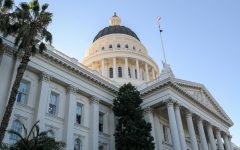
California State Capitol. (Photo: Katy Grimes for California Globe)
Office of Administrative Hearings Procedures – Part 2
The motion must show good cause for allowing the brief, giving consideration to four specified factors
By Chris Micheli, August 25, 2026 2:30 am
Section 1046 states that a non-party with an interest in the outcome of the hearing may, by motion, request permission to file an amicus brief. The motion must show good cause for allowing the brief, giving consideration to four specified factors.
Section 1048 authorizes the agency to make an application to OAH to correct a mistake or clerical error, or make minor or technical changes, in a proposed decision by filing a written request addressed to the Presiding Judge. The application must be signed on behalf of the agency that is seeking the correction(s) and identify the correction(s) being sought and the reasons therefor. The application is to be served on all other parties, together with a copy of the proposed decision. A copy of the proof of service must be filed with the application.
A party has a period of 10 days from the date the application is served to file written opposition. The opposition must be served on all parties and filed with OAH, with a copy of the proof of service. If opposition is filed, the Presiding Judge may permit oral argument or decide the matter on the papers alone. If the Presiding Judge permits oral argument, at least 5 days notice of the time and place for oral argument is to be given. The Presiding Judge decides the matter no later than 5 days after it is submitted.
If the application is granted, the Presiding Judge will prepare, and cause to be served on all parties, a notice and order of correction and/or a corrected proposed decision, which identifies the correction(s) made. If the application is denied, the Presiding Judge will cause notice of the denial to be served on all parties. The Presiding Judge will designate the same ALJ who prepared the proposed decision in the case to review and decide the application for correction. If the same ALJ is not reasonably available, the Presiding Judge may designate another ALJ.
Any party other than the agency must file an application with the agency to correct a mistake or clerical error, or make minor or technical changes, in a proposed decision. The agency may decide the application itself or refer it to the Presiding Judge to decide. If the application is referred to the Presiding Judge, specified provisions apply.
An ALJ who prepares a proposed decision may correct any mistakes or clerical errors or make minor or technical changes in the proposed decision. The ALJ must cause to be served on all parties, a notice and order of correction and/or a corrected proposed decision, each of which must identify the correction(s) made. Before making any correction under this paragraph, an ALJ may provide notice to all parties and an opportunity to be heard.
OAH may correct a clerical error or mistake, or make technical or minor changes, in a proposed decision if all of the parties agree to the correction. The stipulation must be in writing, signed by all parties, and clearly identify the change(s) or correction(s) to be made in the proposed decision. The stipulation must be filed with the Presiding Judge. If the stipulation is accepted, the Presiding Judge prepares, and causes to be served on all parties, a notice and order of correction and/or a corrected proposed decision, each of which identifies the correction(s) made. If the stipulation is rejected, the Presiding Judge causes notice to be served on all parties.
In no event may any correction made pursuant to this policy statement result in reconsideration, or change the factual or legal basis, of a proposed or final decision. All documents filed or issued with a request to correct a proposed or final decision become a part of the record in the case.
Section 1050 provides that an agency referral of a case to OAH for rehearing or reconsideration is required to be filed in the OAH regional office that issued the proposed decision. The referral is required to be in writing, directed to the Presiding Judge, and contain the four specified items of information.
In addition, the agency is required to lodge the record in the case, including the transcript, exhibits, and other papers that are part of the record, with OAH promptly after the agency has received it. If the agency has not lodged the complete record at least 15 days before the scheduled hearing in the case, it must provide written notice to OAH and all other parties.
Section 1100 provides the following definitions:
“Agency” includes every state office, officer, department, division, bureau, board, and commission.
“Agency head” means a person or body in which the ultimate legal authority of an agency is vested, and includes a person or body to which the power to act is delegated pursuant to authority to delegate the agency’s power to hear and decide.
“ALJ” means an administrative law judge of the OAH.
“Appellant” means the business filing the appeal and is the same as the respondent for purposes of the APA.
“Office” means the OAH where the appeal is filed and the hearing is held or the documents are reviewed.
“Presiding Judge” means the Presiding Judge of the regional office of the OAH.
Section 1102 provides that the form for appeals, titled “Appeal of Business Reports and Forms Under Government Code § 11380,” numbered 11380-1 (revision date 7/97), herein incorporated by reference, is available from the Office or may be taken from the OAH Web Site (http://www.dgs.ca.gov/oah).
Any appeal submitted by a business must be served upon the agency head and filed with the OAH within 30 days after exhaustion of the procedures established. The OAH is require the appellant to pay a filing fee and a deposit. The filing fees and deposit amounts are listed on Form 11380-1.
Section 1104 provides that an appeal must be in writing, entitled “Appeal of Business Reports and Forms Under Government Code section 11380”, and contain the specified items of information, without which it will not be accepted for filing. The appellant is required to attach to the appeal (FORM 11380-1) the filing fee, deposit, and a copy of the five specified documents.
Section 1106 states that, within 15 days of service of an appeal, the state agency named is required to submit to the OAH and serve upon the appellant’s representative the name, address, and telephone number of the agency’s authorized representative for the proceeding.
In addition, within 15 days of service of an appeal, the state agency may submit to the OAH and serve upon the appellant’s representative a written response. If the agency objects that the challenged report or form is not within the jurisdiction granted, then it must include its objection and its reason in its response.
The OAH is required to set a hearing date and notify the appellant’s and agency’s representative of the date, time and location. The written notice must be in substantially the same format as set forth in Government Code § 11509, but may include other information.
Section 1108 authorizes an appellant to elect to submit the matter for decision based entirely upon documentary evidence, including declarations. This election may be made on FORM 11380-1 or by calling the OAH at least five business days before the hearing.
Section 1110 requires hearings to be held, or documents reviewed, in the Office where Appellant files the appeal.
Section 1112 states that hearings conducted under the appeal procedure must be reported in accordance with Government Code § 11512(d). The cost of transcription, or reproduction of any electronic recording is borne by the party making the request.
Upon a written request and at the discretion of the ALJ, and party may also record the hearing at his or her own expense. However, any transcript prepared from the private recording will not be an official transcript of the proceedings.
In addition, any party, within 20 days of the date of mailing of the transcript, or longer for good cause shown and in the discretion of the ALJ, may file with the ALJ a notice in writing of any claimed error and must mail a copy of this notice to each party of record.
Section 1114 requires the ALJ to issue a decision to grant or deny, in whole or in part, the appellant’s challenge at the conclusion of the hearing whenever possible or within 15 days of submission of the matter for document review.
In addition, the ALJ may prepare the order or direct a party or parties to submit proposed orders. When directed by the ALJ, a party or representative is required to prepare a proposed order and submit it to all parties for approval as to form before filing it with the ALJ.
Section 1120 says that specified time deadlines are to be observed for certain petitions, as well as OAH scheduling a hearing on the petition filed by a local contracting agency to commence no later than 30 days following the date that such petition is received by the State Department of Education. The OAH is required to prepare and issue a final decision within 30 days following the date the case is submitted by the parties.
Section 1121 provides that, upon receipt of a petition from a local contracting agency, the State Department of Education (SDE) has 10 days to do four specified actions. The OAH is required to consult with and notify the SDE of the time and place where a hearing on the petition filed by a local contracting agency is to be held. The SDE has to send written notice of the time and place of hearing to the local contracting agency, with a copy to the OAH at least 10 days prior to the date of hearing.
Section 1124 provides that a petition by a local contracting agency requesting a hearing under the provisions of Education Code Section 8402 must be submitted in writing to the State Department of Education and contain specified information.
Section 1125 requires parties to keep the OAH currently advised as to any change in or substitution of representation or any change in the address or telephone number of its representative.
Section 1126 provides that, whenever at any stage of the proceeding the OAH determines, by motion or suggestion of a party or on its own initiative, that the action taken by the State Department of Education which is challenged by the petition is not within the jurisdiction granted, the hearing on the petition cannot proceed further and the appeal is dismissed. The decision to dismiss is confirmed in writing and sets forth the reason(s) for dismissal.
Section 1140 sets forth specified time deadlines that must be observed. The OAH is required to schedule a hearing on the petition filed by a private, non-profit human service organization to commence no later than 30 days following the date that such petition is received by the Health and Welfare Agency or the component department within that agency. The OAH, upon a showing of good cause, may extend the 30 day period within which the hearing must start.
In addition, the OAH is required to prepare and issue a proposed decision within 30 days following the date the case is submitted by the parties. The proposed decision is to be transmitted to the Health and Welfare Agency, or the component department within that agency, whichever is involved in the direct service contractual dispute.
Section 1141 states that a private, non-profit human service organization that appealing one or more of the circumstances set forth in Health and Safety Code Section 38061, the Health and Welfare Agency or its component department involved in the dispute shall have ten (10) days to do all five required actions.
Section 1142 states that hearings conducted under the appeal procedure established under Health and Safety Code Section 38057 are to be electronically recorded. The OAH is required to arrange for any electronic recording. Cost of transcription or reproduction of the electronic recording is borne by the party making the request.
Section 1143 provides that a hearing on a petition filed by a private, non-profit human service organization must be held in the San Francisco office of the OAH if the transaction occurred or the organization resides within the First Appellate District, be held in the Los Angeles office of the OAH if the transaction occurred or the organization resides within the Second or Fourth Appellate District, and be held in the Sacramento office of the OAH if the transaction occurred or the organization resides within the Third or Fifth Appellate District.
Section 1144 specifies that a petition by a private, non-profit human service organization requesting a hearing authorized by the provisions of Health and Safety Code Section 38057 must be submitted in writing to the Health and Welfare Agency or its component department, whichever is involved in the direct service contractual dispute, and contain three specified items of information.
Section 1145 requires parties at all times keep the OAH currently advised as to any change in or substitution of representation or any change in the address or telephone number of its representative.
Section 1146 authorizes a hearing officer to issue subpoenas and subpoenas duces tecum at the request of any party for attendance or production of documents at the hearing. Compliance with the provisions of CCP Section 1985 is a condition precedent to the issuance of a subpoena duces tecum.
All witnesses appearing pursuant to subpoena, other than the parties or officers or employees of the State, must receive fees, and all witnesses appearing pursuant to subpoena, except the parties, and will receive mileage in the same amount and under the same circumstances as set forth in statute.
Section 1147 requires oral evidence to be taken only on oath or affirmation. Each party must have the following rights: to call and examine witnesses; to introduce exhibits; to cross-examine opposing witnesses on any matter relevant to the issues; to impeach any witness regardless of which party first called him to testify; and to rebut the evidence against him or her.
The hearing need not be conducted according to technical rules relating to evidence and witnesses. Any relevant evidence is to be admitted if it is the sort of evidence on which responsible persons are accustomed to rely in the conduct of serious affairs, regardless of the existence of any common law or statutory rule which might make improper the admission of such evidence over objection in civil actions.
The hearing is required to be conducted in the English language, except that a party who does not proficiently speak or understand the English language and who requests language assistance must be provided an interpreter approved by the hearing officer conducting the proceedings. The cost of providing the interpreter must be paid by the Health and Welfare Agency or one of its component departments if the hearing officer so directs, otherwise the costs must be paid by the party for whom the interpreter is provided.
Section 1148 requires an OAH hearing officer to have eight specified powers when conducting a hearing on an appeal by a private, non-profit human service organization.
Section 1200 explains that this chapter applies to disputes which are the subject of adjudicative proceedings. These regulations are to be construed to encourage the fair and expeditious resolution of disputes.
If an agency by regulation provides inconsistent rules or provides that these regulations are not applicable to that agency’s proceedings, these regulations will not govern.
Section 1202 provides that the purpose of Alternative Dispute Resolution (ADR) is to provide a less expensive and more satisfying alternative to administrative adjudication without diminishing the quality of justice or the parties’ right to a hearing.
Section 1204 contains the following definitions:
“Agency or Agencies” refers to any agency.
“Alternative dispute resolution” or “ADR” is a method, procedure, or technique used in lieu of traditional or formal adjudication to voluntarily resolve a dispute. As used in this chapter, ADR refers to mediation, non-binding arbitration, and binding arbitration.
“Neutral” refers to an impartial third party who functions as a mediator or an arbitrator.
“OAH” refers to the Office of Administrative Hearings in Sacramento.
Section 1206 provides that any party, other than the agency, interested in resolving a dispute may request ADR by applying to an agency’s executive officer, director, or agency designee. The application is required to maintain specified information. Any Agency may refer a matter to ADR with the written consent of each party to the dispute.
Within ten working days of the receipt of an application from a party requesting ADR, the Executive Officer, Director, or designee of the Agency must review the application to determine if the dispute is suitable for ADR. If it is determined that the dispute is suitable for ADR, the agency has to notify each party and file a request for ADR with the OAH.
In addition, the OAH may establish filing fees or other necessary fees to cover administrative costs. The filing of a request for ADR with the OAH may not stay any pending proceeding and has no effect on any procedural or substantive right of any party to a dispute unless each party agrees otherwise in writing.


- Can California’s Prop 40 Apply to Non-Billionaires? - October 27, 2026
- Credit for Taxes Paid - October 27, 2026
- Key Court Decisions in California Statutory Interpretation - October 27, 2026
RELATED ARTICLES
-
 July 23, 2020
 -
 November 10, 2024
 -
 October 24, 2024