
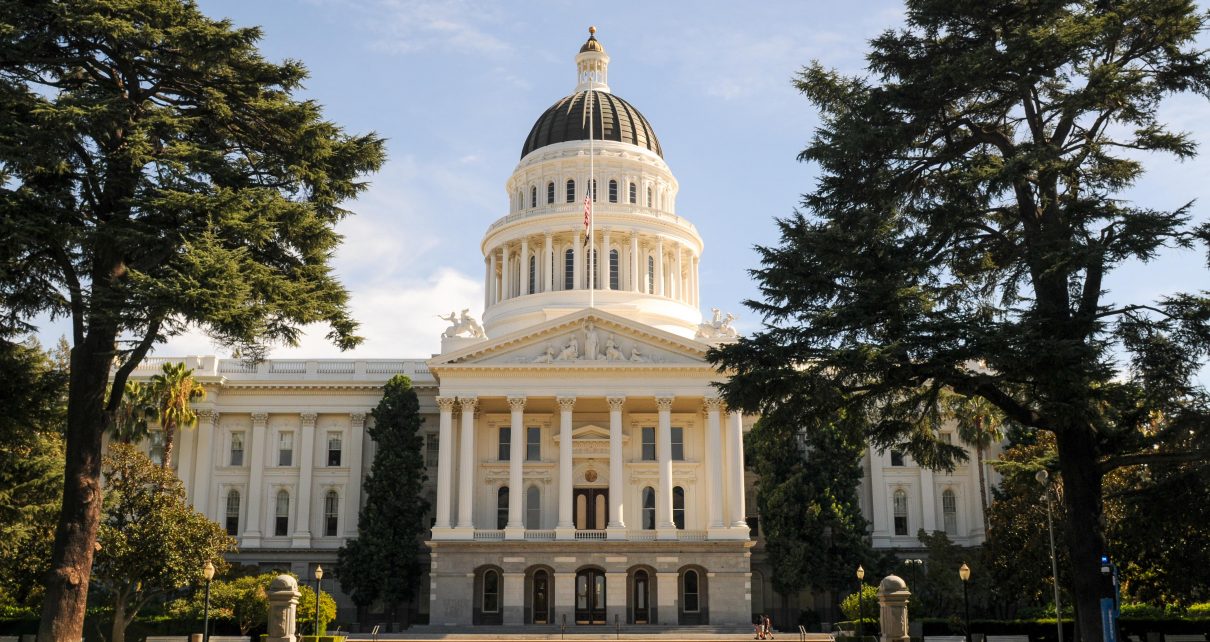
California State Capitol. (Photo: Kevin Sanders for California Globe)
Statutory Exemptions from the Public Rulemaking Process
All regulations are subject to the Administrative Procedure Act unless expressly exempted by statute
By Chris Micheli, September 29, 2026 2:00 pm
Why does the California Legislature continue to adopt partial or full exemptions in statute from the Administrative Procedure Act (APA)? A fundamental purpose of both the federal and California Administrative Procedure Acts is to allow public participation, including notice and comment, in the federal and state rulemaking processes. The only regulations that do not fall under the purview of the APA are those carved out by a statutory exemption.
Providing notice to the public of the proposed rulemaking, as well as an opportunity to be heard during the rulemaking process, is key to having meaningful public participation in the quasi-legislative actions of executive branch agencies, departments, boards, commissions, and bureaus. And there are over 200 of those entities in California statute government.
However, with any exemption from the formal rulemaking process (i.e., a partial or full exemption from the APA), that exemption precludes any meaningful public participation because notice to the public is lacking and therefore so is the ability for interested parties to participate in and ultimately to advocate for or against proposed regulations or changes to existing regulations.
Again, all regulations are subject to the APA unless expressly exempted by statute. According to the Office of Administrative Law, OAL, the following are some of the common examples of exemptions to the APA: a local rule, internal management, forms, audit guidelines, the only legally tenable interpretation, rates, prices and tariffs, legal rulings of tax counsel and precedent decisions.
I would add to this official OAL list the use of statutory exemptions created by the Legislature. It is my fundamental belief that the California Legislature should refrain from abrogating public participation and input into the rulemaking process by creating these statutory exemptions from APA at the request of the executive branch.
Exemptions are also poor public policy because the OAL should always have the ability to be a check on these numerous rulemaking bodies and the hundreds of regulatory changes that they go through each year in order to ensure that these entities are properly complying with the relevant laws and regulations in adopting binding regulations.
These statutory exemptions also represent an unwarranted delegation of authority being made by the Legislature to the executive branch of government. Instead of ensuring that the Legislature remains an equal branch of state government, by granting this exemption to a regulatory agency to bypass the APA, it is my belief that the Legislature weakens its position towards its otherwise coequal branch the executive branch of state government.
What do these partial or full exemptions look like in California bills? There are several different forms these APA exemptions take. The following are some recent examples from the just-concluded 2026 Legislative Session:
Here is a blanket exemption from the entire APA for this executive branch office:
The Administrative Procedure Act (Chapter 3.5 (commencing with Section 11340) of Part 1) does not apply to any regulation, standard, criterion, procedure, determination, rule, notice, guideline, or any other guidance established or issued by the office pursuant to this section.
This bill contains two separate exemptions from different aspects of the APA process, including one from the major regulation fiscal analysis:
(3) Regulations adopted pursuant to this section, or any amendments to those regulations, shall not be considered major regulations as defined in Section 11342.548 of the Government Code.
(4) Regulations adopted pursuant to this section, or any amendments to those regulations, are exempt from the requirements of Section 11346.3 of the Government Code.
Here is a variation of a blanket exemption:
Notwithstanding Chapter 3.5 (commencing with Section 11340) of Part 1 of Division 3 of Title 2 of the Government Code, the department may implement, interpret, or make specific this section, in whole or in part, by means of letters or other similar instructions, without taking regulatory action.
This is a blanket exemption for Franchise Tax Board actions:
The Franchise Tax Board may prescribe rules, guidelines, procedures, or other guidance to carry out the purposes of this section. Chapter 3.5 (commencing with Section 11340) of Part 1 of Division 3 of Title 2 of the Government Code shall not apply to any rule, guideline, procedure, or other guidance prescribed by the Franchise Tax Board pursuant to this section.
These are temporary exemptions which we commonly see under the CalWORKS program:
Notwithstanding the rulemaking provisions of the Administrative Procedure Act (Chapter 3.5 (commencing with Section 11340) of Part 1 of Division 3 of Title 2 of the Government Code), the department may implement, interpret, or make specific this section by means of all-county letters or similar written instructions from the department until regulations are adopted. These all-county letters or similar instructions shall have the same force and effect as regulations until the adoption of regulations.
And here is another blanket exemption after mandating regulations be adopted:
The department shall adopt regulations for the operation of the program on or before July 1, 2028. The adoption of regulations pursuant to this subdivision is hereby exempted from the rulemaking provisions of the Administrative Procedure Act (Chapter 3.5 (commencing with Section 11340) of Part 1 of Division 3 of Title 2 of the Government Code).
Why does the executive branch request these exemptions for their rulemaking activities? Some view the APA as creating bureaucratic delays. Others want to reduce administrative costs of compliance with the APA, while some believe their agency should be able to rapidly respond to complex or specialized situations (of course, that is why emergency rulemaking is permitted).
The alternative emergency rulemaking path allows accelerated implementation while still preserving basic public transparency, making total statutory exemptions unnecessary. So exigent circumstances or other similar explanations are not really justified because the existing APA already provides an alternative route.
Critics of California’s APA sometimes point out that the OAL review process can be viewed as wrapped in housekeeping details, such as requiring agencies to prove the individual necessity of every single provision. But, from my perspective, when the Legislature creates an explicit statutory exemption, it intentionally trades public participation and independent executive oversight for speed and efficiency.
The Legislature has considered and approved the exemption of entire state entities from the standard APA, such as those who want a streamlined governance process (such as the State Personnel Board), or those that have specialized or independent governance structures (including the state’s higher education institutions and the Lottery Commission).
In the end, however, I believe that these statutory exemptions undermine transparency. Bypassing the APA eliminates mandatory public notice and comment periods, prevents meaningful public participation, and weakens legislative oversight by handing unchecked quasi-legislative authority to executive agencies. Loss or public input and erosion of checks and balances justify stopping the legislative practice of partially or fully exempting executive branch actions from the APA process.


- Physically Disabled Persons - October 20, 2026
- What are Some Unique Aspects of California’s Judicial Branch? - October 20, 2026
- Employer Subrogation - October 20, 2026
RELATED ARTICLES
-
 September 9, 2024
 -
-
 November 24, 2023