
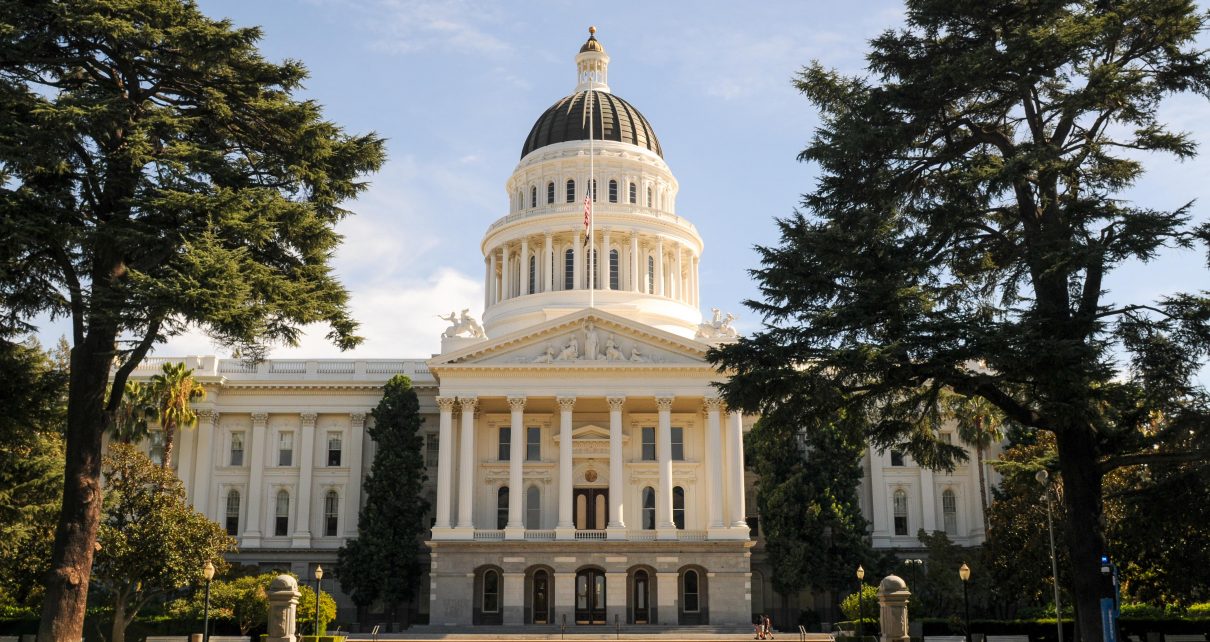
California State Capitol. (Photo: Kevin Sanders for California Globe)
Uniform Child Custody Jurisdiction and Enforcement Act
Provides that a child custody determination made by a court
By Chris Micheli, November 18, 2025 7:18 am
California’s Family Code, in Division 8, Part 3, contains the Uniform Child Custody Jurisdiction and Enforcement Act. Chapter 1 deals with general provisions. Section 3400 states that this part may be cited as the Uniform Child Custody Jurisdiction and Enforcement Act.
Section 3402 defines the following terms: “abandoned,” “child,” “child custody determination,” “child custody proceeding,” “commencement,” “court,” “home state,” “initial determination,” “issuing court,” “issuing state,” “modification,” “person,” “person acting as a parent,” “physical custody,” “state,” “tribe,” and “warrant.”
Section 3403 notes that this part does not govern an adoption proceeding or a proceeding pertaining to the authorization of emergency medical care for a child.
Section 3404 states that a child custody proceeding that pertains to an Indian child is not subject to this part to the extent that it is governed by the Indian Child Welfare Act. A court of this state must treat a foreign country as if it were a state of the United States for the purpose of applying this chapter. A court of this state need not apply this part if the child custody law of a foreign country violates fundamental principles of human rights.
Section 3406 provides that a child custody determination made by a court of this state that had jurisdiction under this part binds all persons who have been served in accordance with the laws of this state, and who have been given an opportunity to be heard.
Section 3407 states that, if a question of existence or exercise of jurisdiction under this part is raised in a child custody proceeding, the question, upon request of a party, must be given priority on the calendar and handled expeditiously.
Section 3408 explains that the notice required for the exercise of jurisdiction when a person is outside this state may be given in a manner prescribed by the law of this state for service of process or by the law of the state in which the service is made. Notice must be given in a manner reasonably calculated to give actual notice but may be by publication if other means are not effective.
Section 3409 provides that a party to a child custody proceeding, including a modification proceeding, or a petitioner or respondent in a proceeding to enforce or register a child custody determination, is not subject to personal jurisdiction in this state for another proceeding or purpose solely by reason of having participated, or of having been physically present for the purpose of participating, in the proceeding.
Section 3410 permits a court of this state to communicate with a court in another state concerning a proceeding arising under this part. The court may allow the parties to participate in the communication. If the parties are not able to participate in the communication, they must be given the opportunity to present facts and legal arguments before a decision on jurisdiction is made.
Section 3411 states that, in addition to other procedures available to a party, a party to a child custody proceeding may offer testimony of witnesses who are located in another state, including testimony of the parties and the child, by deposition or other means allowable in this state for testimony taken in another state. The court, on its own motion, may order that the testimony of a person be taken in another state and may prescribe the manner in which and the terms upon which the testimony is taken.
Section 3412 authorizes a court of this state to request the appropriate court of another state to do all five activities. Upon request of a court of another state, a court of this state may hold a hearing or enter an order. Travel and other necessary and reasonable expenses incurred may be assessed against the parties according to the law of this state.


- Corporations Commissioner Powers - February 27, 2026
- Death Deeds in California - February 27, 2026
- Sources of Law - February 26, 2026
RELATED ARTICLES
-
-
 November 10, 2025
 -
 October 17, 2025