
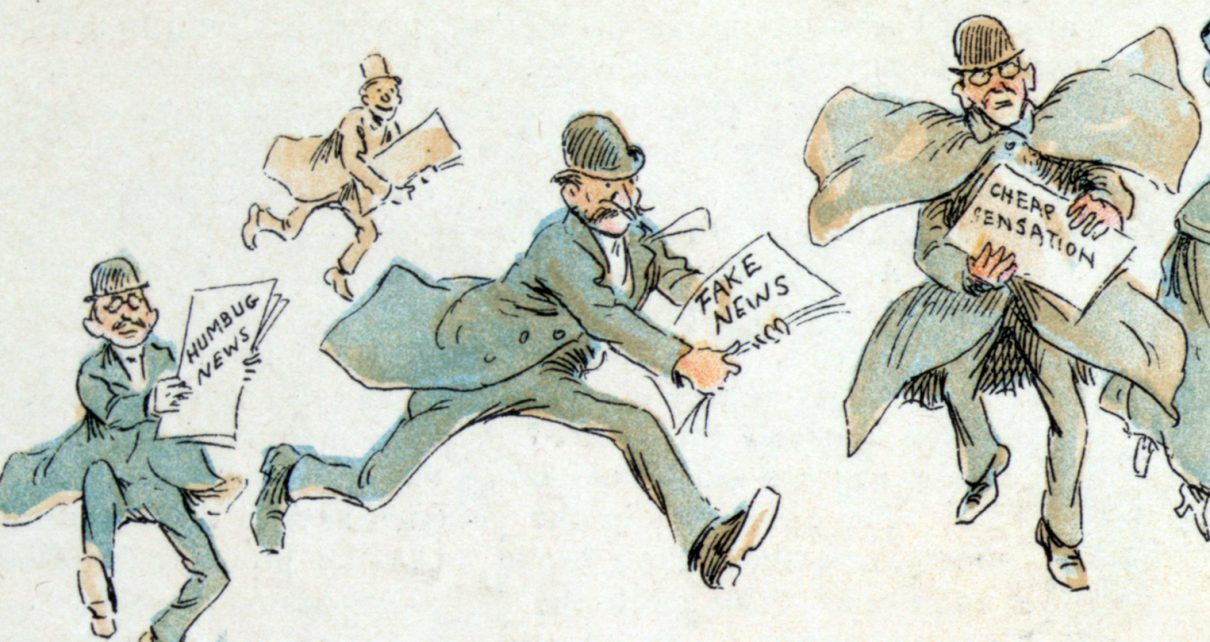
Reporters with various forms of "fake news" from an 1894 illustration by Frederick Burr Opper. (Photo: College of Arts and Humanities fresnostate.edu)
Democrats’ State Funded News is Not a Free Press
A free press is supposed to be independent of the government it covers
By Katy Grimes, September 28, 2026 6:00 am
A free press is supposed to be independent of the government it covers.
Assembly Bill 2222, offers tax incentives to local news outlets that hire qualifying journalists in California. It is state funded news.
Government money is never truly neutral. Once government money flows to newsrooms – especially refundable credits that function like grants – news outlets have a financial interest in remaining eligible.
The Community Newsroom Employment and Workforce Sustainability Act, AB 2222, authored by Assemblyman Chris Ward (D-San Diego), and sponsored by Rebuild Local News, would create refundable tax credits for California local news organizations based on the number of journalists they employ, with enhanced benefits for the smallest community newsrooms and outlets creating new journalist jobs.
The bill also provides eligibility paths for certain public broadcasters, including stations that previously received Corporation for Public Broadcasting community service grants and stations employing qualifying journalists on behalf of university-licensed public broadcasters, InsiderRadio.com reports.
California Attorney General Rob Bonta is all-in on state funded news:
Local journalism is vital to ensuring diverse sources of news content.
That’s why I’m supporting Assemblymember Ward & Assemblymember Wick’s #AB2222 offering tax incentives to local news outlets that hire qualifying journalists in CA.
Every community deserves access to quality…
— Rob Bonta (@AGRobBonta) September 26, 2026
AB 2222 passed both houses of the Legislature in late August 2026 along party lines, and was sent to Gov. Gavin Newsom for his signature or veto by Sept. 30. The bill would create refundable tax credits for 2027–2031 for “local news organizations” that employ qualifying journalists, according to Rebuild Local News:
- $20,000 per full-time journalist for the first five positions
- $15,000 for each additional full-time journalist
- Extra $15,000 stacked for new journalism positions
- $7,500 for qualifying part-time journalists
Credits that exceed tax liability are paid in cash. Eligible outlets include print, digital, broadcast, including public media, nonprofits, and sole proprietors that produce original local news, disclose ownership, and meet fact-checking, corrections and other criteria.
According to bill sponsor Rebuild Local News, “A nonprofit community news website with three full-time news staffers covering the Central Valley would be eligible for $60,000 a year under this program. If the publication hired one more reporter – or converted a freelancer or part-time staffer into a full-time editorial employee – the publication would earn $95,000 in benefits.”
Estimates put annual support to newsrooms in the $40 million+ range, according to the California Department of Finance.
National outlets and PAC-funded “pink slime” sites are excluded from state-funded news grants.
What is a “pink slime” website? As defined by Newsguard, “those that present themselves as neutral local news outlets but are backed by or tied to partisan groups or hostile governments—now outnumber the number of daily local newspapers in the United States.”
Again, it’s ironic that Newsguard is allowed to define what a news outlet is. As we reported in July 2024, they attack news outlets with which they ideologically disagree:
The Globe recently reported that we, along with other online news outlets which specialize in accurate, honest news reporting, have been the target of political censorship by the U.S. Defense Department-backed, Microsoft-backed, Big Pharma-backed “NewsGuard.”
The attacks on the Globe started in 2021 when we received an email from John Gregory, health editor at NewsGuard. We exchanged many emails with Gregory in 2021 and 2022 about NewsGuard’s rating of CaliforniaGlobe.com, where Gregory accused the Globe of publishing misinformation and disinformation about Covid protocols.
We also recently reported that Dennis Prager’s “Prager U” had launched a campaign to expose NewsGuard with a petition, and an enlightening Prager U video explaining how this is being done.
Now another NewsGuard victim is fighting back. Jonathan Turley, a Constitutional Law Professor at George Washington University Law School, dared to criticize NewsGuard, which he describes as “a rating operation being used to warn users, advertisers, educators and funders away from media outlets based on how it views the outlets’ ‘credibility and transparency.’”
“Roughly a week later, NewsGuard came knocking at my door,” Turley said. “My blog, Res Ipsa (jonathanturley.org), is now being reviewed and the questions sent by NewsGuard were alarming, but not surprising.”
Turley said he’s not sure why he’s receiving the sudden interest from NewsGuard as he has previously criticized NewsGuard “as one of the most sophisticated operations being used to ‘white list’ and ‘black list’ sites.”
Who is Rebuild Local News?
According to Influence Watch:
Rebuild Local News began in 2020 as part of the GroundTruth Project and Report for America. In 2023, Rebuild Local News became an independent nonprofit coalition. The Coalition consists of at least 35 members representing more than 3,000 locally owned and nonprofit news organizations in the U.S.
Their funders may look familiar:
Many of the financial supporters of Rebuild Local News include the Ford Foundation, Knight Foundation, Microsoft, Yellow Chair Foundation, the Lenfest Institute, American Journalism Project, MacArthur Foundation, Argosy Foundation, and Charles H. Revson Foundation. In 2023, the MacArthur Foundation provided a one-year $100,000 grant. The Ford Foundation provided a $190,000 grant to Rebuild Local News in 2023.
Notably, Gov. Newsom’s Department of Finance opposed AB 2222 as a new uncapped subsidy that mainly supports existing jobs.
The Department of Finance analysis explains:
The Department of Finance is opposed to this bill because it creates a new refundable tax credit that will result in significant General Fund revenue losses and administrative costs not included in the 2026 Budget Act and is likely to mainly subsidize existing activity rather than encourage net new hiring. Further, a refundable tax credit with no cap creates unlimited fiscal liability to the state, unlike a Budget appropriation which is limited and can be adjusted each year in the Budget. While the bill has an offsetting revenue-raising provision related to federal tax conformity, tax conformity issues should generally be considered in a comprehensive, revenue-neutral manner rather than individually.
The refundable tax credit created by this bill is likely to mainly provide windfall benefits to taxpayers rather than encourage net new hiring activity since the credit is allowed for journalists already employed as well as new hires, which results in fiscal costs to the state without generating new incremental economic benefit. For example, an employer with six journalists will receive a tax credit, as well an employer with four journalists that has recently laid off two journalists. Windfall benefits for a tax credit mean that the state is spending money in the form of tax credits but not receiving any incremental economic benefit to justify the expenditure, and therefore the tax credit should be mainly viewed as tax relief.
Controversy over the bill is because it boils down to “state funded news.”
Supporters include many newspapers, broadcasters, SAG-AFTRA, public radio, and labor groups, call it viewpoint-neutral job support, analogous to historical postal subsidies or film tax credits, and say government does not pick stories.
They argue California has lost a large share of newspapers and journalists and needs local coverage of schools, cities, and courts.
Critics of the bill say refundable credits are a direct cash subsidy from taxpayers to newsrooms.
Naturally, concerns over AB 2222 include:
- Independence: outlets that take state money may soften coverage of the same government that writes the checks.
- Eligibility and capture: even with ownership disclosure and “original local news” rules, definitions and administration can favor connected or ideologically aligned outlets.
- Double dipping: nonprofits already enjoy tax advantages; public broadcasters already receive public money.
- Opportunity cost and precedent: California already runs other journalism programs (UC Berkeley fellowships, Civic Media grants partly matched by Google). Adding another large program expands government involvement in the press.
It’s ironic that Democrats have been screeching about a free press, yet in California they want state funded media. State funded, approved media is the opposite of a free press. And while California has lost a large share of its local journalism jobs and newspapers – the policy problem the bill tries to address – news outlets should look at their programming and news content, and ask themselves why.

A California native and Navy mom, Katy lives in Sacramento, CA.
- MIA on the Campaign Trail, Xavier Becerra’s Tone-Deaf Remarks on Black Californians on Radio Show - October 19, 2026
- President Trump is Unleashing American Energy While Gov. Newsom Tries to Restrict Offshore Drilling - October 19, 2026
- Voters’ Prop 36 Delivers Accountability: Repeat Thief Sentenced to 9 Years in State Prison - October 17, 2026
RELATED ARTICLES
-

-
 May 30, 2018
 -
 June 14, 2023
At least federal money is not going towards fake news(USAID money) I have been told.
Poli-Sci 101: you scratch my back, I scratch yours.
MSM has been doing the governments bidding for years, now it is time for the payback!
The only people to stop this are truthful journalists and those are difficult to find for the average schmoe.
“To compel a man to furnish funds for the propagation of ideas he disbelieves and abhors is sinful and tyrannical.” — Thomas Jefferson
The idea that because local news media are failing financially that the state needs to hire journalists ignores the root cause . . . Independence from distorted, fabricated, distracted or dismissed reporting. Public trust in health, education, welfare, courts, elections and office holders could not be lower. This is a Marxist, socialist, communist attempt for totalitarian control.
Will Katy Grimes be eligible for exclusive coverage of the Capital?
“Newsom is good”
I identify as an independent journalist.
Send me my money.
To compel a man to furnish funds for the propagation of ideas he disbelieves and abhors is sinful and tyrannical.” — Thomas Jefferson
The idea that because local news media are failing financially that the state needs to hire journalists ignores the root cause . . . Independence from distorted, fabricated, distracted or dismissed reporting. Public trust in health, education, welfare, courts, elections, office holders and legacy media could not be lower. This is a Marxist, socialist, communist attempt for totalitarian control.
Will Katy Grimes be eligible for exclusive coverage of the Capital?
Newsguard should be renamed DNCguard. Take a look at their new source scores. All conservative outlets ranked low, and leftist outlets ranked high.
Every totalitarian government depends on propaganda to control its citizens. The Democrats are paying news sources to disseminate propaganda. “Facts? You don’t need no stinkin’ facts.”
NewsGuard gave perfect or near-perfect ratings to outlets that published years of debunked Russia collusion stories:
The New York Times and The Washington Post both received 100/100 ratings from NewsGuard, despite both botching reporting on the Russia-collusion narrative extensively (per The Federalist, March 2023).
BuzzFeed News retained a perfect 100/100 rating even after the Steele dossier was discredited and its primary source Igor Danchenko was indicted.
In April 2019, Breitbart published a list of the top 51 debunked Russia Collusion Hoax stories and found that 9 of the first 12 carried NewsGuard’s green “credible” checkmark (documented by Discover the Networks and InfluenceWatch).
NewsGuard co-founder Gordon Crovitz personally “avidly promoted the Trump-Russia collusion hoax and the infamous Steele Dossier” (per Discover the Networks). NewsGuard co-founder Steven Brill similarly dismissed the Hunter Biden laptop story as “a hoax perpetrated by the Russians again” on CNBC in October 2020.
NewGuard is a total joke.
Will all these approved news outlets be reporting on “OUR Democracy (TM)”???
Bonta used the dog-whistle word of “community” so we know that there’s socialist underpinnings in play here….
Community community community
.
Shares a common root with COMMUNISM