
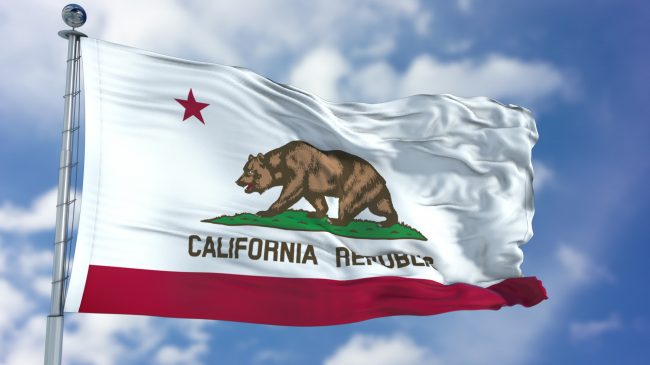
California Bear Flag. (Photo: ca.gov)
If California Becomes the Insurer of Last Resort for Everything, Who Insures California?
California’s Greatest Insurance Gamble
By Alan Korsgarden, June 29, 2026 7:00 am
Earlier this month, my sister concluded her campaign for California Insurance Commissioner as part of California’s jungle primary. From the beginning, we understood the challenge of taking on one of the state’s most established political machines. Although she finished third, she accepted the results with grace but not resignation. Her campaign may have ended, but her commitment to improving California’s insurance marketplace continues. It is a commitment shared by our entire family.
For more than forty-five years, insurance has been woven into the fabric of our lives. After our father was killed in an automobile accident, the insurance industry provided my mother with the opportunity to build a career while raising five children. We learned early that insurance is far more than policies and premiums. It is a promise. It helps families recover from tragedy, allows businesses to rebuild after devastating losses, and provides the financial certainty that enables people to move forward after life’s most difficult moments.
Today, California may be approaching one of the most consequential public policy decisions in its history.
Increasingly, some policymakers appear willing to move the state toward becoming the insurer of last resort across broader segments of the insurance marketplace. Before California assumes that responsibility, one question deserves careful consideration: If California becomes the insurer of everything, who insures California?
Insurance is not simply another industry. It is one of the foundations upon which California’s economy rests. More than $12 trillion in real estate depends upon functioning insurance markets. Mortgage lending, commercial development, automobile ownership, agriculture, manufacturing, trucking, healthcare, professional services, and the formation of small businesses all rely on the ability to insure risk. Without available insurance, much of modern commerce simply cannot function. Insurance is the lubricant that keeps the economic engine running.
One of the most overlooked contributors to rising insurance costs is crime. Insurance premiums are built upon one fundamental principle: expected losses. When losses increase, whether from wildfires, automobile accidents, fraud, vandalism, organized retail theft, or cargo theft, the cost of providing insurance rises as well. Insurance companies cannot ignore those losses because claims must ultimately be paid.
Across California, retailers increasingly face organized theft, repeated vandalism, burglary, and property damage. These losses affect far more than the businesses directly impacted. Higher claims lead to higher insurance premiums. Businesses respond by investing in private security, surveillance systems, reinforced storefronts, and additional employee safety measures. Those costs eventually become part of the price consumers pay every day. Insurance does not create these costs. It simply reflects them.
Business investment follows the same logic. Large employers evaluate crime rates, employee safety, regulatory stability, litigation exposure, property protection, and insurance availability before deciding where to expand. When these risks become more difficult to measure or insure, capital becomes more expensive and less willing to invest. Insurance often serves as one of the earliest indicators because it converts every form of uncertainty into a measurable financial cost. The impact is perhaps greatest on California’s small businesses. A neighborhood grocery store, pharmacy, restaurant, or hardware store often operates on narrow margins. When repeated theft or vandalism drives insurance premiums higher, owners have few choices. They can raise prices, reduce staffing, absorb lower profits, or close their doors entirely. Insurance is not the cause of those economic pressures. It is the financial reflection of them.
If California eventually assumes responsibility for insuring more of these risks through government programs, the underlying losses do not disappear. They simply move from private insurance company balance sheets to the state’s balance sheet. The economic cost remains exactly the same. The difference is who ultimately pays the bill. Instead of shareholders absorbing losses, taxpayers increasingly become responsible through higher taxes, greater borrowing, or reductions in other public services.
Insurance is sometimes criticized as though it creates economic problems. In reality, insurance simply measures them.
When wildfire risk increases, premiums rise. When earthquakes become more likely, premiums rise. When litigation expands, premiums rise. When organized retail theft becomes more common, premiums rise.
When fraud increases, premiums rise.
Insurance companies do not create these risks; they price them. No insurance system, whether public or private, can permanently charge less than the actual cost of risk. If premiums are held artificially low, someone else eventually pays the difference through taxes, debt, reduced public benefits, or higher costs elsewhere in the economy. That is not an ideological statement. It is simply the mathematics of risk.
In many ways, insurance serves as America’s economic report card. Every major public policy decision eventually appears in an insurance premium.
More crime results in higher commercial premiums.
More litigation increases liability costs.
Poor forest management contributes to higher homeowners insurance.
Unsafe roads increase automobile premiums.
Weak building standards produce larger catastrophe losses.
Inflation raises claim costs.
Regulatory uncertainty reduces competition among insurers.
California already has a preview of what a shrinking private insurance market looks like through the California FAIR Plan.
As private insurers reduced their exposure in wildfire-prone regions, hundreds of thousands of homeowners found themselves with few alternatives. What was originally intended as a safety net has increasingly become, for many Californians, the only available option. Families often pay substantially higher premiums while receiving more limited coverage and purchasing supplemental policies simply to obtain protection that once existed in the competitive marketplace.
Government-administered insurance programs frequently face greater bureaucracy, slower decision-making, and higher administrative costs than competitive markets. Competition encourages innovation, operational efficiency, customer service, and product development. The FAIR Plan was designed to be an insurer of last resort, not a permanent replacement for a healthy private insurance market.
The experience of the Affordable Care Act also offers lessons worth considering. The ACA successfully expanded health insurance coverage to millions of previously uninsured Americans. At the same time, it introduced a highly complex regulatory system. For many individuals purchasing coverage without significant subsidies, premiums and deductibles increased substantially as insurer participation declined in certain markets.
Regardless of one’s political views, the experience demonstrates that expanding government involvement in insurance often produces trade-offs that deserve careful evaluation.
California does not need to replace private insurance. It needs to repair the marketplace.
That begins by encouraging more insurers to compete while modernizing regulations so rates can more accurately reflect real-world risk. Consumers should be protected from unfair practices, particularly after catastrophic events, but regulations should also encourage capital to remain in California rather than drive it elsewhere.
The state must also confront the underlying causes of rising losses. Better forest management, expanded water storage, stronger utility management, improved wildfire mitigation, and investments in flood and earthquake resilience would reduce future claims before they occur. Consumers who invest in making their homes and businesses safer should receive meaningful premium discounts. The FAIR Plan should remain exactly what it was intended to be—a true insurer of last resort rather than a substitute for a competitive insurance marketplace. Finally, Californians deserve greater transparency so they can better understand how risk, pricing, and mitigation are connected.
California now stands at an important crossroads. The choice is not simply between public insurance and private insurance. The real question is whether California wants to concentrate more financial risk on the state’s balance sheet or continue relying upon a competitive marketplace supported by global capital. That debate should rise above partisan politics.
Insurance is not a Republican issue or a Democratic issue. It is an economic issue. The decisions California makes today will shape the affordability, stability, and resilience of our state for generations to come.


RELATED ARTICLES
-
 September 16, 2024
 -
-
I SO wish that this article had been written BEFORE the recent primary as it explains the complexities of the risk management industry in layman’s terms, and lays out why California’s regulatory and political environment under Democrat control has driven the commercial insurance industry out of the state.
Most importantly, let this quote sink in :
“When fraud increases, premiums rise.”
Recent numerous reports have shown just how PERVASIVE fraud is in Cslifornia under Democrat control, along with their soft on crime policies as well.
The state is reaping what we are allowing corrupt politicians to sow… (looking at you, Gavin Newsom and your “First Partner” in crime)
Had this article been published far and wide BEFORE the primary, maybe Stacy Korsgaden (the author’s sister) might have won the race outright, rather than ending up third behind two more “insurance companies are the enemy” social-justice warrior, petulant children Democrats who are out to protect “our communities” while normal people suffer under the state-run FAIR plan and pray thst we dont experience an incurable loss that can’t or won’t be paid by an overextended and inefficient program.
My reactions to Mr. Alan Korsgaden’s article are different from yours; he covered a lot of ground, but not all of it.
There is nothing in it that I think would influence voters. Stacey’s approach and campaign did not impress me any more than the Chess Master’s. Alan’s approach essentially lets insurers totally off the hook for their risk analysis, their failures to reach out to lenders, realtors, developers, attorneys, and legislators seeking better mutual understanding, and cooperation to achieve the best results for our citizens, and for our state’s economy.
Nothing is happening in a vacuum – each interacting industry wants advantages, and no one wants to give. The same is true for insurers who want to grow by cherry picking their competition’s most profitable accounts. The insurance industry is a “semi-public utility” for profit. When it buys you a replacement car, home, or business etc., people love it. When things lost are not covered, or insurers argue over conditions, exclusions, and limitations – policyholders can easily become disappointed and distrustful.
Are consumer advocates helping, hurting, or both? The state CDI is supposed to be our consumer advocate, yet they don’t advocate for small businesses, and they don’t seem to push back hard enough on what some of us see as unfair business practices, predatory pricing, and applying unproven AI models and tools to turn what was a
preferred Homeowner yesterday into an ineligible risk today!
As for our CA voters – they were willing to bite on Prop103 in 1988, and so no signs of having learned anything since. And since CA a one party ruled state, breaking though that barrier requires strong Democratic party support. I would not look to Democrats for improved leadership. And if there were enough Republican, Independent, and Conservative Democrat voters to elect Stacey or one of a couple others I preferred, what would it take to get them to mail in a ballot?
I’d like to see each insurer do their own community outreach, PR, and lobbying rather then depending on their
industry association reps to do it for them. I’d like to see leadership return to insurers, rather than watching them waste money on agent marketing PR while cutting our pay. I’d like to see insurers shift from reactive to proactive on safety and risk management. Explain to CDI why their sustainability plan is a joke.
“If California Becomes the Insurer of Last Resort for Everything, Who Insures California?”
Look in the mirror.
True. But we’re already looking into that mirror, and we are just all getting a different sized piece of the shared billings. We have no idea what we should be paying – if it should be more or less. We only know what we have been paying the past 1-5-10-15-20+ years for various types of policies. We all know that inflation has driven the costs of everything higher, with homes and car leading the way, but we have no way to know what insurers true costs are, and they don’t want us to know.
In theory – CA could form its own not for profit Re-Insurance Co. , and pay a leading international Re-Insurer to help run it. The advantage might be dramatically lessening the shock when primary property insurers told us in 2024 that they couldn’t get reasonably price reinsurance, or couldn’t get enough of it to accept large risks such as CA HOAs valued over $25M – $50M – $100M – and more. Our choices disappeared, and the results were 10X higher premiums that forced individual unit/homeowners to pay Special Assessments just for new insurance on top of our normal monthly dues.
I’d like to keep the state out of our business, but we need to explore all reasonable options, then explain the results to the people.
I voted for Stacy. The only reason why I think she lost is the amount of voter fraud in this state. As of today, the Secretary of State website says we still have 11 days left of vote counting. Why, so the Democrats can stuff some more ballots to get the election results to come out for Democrats?
The people in this state have suffered enough with the dingbat Democrat running the Insurance Commission. You want to know what penalty dingbat Lara is proposing for State Farm for insurance related payout issues? Cancelling State Farm insurance for all Californians. That’s 10% of everyone insured in the state. Lara is a moron. A 5th grader could do a better job.
The last thing we need is another dumb Democrat running the Insurance Commission. We need Democrats out of office.
But but but… (this is copied verbatim from his website Ricardo Lara dot com ) :
“Ricardo Lara serves as California’s Insurance Commissioner. Following his eight years of elected service in California’s Assembly and Senate, he made history in 2018 as the first openly gay person to ever be elected to statewide office in California history. Raised by a factory worker and a seamstress — Venustiano and Dolores — Ricardo’s humble beginnings guide his work as he leads the state’s largest consumer protection agency.
As your Insurance Commissioner, Ricardo has taken on tough fights and won for working families — holding the insurance industry accountable while fighting for health care for all, helping California consumers during the unprecedented devastation of the COVID-19 pandemic, and assisting California wildfire victims in rebuilding their lives.”
If you’re a homeowner, aren’t you GLAD that you’ve got an insurance commmissioner who is “holding the insurance industry accountable” and “assisting California wildfire victims in rebuilding their lives”???
(How’s that working out for the former residents in the Palisades/Malibu and Altadena???)
We live in a clown-world state, with COMPLETELY messed-up priorities….
“But but but…”
“(How’s that working out for the former residents in the Palisades/Malibu and Altadena???)
We live in a clown-world state, with COMPLETELY messed-up priorities….”
All of Commissioner Lara’s self congratulations will not help thousands of total loss fire victims in NorCal and SoCal get new homes built. It’s been years already! At least real clowns can make us laugh!
We can argue if Stacey was the best non Democrat choice. And we can agree the Democrats care far more about winning and keeping control than they do about fair elections. But the idea that any of us could be swept into office with this electorate is a dope dream imo. The two Democrats running in NOV are both likely as bad or worse than the current commissioner. As i see it he’s done a small amount of good via public outreach, and a huge amount of damage via being a snail, and thinking he can force this industry into submission.
The insurer of last resort is the real property owners and private sector employed of California. The California Supreme Court has voided the populace standing regarding the opposition legislative expenditures.
Eons ago Jesse “Big Daddy” Unruh bragged that the state was only limited to spend by its ability to tax and thus spending ability unlimited!
Depending on the source, 80 to 90% of wildfires are caused by arson. This includes negligence, park a car on dry grass, tow a boat with the chain dragging, or the worst offender, deliberate arson. We live 100 miles north of Sacramento, and the WatchDuty app shows fires popping up every day in the 10-20 miles distance from our house. The cause is always “investigated” but we seldom find out who is responsible. A homeless advocate torched the Bidwell museum in Chico and he is locked up now for 11 years. I bet he’ll be out in 5 years, and might do it again a few times; the idiot is in his twenties. Deliberate arson should bring mandatory life without parole in federal prisons, but in CA some offenders get away with counseling. Burn baby, burn.
Wildfires cause the insurance crisis and up to 90% of wildfires are caused by arson. Palisades, Paradise, Thompson Fire, the arsonist gets a few years and go out on parole to do it again. Mandatory life without parole in federal prison would help; counseling doesn’t work.