
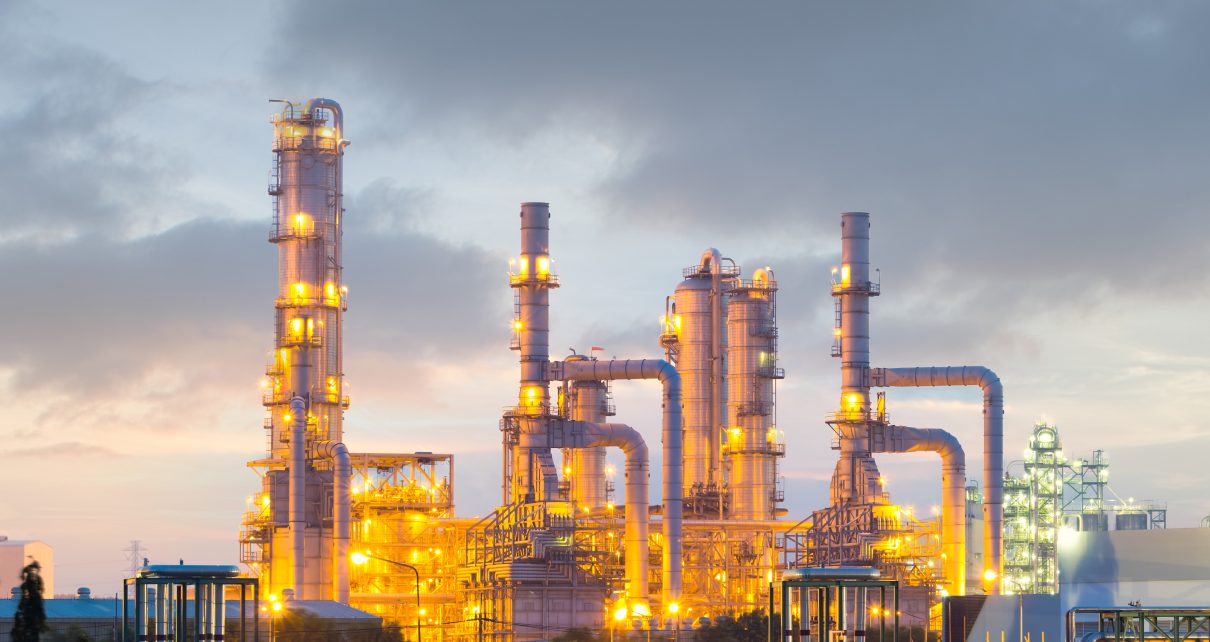
Oil Refinery Plant (Photo: chuyuss/Shutterstock)
American Refineries are Sitting Ducks
Like the Russian refineries that have been attacked with Ukrainian drones, America’s refineries are easily vulnerable
By Mike Ariza and Ronald Stein, November 11, 2026 1:00 pm
Most political leaders and policymakers remain oblivious to the fact that raw crude oil is useless black tar until refined into useful transportation fuels and products for today’s materialistic society.
Ukraine has been using drone attacks on Russian refineries to reduce the supply chain oftransportation fuels demanded by the Russian military and its economy.
- Starting in August 2025, increased Ukrainian drone attacks on Russian oil refineries during the Russo-Ukrainian War caused widespread damage and a significant decrease in production of refined products across the Russian oil industry, leading to a fuel crisis in the country.
- According to a June 25, 2026, analysis by CNN, Ukraine had struck Russian oil facilities over 300 times since the start of Russia’s full-scale invasion on 24 February 2022. Russia is now facing severe nationwide fuel shortages caused by Ukrainian drone and missile strikes on its major oil refineries.
- Drivers across multiple regions, especially in Siberia and remote areas, face lines at gas stations lasting hours or even days.
- Local authorities have introduced purchase limits, such as capping vehicles at a single fill-per-day in regions like Altai and banning filling portable gas canisters in others.
- National average gasoline prices climbed over 18% since the beginning of the year.
The good news is that Ukraine drone attacks on Russian refineries have been successful in demobilizing the Russian military by reducing the diesel and jet fuel production capabilities of those damaged refineries.The bad news is that the world has learned the supply chain for all transportation fuels is very vulnerable. For diesel specifically, Russia previously exported 1.3 million barrels per day into the world supply chain. This is equivalent to five times the daily diesel consumption in California.
This loss of Russian exports coupled with the Iranian war and loss of production in California due to refinery closures has caused a severe global diesel supply shock.
Due to the record margins and to help with these supply shocks US Refineries have been running at max rates. In addition, they have postponed their scheduled spring maintenance shutdowns known as a turnaround. Now we are heading into the fall where other refineries would typically be scheduled to shut down for turnaround.
It is important to note that these turnarounds are scheduled for a reason. These turnaround schedules are based on decades of operational experience. Inspections need to be done. Repairs need to be made As equipment continues to run, the heavy oil sections in the refineries will plug.
This presents its own problems and can be very risky. You also run the risk of catastrophic failures. Some examples of this are equipment such as furnaces having a catastrophic failure due to thinning tubes. The same thing can happen in other equipment that is in a severe service.These failures can cause severe damage to equipment resulting in significantly increased downtime periods.
But most importantly, these failures can result in personnel injuries and / or fatalities. While very profitable and helping with supply shortages, continuing to run in this mode is inherently dangerous.
While Crude oil production for the most part can be easily started or stopped, damaged refinery infrastructure could take weeks to several months for the refinery to get back up on rates.
The Pentagon has launched FORTRESS (Federal Operations for Resilience, Troop Resources, Energy, Supply, and Survivability), unveiled by Defense Secretary Pete Hegseth on September 30, 2026, is an initiative designed to make roughly 500 major U.S. military installations self-sufficient for at least 90 days during a major conflict or infrastructure failure.
Pentagon’s “FORTRESS America” Initiative (United States)
- The Goal: To make major U.S. military installations self-reliant and capable of running independently if civilian power grids, internet systems, or global supply lines are damaged or cut off during a major conflict.
- The 90-Day Standard: Internal Pentagon planning documents require major continental U.S. bases to sustain essential operations—including electricity, water, transportation fuel, and communications—independently for at least 90 days.
Key Components:
- Energy Independence: Deploying portable nuclear microreactors, large-scale battery storage systems, and localized microgrids.
- Strategic Reserves: Stockpiling critical supplies like transportations fuel, munitions, medical equipment, and rare minerals.
- Five Pillars: Energy independence, supply chain and defense industrial base resilience, a strategic defense reserve, installation hardening/cyber resilience, and resilience in space and the electromagnetic spectrum.
IN KEEPING WITH THE GOALS OF OPERATION FORTRESS, immediate attention needs to be focused on protecting the refineries that supply our military with transportation fuels that are refined from raw crude oil. Military bases in California do not have large fuel supply storage to sustain a campaign for any significant length of time.
Our dutiful refinery gate guards and local police cannot be expected to protect a refinery asset against a coordinated attack.
We do not have unlimited funds. Right now our oil companies are making record profits. They should consider redirecting some of those profits for the defense of the most critical refinery infrastructure across the nation.
Refineries need to be prioritized based on strategic location and their ability to supply our military with their transportation fuel demands. In California, to the North the Chevron Richmond Refinery supplies all of the jet fuel to Travis Air Force Base. To the south, Marathon and Chevron El Segundo should by virtue of the size receive top priority with regard to the supply chain for transportation fuels, electrical grid reinforcement, and military defensive equipment and personnel.
In evaluating which refineries to protect, further consideration should be given to the crude oil supply sources for each refinery. For instance, both Marathon and Chevron receive crude oil from in-state suppliers or from tankers. However, Marathon receives a much larger portion of their crude oil from in-state production. If a problem developed with tankers or the port, Marathon could significantly increase in state crude oil supplies to maintain their crude oil rates.
We have seen drone attacks like those from Ukraine against Russian refineries, suicidal plane attacks like 9/11, and many other types of terrorist attacks all over the world.
Common sense tells us that it is not a matter of IF it is going to happen, it is a matter of WHEN it will happen. Decisive action needs to be taken NOW!!!!!!


Mike held the positions of number one control board Operator at Flying J and Senior Refinery Control Board Supervisor at Valero. He was an instructor of both operator field and control board classes. Among his peers he is often referred to as one of the
top ten control board operators in the country.
Ronald Stein, P.E. is an engineer, columnist on energy literacy at America Out Loud NEWS, and advisor on energy literacy for the Heartland Institute and CF ACT, and co-author of the Pulitzer Prize-nominated book “Clean Energy Exploitations.” He has been featured in the CIO Look Magazine as one of The Most Influential ENERGY LEADERS Shaping the Future of the ENERGY SECTOR.
- American Refineries are Sitting Ducks - November 11, 2026
RELATED ARTICLES
-

-
February 18, 2025
-
 April 13, 2025