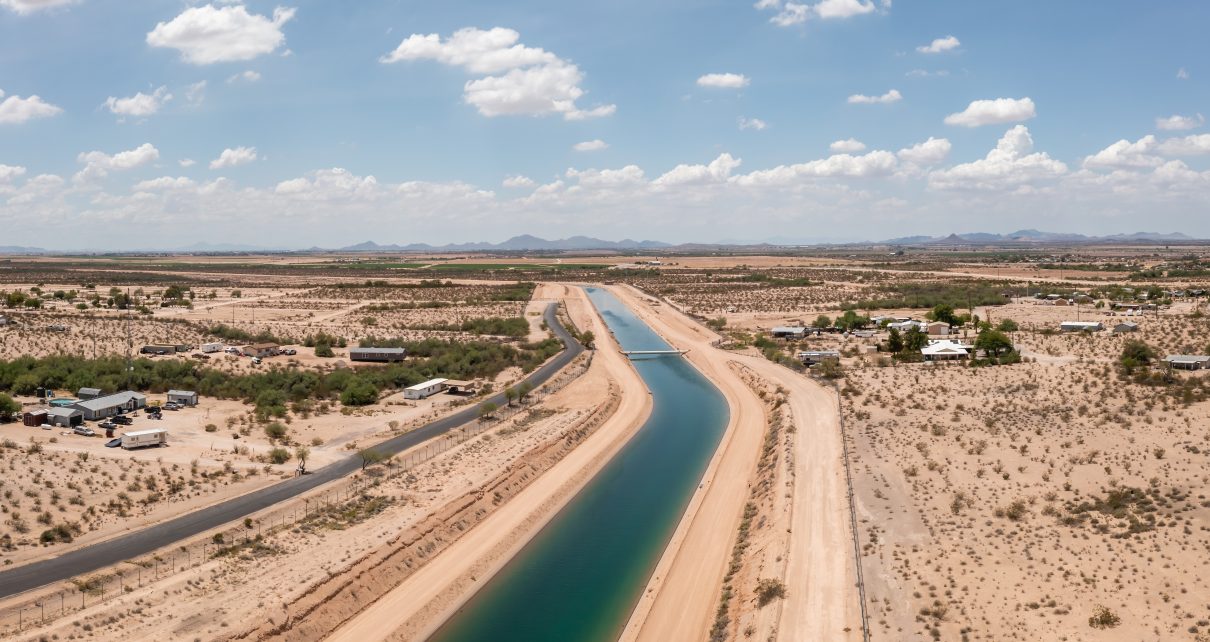
The Central Arizona Project (CAP), designed to bring 1.5 million acre-feet of Colorado River water per year to Pima, Pinal and Maricopa counties. (Photo: Manuela Durson/Shutterstock)
Arizona’s Colorado River Cuts Echo the Parker Dam War
New river cuts hit Arizona hardest—90 years after the National Guard stopped Parker Dam
By Matthew Holloway, September 14, 2026 9:35 am
Arizona is preparing to shoulder the largest share of another round of Colorado River reductions. Nearly a century ago, its governor answered a dispute over the same river by sending troops to a dam site.
The Interior Department’s August 21 decision establishes annual reductions of 1.25 million acre-feet for the Lower Basin in 2027 and 2028. If Arizona, California, and Nevada implement their proposed sharing agreement, Arizona’s annual reduction would be 760,000 acre-feet, followed by California’s 440,000 and Nevada’s 50,000.
Arizona’s reduction outstrips California’s by 320,000 acre-feet, and it’s a fact that Arizonans are keenly aware of, with the state shouldering approximately 61% of the three states’ combined cuts, compared with California’s 35%. The state-by-state distribution remains expressly conditioned on implementation of that agreement.
For many in rural areas of Central Arizona, the proposed cuts are adding insult to injury. Arizona is already taking a 512,000-acre-foot reduction in 2026, approximately 18% of its Colorado River supply. Nearly all those reductions have fallen on Central Arizona Project users, with the priority system leaving less water available for central Arizona agriculture. The proposed 760,000-acre-foot reduction represents a punishing 248,000-acre-foot reduction year-over-year, in already parched areas struggling with subsidence and a declining water table.
The negotiations have changed. The reservoirs have changed. Arizona’s concern about its position on the river has a history stretching back to an armed confrontation over Southern California’s water ambitions.
Remember the Parker Dam War?
California’s Aqueduct Meets Arizona’s Resistance
During the early 1930s, Southern California was organizing an enormous undertaking to bring Colorado River water west. As the National Park Service recounts, the Metropolitan Water District’s aqueduct campaign included a $220 million bond issue and an approximately 242-mile route. Parker Dam would create the reservoir serving that system.
Metropolitan promoted the project through an extensive public campaign, including a film titled Thirst shown in approximately 200 theaters, according to the Historic American Engineering Record’s account of the Colorado River Aqueduct. Its aqueduct required tunnels, pumping facilities, and a dependable place to divert river water. Parker was a critical piece of that infrastructure.
Across the river, Arizona Governor Benjamin B. Moeur feared California’s development would prejudice Arizona’s interests. The National Park Service’s history explains that Metropolitan financed the dam, while the federal government undertook its construction and retained ownership. Arizona’s resistance therefore brought it into conflict with Washington as well as the Southern California interests behind the project.
The Colorado River’s governing arrangements were still contested. The 1922 Colorado River Interstate Compact apportioned water between the Upper and Lower Basins; it did not establish the familiar individual allocations for Arizona, California, and Nevada. The 1928 Boulder Canyon Project Act subsequently provided a path forward with six-state ratification, conditioned on California accepting a limitation, and contemplated a separate agreement among the three Lower Basin states.
Against that background, construction on the river carried consequences extending well beyond a single dam.

Governor Moeur Sends The Guard
An initial Arizona reconnaissance deployment in March 1934 preceded the larger confrontation that November, according to the historical documentation accompanying the Moeur House National Register nomination. The Bureau of Reclamation’s Parker-Davis Project history records that Moeur declared martial law at the construction site on November 10. Interior Secretary Harold Ickes suspended work three days later.
Contemporary coverage described Arizona troops carrying rifles and machine guns. A syndicated news review published November 23, 1934, reported that Moeur demanded half the hydroelectric privilege and quoted his assessment: “It’s a showdown this time.” The account also reported that Metropolitan chairman W. P. Whitsett agreed Arizona should receive half the power privilege.
In an interview with local historian John Larsen Southard in 2013 KJZZ found that 40 riflemen and 20 machine gunners were deployed by Gov. Moeur on the Colorado river bank to support Arizona’s improvised “navy,” of ferryboats used during the deployment. That episode became a durable historical curiosity. The armed obstruction ended without an exchange of gunfire, according to a historical account published by the American Geosciences Institute’s Earth magazine.
“He backed up the navy with a deployment of the National Guard Troops from Phoenix. In fact if you look at the photos from deployment day, they had rifles at the shoulder,” said Southard. “They are equipped. They looked and were a real fighting force.”
Water and electricity were both at issue. Federal notes describing the existing construction agreement reserved half the power to Metropolitan and half to the United States. That federal reservation should not be confused with an established Arizona entitlement or a concession newly obtained through the deployment.
“It’s the last occurrence in American history when one state took up arms against another no matter how unlikely it was that the arms would ever be fired,” Southard told the outlet.
The consequential fight continued in court.
Washington Loses Its Case
The federal government filed suit on January 14, 1935, seeking to restrain Arizona’s interference. The resulting case was United States v. Arizona. On April 29, the Supreme Court dismissed the federal complaint because it failed to establish that construction of the dam was authorized.
Arizona had secured a legal victory with immediate practical consequences: construction was suspended again on April 30.
The ruling addressed the authorization presented by Washington. It did not settle the states’ competing water allocations or give Arizona a permanent veto over the project. The Court also identified the lands at both ends of the proposed dam as federal public lands within the two states.
Congress responded. Section 2 of the August 30, 1935, Rivers and Harbors Act expressly authorized Parker Dam and ratified prior contracts. The legislation also authorized Head Gate Rock Dam in Arizona. Congress had supplied statutory authority for construction to proceed.
Reclamation records a September notice to resume and renewed construction in October. Parker Dam was completed in 1938.
The River Fight Outlasted The Troops
Arizona ratified the Colorado River Compact in 1944. As Reclamation’s historical overview explains, the major Supreme Court decision addressing Lower Basin mainstem allocations came in 1963, decades after the Parker confrontation. Congress authorized the Central Arizona Project in 1968.
Today’s circumstances include prolonged drought, depleted reservoirs, and a sharing proposal in which California would also accept reductions. The new federal framework allows further negotiations and adjustments as operating conditions develop.
Yet the historic location supplies an enduring connection between the disputes that still resonates today. Lake Havasu, impounded by the dam Arizona sought to stop, became a water source for both Southern California’s aqueduct and the Central Arizona Project. And the border between Arizona and California is a symbolic fault line in what has become a bitter partisan division of America’s body politic.
Arizona eventually built its own future around water drawn from that reservoir. Its struggle over the river’s development, distribution, and limits continued long after the Guardsmen went home.
Parker Dam still stands. And Arizonans remember.


- Biggs Alleges ‘Culture Of Corruption’ As Gaming Donor Continues Arizona Operations Despite Shutdown Demand - October 24, 2026
- Arizona Opens Only Three of 21 Planned EV Charging Stations, Four Years After Approval - October 23, 2026
- Arizona Seeks To Join Colorado River Lawsuit After Failed Negotiations, GOP Criticism Of Hobbs - October 21, 2026
RELATED ARTICLES
-
-
 August 24, 2026
 -