
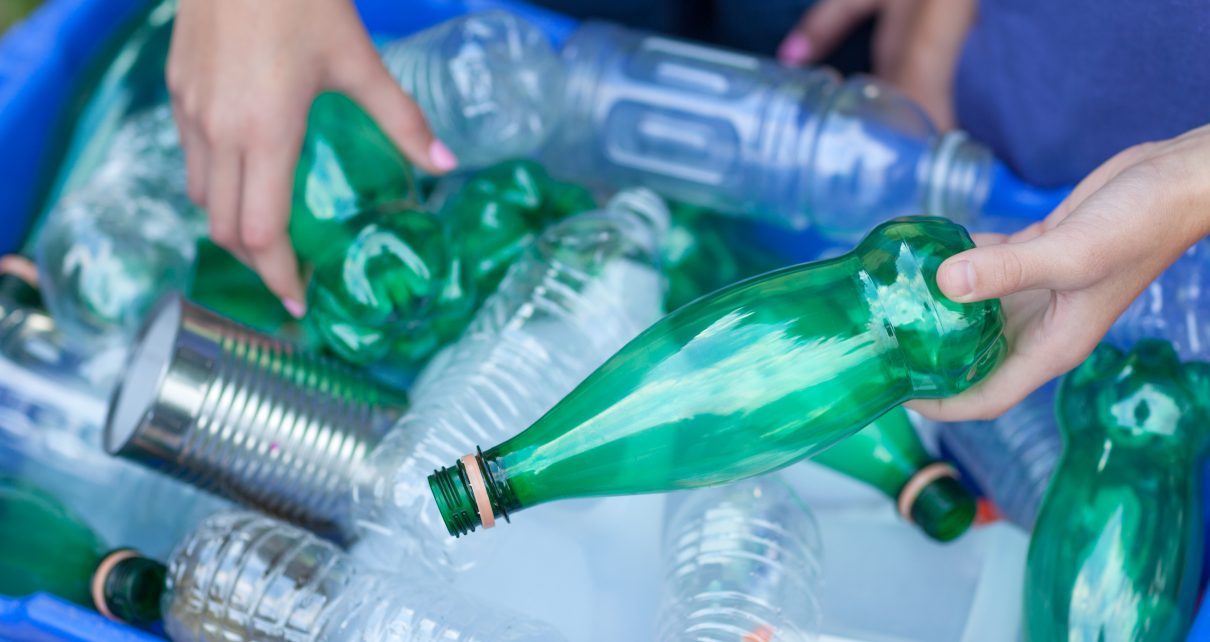
Children putting clear and green bottles and metal cans in recycling blue bin outside in yard. (spwidoff/Shutterstock)
California Businesses, Farmers, Manufacturers, Retailers Ask CA Legislature to Pause Plastic Packaging Mandate
California can’t regulate or burden interstate commerce by effectively setting national packaging standards
By Katy Grimes, August 24, 2026 11:28 am
“California businesses and workers who must implement and pay for SB 54 (by Sen. Ben Allen (D-Santa Monica): the farmers, dairies, food and beverage producers, manufacturers, grocers, retailers, restaurants and their union workforces. We are asking you to pause SB 54 before you adjourn and return next session to substantially repair the program so California can actually achieve recycling mandates without making affordability worse for Californians,” a letter from August 11th says.
They want the California Legislature to halt Senate Bill 54 from 2022 which requires producers to reduce single-use plastic for packaging and food service items by 25%, and ensures that all such items are recyclable or compostable by 2032.
These regulations became effective on May 1, 2026.
This bill is such a nightmare for businesses that in June the Globe reported that Nebraska Attorney General Mike Hilgers is leading a coalition of 17 Republican state attorneys general, and the National Association of Wholesaler-Distributors, in suing California over Senate Bill 54— the Plastic Pollution Prevention and Packaging Producer Responsibility Act.
You can see the problem, and reason for the lawsuit, which accuses California of trying to “impose its own policy preferences on the entire nation” with the plastic packaging law.
The California law applies to products sold in California, regardless of where the business or production is located.
California claims the state law addresses plastic pollution overwhelming waterways, oceans, and landfills, shifting costs from taxpayers and local governments to producers, and encouraging innovation in sustainable materials.
The law prohibits producers of expanded polystyrene food service ware from selling, offering for sale, distributing, or importing expanded polystyrene food service ware in or into the state unless the producer demonstrates that expanded polystyrene meets California’s recycling rates, according to SB 54 Assembly Appropriations analysis.
The law says that violations of the plastics recycling Act by the producer, wholesaler, or retailer shall be subject to penalties. And, it authorizes CalRecycle to conduct investigations, including inspections and audits, to determine compliance with the Act. It also authorizes CalRecycle to issue notices of violation and penalties up to $50,000 per day per violation.
But we have a problem. I am told that the bill’s author, Senator Allen, knows this his bill is going to increase costs, but he refuses to fix it because it’s his “signature legislation.”
Never get in between a climate changey bill and its author.

Sen. Allen’s zeal at having SB 54 signed into law by Gov. Newsom was evident:
“The most comprehensive measure in the nation to address the plastic waste crisis was signed into law today by California Governor Gavin Newsom. Authored by Senator Ben Allen (D – Santa Monica), Senate Bill 54 places the responsibility for costs on the producers rather than the local communities who pay for waste management and recycling,” Sen. Allen’s website says.
“We knew that we needed to act. And in this time of extreme polarization in our nation, California was able to show that we can pass strong environmental legislation with bipartisan support that brought together the environmental and business communities,” Sen. Ben Allen said.
Thankfully, business owners, manufacturers, farmers, grocers, retailers, and restauranteurs, have a bottom line as reality, and know this bill will make it prohibitively expensive to comply.
Sen. Allen was warned this would happen. And now California businesses are pleading for relief and other states are suing.
The lawsuit says California can’t regulate or burden interstate commerce by effectively setting national packaging standards. Businesses nationwide must redesign packaging, labels, or supply chains just to access California’s large market, or segment production, which is extremely costly.
The law imposes compliance costs, which get passed to consumers through higher prices on groceries, packaged goods, and everyday items. The states claim this hits lower-income families hardest and creates a “backdoor national mandate.”
“Once again, California is trying to enact a policy that negatively impacts the rest of the country,” said AG Hilgers in a news release. “If California goes unchecked, consumers will be forced to pay more for basic necessities.”
The letter-signers this month said:
The program administrator, Circular Action Alliance (CAA), says it cannot meet the mandates of SB 54. California pays $78 billion and misses the targets anyway.
CAA’s own program plan seeks exemptions from $50,000 per day, per violation for 56 packaging categories and concedes the statutory mandates cannot be met. This is because the statute itself has mandates and timelines in law that are now illuminated as not possible under the statutory construction of the law. No one voted for that.
The Legislature needs to PAUSE SB 54’s implementation and prevent these cost increases from hitting consumers.

They continue:
Failing to Act Costs California Everything. Not acting results in a regressive, up to $1000 per year grocery/retail, tax on every California family. Not acting costs $2 billion this year starting August 2026 and increases to up to $2.7 billion in the 2nd year, $3.3 billion in the 3rd year, $4.2 billion in the 4th year, and $5 billion in the 5th — a total up to $17.2 billion in just fees. This is not new liabilities. This is not penalties. This is not even the cost on producers to change packaging, assembly lines and do R&D. Those bring the total to $78 billion in compliance costs on California businesses — all for a program that will not achieve SB 54 mandates embedded in statute.
Be sure to reread Crazifornia: 17 States Sue California To Block Plastic Packaging Recycling Law.
Here is the coalition letter:


A California native and Navy mom, Katy lives in Sacramento, CA.
- California Voters: Howard Jarvis Taxpayers Association’s 2026 Voting Guide - October 23, 2026
- Newsom Gaslights Over California’s Bad Student Test Scores - October 22, 2026
- How the DMV Enabled Voter Fraud in California - October 21, 2026
RELATED ARTICLES
-
-
-

-
 June 24, 2022
 -

Here we are again…
California Democrats grandstand on bills that have national implications in their blind devotion and zeal to be “leaders in combating climate change” when the climate is going to change as it has for millenia, and their legislation only drives up costs of daily living in the 21st century.
How are they so stupid?
Oh yeah, it’s because they are emotion-driven children, or for sale to the highest bidder, or both….
Glad Nebraska and 17 other states are taking the stand they are so that some logic and reason can be applied to the situation…
Screw you, Ben Allen AND your “signature legislation” – why don’t you fix the homeless problem in your district first, and get homes rebuilt in the Palisades?