
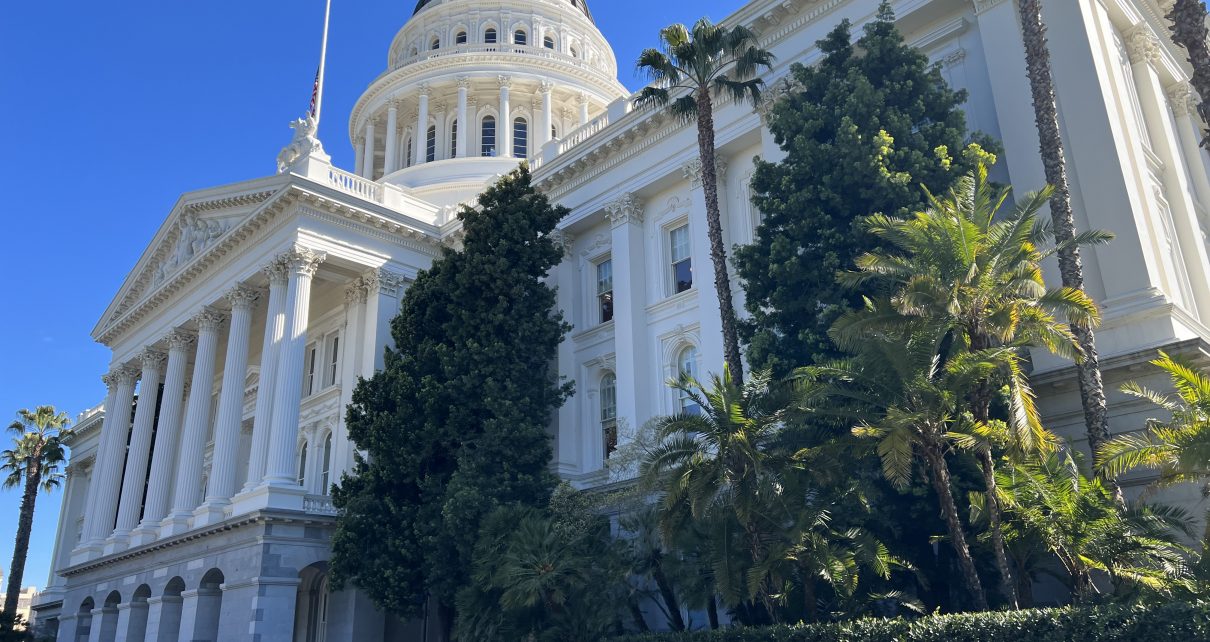
California State Capitol. (Photo: Kevin Sanders for California Globe).
Formation and Construction of Lease Contracts
A lease contract may be made in any manner sufficient to show agreement
By Chris Micheli, April 3, 2025 6:23 am
Division 10, Chapter 2 of the Commercial Code deals with the formation and construction of lease contracts for purposes of personal property leases. Section 10201 specifies that a lease contract is not enforceable by way of action or defense unless one of two specified circumstances occur.
Any description of leased goods or of the lease term is sufficient and satisfies existing law whether or not it is specific, if it reasonably identifies what is described. However, a record is not insufficient because it omits or incorrectly states a term agreed upon. A lease contract that does not satisfy the requirements, but which is valid in other respects, is enforceable in three specified circumstances. There are also specified rules for a lease term under a lease contract.
Section 10202 states that terms with respect to which the confirmatory memoranda of the parties agree or which are otherwise set forth in a record intended by the parties as a final expression of their agreement with respect to such terms as are included may not be contradicted by evidence of any prior agreement or of a contemporaneous oral agreement, but they may be explained or supplemented by two other specified activities.
Section 10204 specifies that a lease contract may be made in any manner sufficient to show agreement, including conduct by both parties which recognizes the existence of a lease contract. An agreement sufficient to constitute a lease contract may be found although the moment of its making is undetermined.
Section 10205 provides an offer by a merchant to lease goods to or from another person in a signed record that by its terms gives assurance it will be held open is not revocable, for lack of consideration, during the time stated or for a reasonable time. Also, any term of assurance on a form supplied by the offeree must be separately signed by the offeror.
Section 10206 states an offer to make a lease contract must be construed as inviting acceptance in any manner and by any medium reasonable in the circumstances. If the beginning of a requested performance is a reasonable mode of acceptance, an offeror who is not notified of acceptance within a reasonable time may treat the offer as having lapsed before acceptance.
Section 10208 provides an agreement modifying a lease contract needs no consideration to be binding. A signed lease agreement that excludes modification or rescission except by a signed record may not be otherwise modified or rescinded, but, except as between merchants, the requirement on a form supplied by a merchant must be separately signed by the other party.
Section 10209 specifies the benefit of a supplier’s promises to the lessor under the supply contract and of all warranties, whether express or implied, including those of any third party provided in connection with or as part of the supply contract, extends to the lessee to the extent of the lessee’s leasehold interest under a finance lease related to the supply contract, but is subject to the terms of the warranty and of the supply contract and all defenses or claims arising therefrom.
Any modification or rescission of the supply contract by the supplier and the lessor is effective between the supplier and the lessee unless, before the modification or rescission, the supplier has received notice that the lessee has entered into a finance lease related to the supply contract. If the modification or rescission is effective between the supplier and the lessee, the lessor is deemed to have assumedvpromises of the supplier to the lessor and warranties that were so modified or rescinded as they existed and were available to the lessee before modification or rescission.
Section 10210 provides that express warranties by the lessor are created by any of three specified methods. It is not necessary to the creation of an express warranty that the lessor use formal words, such as “warrant” or “guarantee,” or that the lessor have a specific intention to make a warranty, but an affirmation merely of the value of the goods or a statement purporting to be merely the lessor’s opinion or commendation of the goods does not create a warranty.
Section 10211 specifies that there is in a lease contract a warranty that for the lease term no person holds a claim to or interest in the goods that arose from an act or omission of the lessor, other than a claim by way of infringement, which will interfere with the lessee’s enjoyment of its leasehold interest.
In addition, a lessee who furnishes specifications to a lessor or a supplier is required to hold the lessor and the supplier harmless against any claim by way of infringement or the like that arises out of compliance with the specifications.
Section 10212 creates an implied warranty that the goods will be merchantable in a lease contract if the lessor is a merchant with respect to goods of that kind. Goods to be merchantable must be at least such as the six specified conditions. Additionally, other implied warranties may arise from course of dealing or usage of trade.
Section 10213 says that, if the lessor at the time the lease contract is made has reason to know of any particular purpose for which the goods are required and that the lessee is relying on the lessor’s skill or judgment to select or furnish suitable goods, there is in the lease contract an implied warranty that the goods will be fit for that purpose.
Section 10214 provides words or conduct relevant to the creation of an express warranty and words or conduct tending to negate or limit a warranty must be construed wherever reasonable as consistent with each other.
In order to exclude or modify the implied warranty of merchantability or any part of it, the language must mention “merchantability,” be by a writing, and be conspicuous. Language to exclude all implied warranties of fitness is sufficient if it is in writing, is conspicuous and states, for example, “There is no warranty that the goods will be fit for a particular purpose.” There are additional rules applicable to implied warranties.
Section 10215 specifies that warranties, whether express or implied, must be construed as consistent with each other and as cumulative, but if that construction is unreasonable, the intention of the parties determines which warranty is dominant. In ascertaining that intention, the three specified rules apply.
Section 10217 say that identification of goods as goods to which a lease contract refers may be made at any time and in any manner explicitly agreed to by the parties. In the absence of explicit agreement, identification occurs in one of three specified circumstances.
Section 10218 provides a lessee obtains an insurable interest when existing goods are identified to the lease contract even though the goods identified are nonconforming and the lessee has an option to reject them. Also, if a lessee has an insurable interest only by reason of the lessor’s identification of the goods, the lessor, until default or insolvency or notification to the lessee that identification is final, may substitute other goods for those identified.
Section 10219 specifies that, except in the case of a finance lease, risk of loss is retained by the lessor and does not pass to the lessee. In the case of a finance lease, risk of loss passes to the lessee. In addition, if risk of loss is to pass to the lessee and the time of passage is not stated, the three specified rules apply.
Section 10220 states where risk of loss is to pass to the lessee and the time of passage is not stated, then one of two specified circumstances would occur. Whether or not risk of loss is to pass to the lessee, if the lessee as to conforming goods already identified to a lease contract repudiates or is otherwise in default under the lease contract, the lessor, or, in the case of a finance lease, the supplier, to the extent of any deficiency in his or her effective insurance coverage may treat the risk of loss as resting on the lessee for a commercially reasonable time.
Section 10221 specifies that, if a lease contract requires goods identified when the lease contract is made, and the goods suffer casualty without fault of the lessee, the lessor, or the supplier before delivery, or the goods suffer casualty before risk of loss passes to the lessee, then there are specified rules if the loss is total or the loss is partial.


- Undertakings in California - March 15, 2026
- Marine Life Definitions - March 15, 2026
- An Introduction to the California Constitution - March 14, 2026
RELATED ARTICLES
-
 November 20, 2024
 -
 February 15, 2025
 -
 November 15, 2024
One thought on “Formation and Construction of Lease Contracts”