
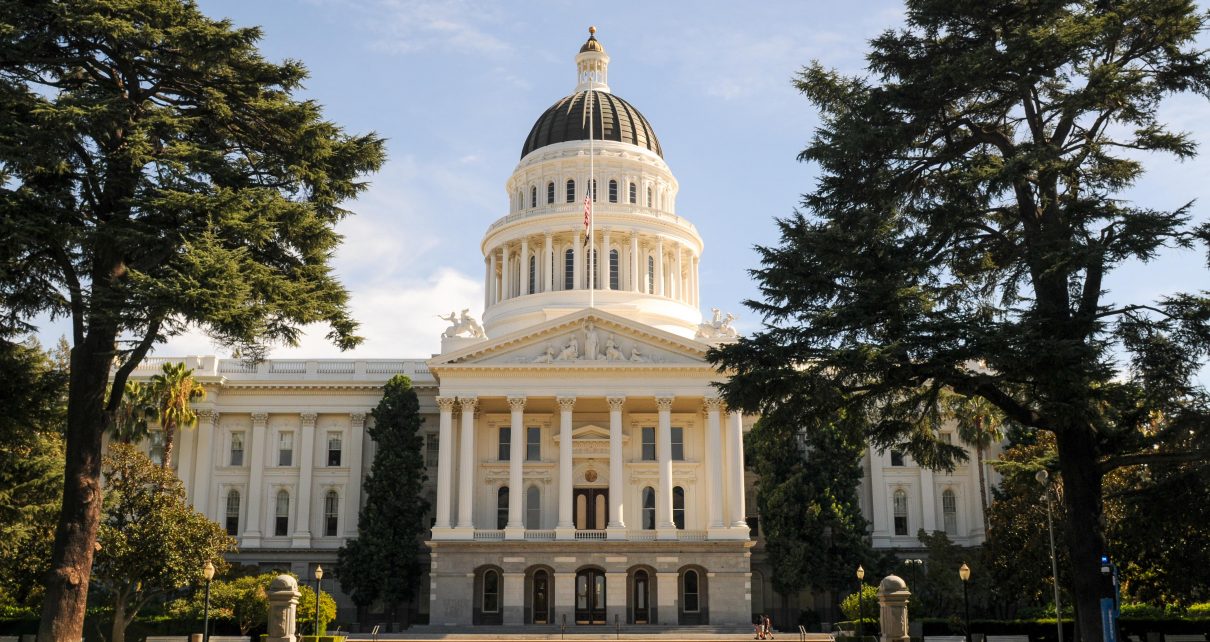
California State Capitol. (Photo: Kevin Sanders for California Globe)
New BLS Data Shows Union Membership Drives Falling Flat
The union’s organizing efforts have failed to keep up with the growing economy, leading to a declining foothold in the workforce
By Katy Grimes, February 19, 2026 12:33 pm
New data from the Bureau of Labor Statistics shows that private-sector union membership remains at an all-time low of 5.9 percent.
This comes despite recruitment efforts from major unions, like the SEIU and the UAW, who have spent vast amounts in recent years in an effort to bolster their ranks at universities and in the restaurant and hospitality sector. The union’s organizing efforts have failed to keep up with the growing economy, leading to a declining foothold in the workforce.
From the BLS report:
The union membership rate–the percent of wage and salary workers who were members of unions–was 10.0 percent in 2025, little changed from the prior year, the U.S. Bureau of Labor Statistics reported today. The number of wage and salary workers belonging to unions was 14.7 million in 2025. In 1983, the first year for which comparable data are available, the union membership rate was 20.1 percent and there were 17.7 million union members.
Data about union members are collected as part of the Current Population Survey, a nationwide sample survey of households in which people are asked, among other things, about union membership. (See the Technical Note in this news release.)
–The union membership rate of public-sector workers (32.9 percent) continued to be more than five times higher than the rate of private-sector workers (5.9 percent). (See table 3.)
–Workers in education, training, and library occupations (32.5 percent) and in protective service occupations (31.3 percent) had the highest unionization rates. (See table 3.)
–Men continued to have a higher union membership rate (10.4 percent) than women (9.6 percent).
(See table 1.)
–Black workers remained more likely to be union members (11.4 percent) than White (9.9 percent), Asian (8.7 percent), and Hispanic (8.9 percent) workers. (See table 1.)
–Nonunion workers had median weekly earnings that were 84 percent of earnings for workers who were union members ($1,174 versus $1,404). (The comparisons of earnings in this news release are on a broad level and do not control for many factors that can be important in explaining earnings differences.) (See table 2.)
In 2025, the number of employees who belonged to unions was similar in the public sector (7.3 million) and the private sector (7.4 million).
“Despite years of heavy spending and aggressive organizing campaigns, the union effort to organize the private-sector continues to fall flat,” said Center for Union Facts Communications Director Charlyce Bozzello. “This data suggests that no amount of positive news headlines has changed the fact that workers simply don’t see unions as a relevant tool in today’s rapidly modernizing workforce.”
Notably, “Industries with the highest unionization rates in 2025 included utilities (17.8 percent), transportation and warehousing (13.6 percent), and educational services (13.4 percent). The lowest unionization rates occurred in finance (0.8 percent), insurance (1.2 percent), professional and technical services (1.3 percent), agriculture and related industries (1.6 percent), and food services and drinking places (1.8 percent).”
A lot of the unionization efforts in the hospitality sector are being led by the SEIU, whose California offshoots have been spearheading the proposed Billionaire tax. California billionaires are already leaving the state in record numbers, and taking their billions with them. According to one billionaire, more than $1 Trillion has already left.
Good job SEIU.
Internal Strife
A shocking document revealing internal strife and discontent at Local 11 was leaked to a local political blog in California this week.
The memo calls out the union and its leadership for a series of failings and identifies its authors as “labor leaders, elected officials, and community leaders.” For this longtime union watchdog, the memo reads as a synopsis of our years of research into Local 11’s inner workings.
The memo describes a pattern of alleged racial discrimination and marginalization at Local 11:
“Instead, Black staff members began leaving-some pushed out, some choosing to walk away from what they described as an increasingly hostile, racially exclusionary environment. Today, the near-absence of Black staff in an organization that claims to speak for low-wage workers across a multiracial region raises a painful question: Whose voices count?”
Another labor union in trouble
The Globe also did an article in early February about another labor union in trouble. The National Right to Work Legal Defense Foundation is representing an employee of medical waste management firm Veolia Environmental Services and just hit Teamsters Local 63 union officials with federal charges, maintaining that union officials threatened to have her fired for refusing to join the union. The employee, Alexus Villanueva, also charges Teamsters bosses with unlawfully forcing her to pay full union dues, including dues for union political activities, via paycheck deduction.
Lastly, the Globe reported that the Center for Union Facts recently analyzed spending data from two labor unions affiliated with the International Brotherhood of Teamsters – the Brotherhood of Locomotive Engineers and Trainmen, the Brotherhood of Maintenance of Way Employees, between the years of 2022 and 2024, and found that of the money both unions spent on political or issue advocacy between 2022 and 2024 (DNC & Aligned, Bipartisan Efforts, GOP & Aligned, Special Interests, Civil Rights, and Left-Wing Media), all of it went to issues on the left.
The Center for Union Facts has one of the country’s largest databases on union spending and leadership salaries that are funded by members’ dues. The site’s largest volume of visitors comes from union members who are often unaware of how their dues dollars are being spent.
There are clearly problems in labor union paradise.


A California native and Navy mom, Katy lives in Sacramento, CA.
- Why California Has an Oil and Gas Crisis… and China’s Involvement - March 11, 2026
- Yamaha Leaving California for Business-Friendly, Crime-Free Kennesaw Georgia - March 10, 2026
- Marathon, Chevron, PBF Warn Governor Newsom of Widespread Refinery Shutdowns, Fuel shortages, Economic Collapse - March 10, 2026
RELATED ARTICLES
-

-

-
 June 1, 2023