
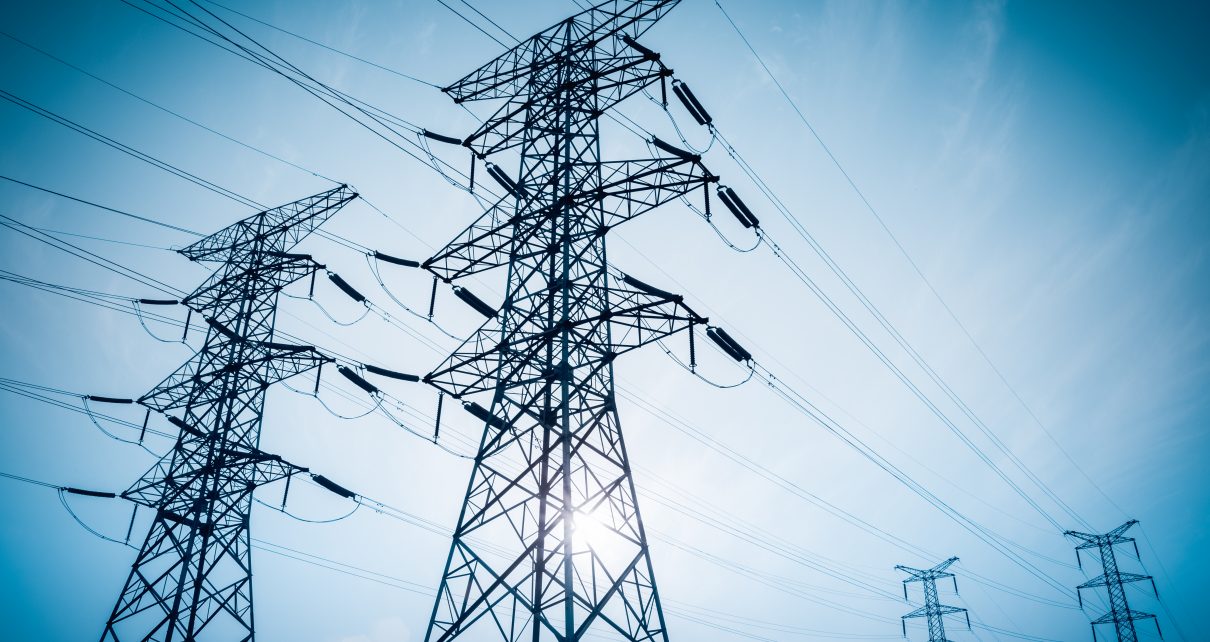
Electricity Transmission Pylon at Dusk. (Photo: chuyuss/Shutterstock)
Ringside: Shifting Costs Does Not Solve California’s Electricity Shortages
Last year, the average rate in California rose by 96 percent compared to ten years ago
By Edward Ring, November 20, 2025 2:55 am
 California’s Little Hoover Commission was created in 1962 “as an independent and bipartisan state agency charged with making recommendations to the governor and Legislature on ways to make state programs more efficient.” Funded by taxpayers, officially nonpartisan, they’ve just released a set of recommendations to lower “The High Cost of Electricity in California.”
They’re right about the high cost. On page 3 of their report they display a table “Average Price of Electricity by Sector (2014-2024).” A look at residential prices in California vs. the U.S. average reveals a growing disparity.
Ten years ago, a California resident could expect to pay 16.25 cents per kilowatt-hour, compared to 12.52 cents/kWh in the rest of the U.S. That is, Californians paid 30 percent more than people elsewhere in the U.S.
Last year, the average rate in California rose by 96 percent compared to ten years ago, to 31.86 cents/kWh, compared to a 32 percent rise in the rest of the U.S. to 16.48 cents/kWh. Californians are now paying 93 percent more for electricity than people in the rest of the U.S.
Notably, the rise in the CPI between 2014 and 2024 was also 32 percent, which is to say that adjusting for inflation, the price of electricity in the rest of the U.S. was flat. It didn’t change at all. But in California, after adjusting for inflation, the price of electricity increased by 48 percent.
The Little Hoover Commission (LHC) attempts to explain the reasons for this increase, but their explanations don’t tell the whole story. They claim wildfires and homebuilding in the “wildland urban interface” have caused distribution costs to explode. But why would these factors be disproportionate to other western states that have also been ravaged by wildfires and also undergone massive exurban expansion?
The Little Hoover Commission report goes on to blame “Power for Profit” as a source of rising rates. Notwithstanding the implicit anti-capitalist bias in this phrase, they correctly point out that recovery of capital investments constitutes a major portion of electricity bills. But here again, they fail to explain why this isn’t putting upward pressure on rates in other states.
The Little Hoover Commission also claims that the billions of dollars of capital investment needed to retrofit the state’s grid to accommodate renewables is causing California’s higher electricity prices. But why hasn’t that caused higher electricity rates in Texas, a state where renewables as a percent of total power is comparable to California?
It might be somewhat off-topic to suggest that electricity costs more in California because everything costs more in California. Figuring out how to lower the cost of everything in California may go beyond the scope of Little Hoover Commission’s report, but that’s the biggest cause. In California utilities pay far more than utilities in other states for capital investments, maintenance and upgrades, and disaster preparedness and recovery.
Recommendations from the Little Hoover Commission include redistributing funds from the Cap and Trade program to low income households to help them pay their bills, and – yes, it’s still on the table – to fluctuate the fixed charge in proportion to each customer’s household income. But redistributing wealth fixes nothing. It merely raises costs for some while lowering rates for others.
Nowhere does Little Hoover Commission make an obvious suggestion: optimize use of California’s conventional sources of electricity, utilizing plants that are already paid for. In 2024, Diablo Canyon supplied 9 percent of California’s total in-state electricity generation, hydroelectric contributed 14 percent, and natural gas was responsible for 40 percent of the total, still more than any other source. Altogether these conventional sources still contributed 62 percent of California’s 216,000 gigawatt-hours of in-state electricity production.
The Little Hoover Commission might have suggested that we quit shutting down a natural gas power plant every time another solar farm or battery park comes online. The Little Hoover Commission even might recommend we permit natural gas plants to provide baseload power instead of just backup when the sun is down – California’s fleet of natural gas power plants only operated at 26 percent of capacity in 2024. If they’d operated at 90 percent of capacity, they could have generated 304,133 gigawatt-hours in 2024, instead of only generating 86,479 gigawatt-hours. If they’d done that, electricity in California would be dirt cheap. Instead of closing California’s fleet of natural gas power plants, they could be upgraded to operate long-term with better efficiency and negligible pollution.
The Little Hoover Commission might also recommend nuclear power plant proposals compete on a level playing field instead of having their costs artificially elevated through over-regulation. And they might call for the state legislature to restore California’s timber industry so the private sector can profitably thin our forests and chaparral to reduce fire danger, and actually create jobs and pay taxes in the process.
The Little Hoover Commission has released a report that addresses symptoms and ignores the most significant underlying causes. High prices are lowered through competition, not wealth redistribution. Prices are lowered through deregulation, not through more regulatory oversight. Rates will go down when the supply of electricity rises faster than demand.


- Ringside: The Abundance Alliance - April 23, 2026
- Ringside: Why Producing More Oil In California HELPS the Environment - April 15, 2026
- Ringside: Floating Offshore Wind – A Financial and Environmental Catastrophe - April 9, 2026
RELATED ARTICLES
-
-

-
 September 11, 2025
To give the short story, electricity costs so much because legislative leftists in sacramento and associated bureacrats want it to be so and by meddling in the market to make it so. The long story starts in the 70s and early 80s when ít was determined that preference would be given to “alternative” energy production at a much higher cost than traditional methods, and that’s been expanded ad infinatum. It’s that simple.
One thing that would help keep costs down for the utilities would be to go back to letting the utilities generate their own electricity. That was a disaster when deregulation took generation away from the utilities with scams like Enron manipulating the market for big bucks and all the government subsidized “green energy” con jobs. The idea was that competition would force costs down, which actually is a sound assumption for most business, but not worth a bowl of spoiled beans with utilities. This is a great example of people making judgments based out of mob ignorance of the subject at hand. I’m not sure how far the ship for utility generation has sailed out of port, but it might not hurt to try to turn it around. The “green energy scam” is impossible without subsidization and high electrical rates.
Would be interesting to learn how California utilities’ pension costs compare against Texas’….
Combine the lack of maintenance in California utilities infrastructure and the generous pension plans, combined with California’s illogical “renewables” mandates, and here we are….
The pension plans might not be so generous as some think. In fact there were quite a few retirees who had to go back to work in some fashion when their retirement investments took a nose dive in the early 2000s. There should be some sort of requirement that people should learn the difference between a labor intensive business and a capital intensive business before they talk about employee compensation. Then look at how boards of directors milk multiple, diverse, often competing companies by serving on several boards. Furthermore, the days of “maintenence by storm” are long over, since 1998 California electrical utility maintenence and rebuilding has been the reason every lineman west of the mississipi who wants to work has a job, and that intensified after the big PG&E fire related payout. As far as the PG&E fires, most don’t seem to have a stated cause beyond vahue statements like “it originated in a substation,” very little specific fact, and all the shouting “PG&E murdered people,” how? I’m not a utility shill and I think PG&E is a wierd outfit, but a lot of people get real loud about things they know nothing about.
The reason for california electrical utility emphasis on maintenence in 1998 had to do with some fallout from deregulation. There was concern that the electrical utilities would follow the lead of entities like the cable tv companies renting pole space from the utilities by letting everything fall apart. So there came about “customer minutes of interuption ” While I’m not entirely sure of how the mechanism actually works, it seems the utilities are penalized by how long customers are out of power. The penalty PG&E had to pay for the fire kicked the maintenence projects into high gear. In years past the utilities were largely pocketing the money the PUC granted for maintenance, so in effect the companies were double dipping when they recovered the cost plus a percentage for repairing storm damage. Since being penalized for outages and government let the forest overgrow, creating fuel for fires such as in PG&E territory, the PUC will allow the massive rebuilding. Another factor in the original lack of maintenece is the environmental groups would sue every chance they got for practically everything not immediately accessable by road. The rebuilding effort in addition to the “green” nonsense will be reflected in electrical rates. It will probably be of little comfort to rate payers that residential service isn’t much of a money maker for the utilities. The big money is in industrial service.
I just got an email from Southern California Edison that my electric rates will be going up 13%. This insanity needs to stop.
Then change the legislature and run off the unelected bureaucrats who work so tirelessly to impoverish you by making it so expensive for providers to bring you electricity, natural gas, gasoline and diesel. The revolution needs poverty stricken, pissed off, hate filled people to be fulfilled. Ever notice with gas prices that the california state government shovels hidden taxes into gas sales and creates scarcity by making it nearly impossible to refine gas all the while yelling about “big oil greed?”
Protect Freedom ….. My SoCal Edison, 2nd Tier rate is $0.42/kWh. I would love to pay $0.318.
Now we get into economy of scale. The SCE territory is quite large, with districts like Ridgecrest, Barstow and Yucca Valley covering vast swaths of desert with long, long distribution and sub transmission circuits. The city of Ridgecrest itself has a population of less than less than 30k, but the district roughly covers from Little Lake, to Scotty’s Castle in Death Valley, to Death Valley Junction, to Kramer Junction, to Califoria City, to Little Lake. Since before SCE acquired Calectric in 1963 and at least recently the Ridgecrest District has had two line crews and two 2 man service crews (converted into two one man troublemen, dropping two men prior to 1994), which is the minimum necessary. Barstow and Yucca Valley were and probably still are the same. Then you take an unnamed municipality of about 30k population with a service territory of less than 34 square miles. It has the minimum of two line crews and two troublemen, which is a strain on the city’s finances. The difference in revenue is that the Ridgecrest district has a lot more meters turning than the small city, plus the districts in urban districts might eight or 10 crews due to density of the population. Then consider SCE territory has something like 50k square miles serving perhaps 15 million people in 15 counties and 180 incorporated cities. It’s like a mom and pop restaurant vs a nationwide restaurant chain, the former struggles with purchasing product and labor costs with regulation costs stacked against them, the latter gets discounted bulk product and can spread their labor and regulatory costs among many stores. The financial difference between utilities and restaurants is that utilities have their money tied up in plant and purchases, restaurants labor and purchases. As a note, SCE district manager salery is or was based on how many meters are in the district.
With a very few exceptions, governments should never own utilities. To keep it short, all city and federal electrical employees I’ve been around are a collection of lazy slugs who live the good life with on the job retirement. From what I’ve seen Los Angeles DWP is the premier example of it. One to be unnamed smaller municipality in middle coastal california I temporarily worked for had the mentality of always being on break. On one occasion, we were out on the job with the foreman panicking over what he saw as a two week job. I and another temporary lineman I had worked with elsewhere banged it out in about four hours. One miltary base I worked on, the mode was like this: an electrician gets a WO first thing in the morning about a light out. Electrician goes to site and flips the switch, the light is out. So he goes back to the shop to get a ladder. Returning to the site, he removes the bulb and determines the wattage. Back to the shop for a bulb. At the site he replaces the bulb and flips the switch. Arriving at the shop he removes the ladder from the truck and disposes of the bad bulb. It’s now quitting time. All day, one light bulb. The line crew there spent all day sitting on their cans telling funny stories while the contract crew was working. To be fair, there may be productive government electrical employees, but I haven’t seen any. Furthermore, unproductive employees are a symptom of a problem with management. It being practically impossible to fire a government employee might have something to do with it. Another problem, and I saw this first hand with the war in Los Angeles between mayor Villaraigosa and DWP management, is that city hall likes to spend other people’s money and get to seeing the city utility as a cash cow to be milked. This leads to depleting funds necesary to operate the utility. Politicians can’t help themselves when it come to money for pet projects. Outside of military facilities, governments should never own utilities.
I would like to discuss different types of utilities and the vulnerabilities of utilities no one seems the think of, but for now I’d like to rant about the uniformed, sometimes foaming at the mouth mob. Most people only know that electricity comes out of the wall; all that ugly overhead construction needs to go underground; Their bills are too high; and are convinced utility workers are overpaid and that’s why their bills are so high. Wages and salaries are barely a blip in utility costs. During the raid conducted by the Kindom of Los Angeles City Hall on the DWP Empire’s piggy bank, the media led the crusade against the workers and ignored the reason for the ruckus was that city hall was spending money like two or three entire fleets of drunken sailors on shore leave at the same time, and they were bankrupting the city. While DWP excutives defended their turf, I don’t think the noise woke them up to the fact they had a utility to run. News crews followed electrical crews around, conducting ambush interviews and filming from the bushes. They did catch DWP employees having barbeque parties in the park and other DWP employees going home for the day as well as a contract foreman drinking beer during lunch, but none of that that was the cause of the city going broke. IT WAS POLITICIANS SQUANDERING THE TAXPAYER’S MONEY ON THINGS HAVING NOTHING TO DO WITH THE UTILITY. There were also crazy city ordinances like utility trucks couldn’t be on the street before 9am and off by 3pm. I don’t know how much work DWP was giving their crews, but at the time we were given only 3 hours worth of work or so a day and outproducing their crews 2 to 1. A couple days before I left a woman approached me and sweetly asked about my wages. I replied that the CEO of Enron made a lot of money. She became irate and said “You don’t want to tell me. I’ll take that money from you.” I got the last laugh, because within a couple days of leaving I had another job while her city hall was still running Los Angeles into the ground.
We need localized generation as we are way too dependent on imported power. Transmission to distribution transformers for substations and generation facilities are often built to order, take months to deliver and are very expensive, so spare transformers aren’t much kept in stock. SF6 gas and oil filled circuit breakers are similarly vulnerable. Cameras and alarms don’t frighten terrorists and other saboteurs. Some might talk about armed guards, but pistols aren’t much of a deterrant to RPGs and bullets flying around a substation firefight can be catastrophic to equipment. Take out a very few 500kv substations and southern california goes in the dark. No electricty to pump water, pump gasoline and diesel, refrigerate food, power medical facilities and home devices and so on. Circuit switching is increasingly remote controlled, either radio controlled (like a garage door opener) or often is conducted unisolated from the internet. Both are subject to intrusion and hacking. The atlantic and pacific oceans used to protect us from such shenanigans, but no longer. Rooftop solar is designed to work only if the utility is energized, this is to prevent dangerous backfeed to the circuit but also isolates the house from solar generation.