
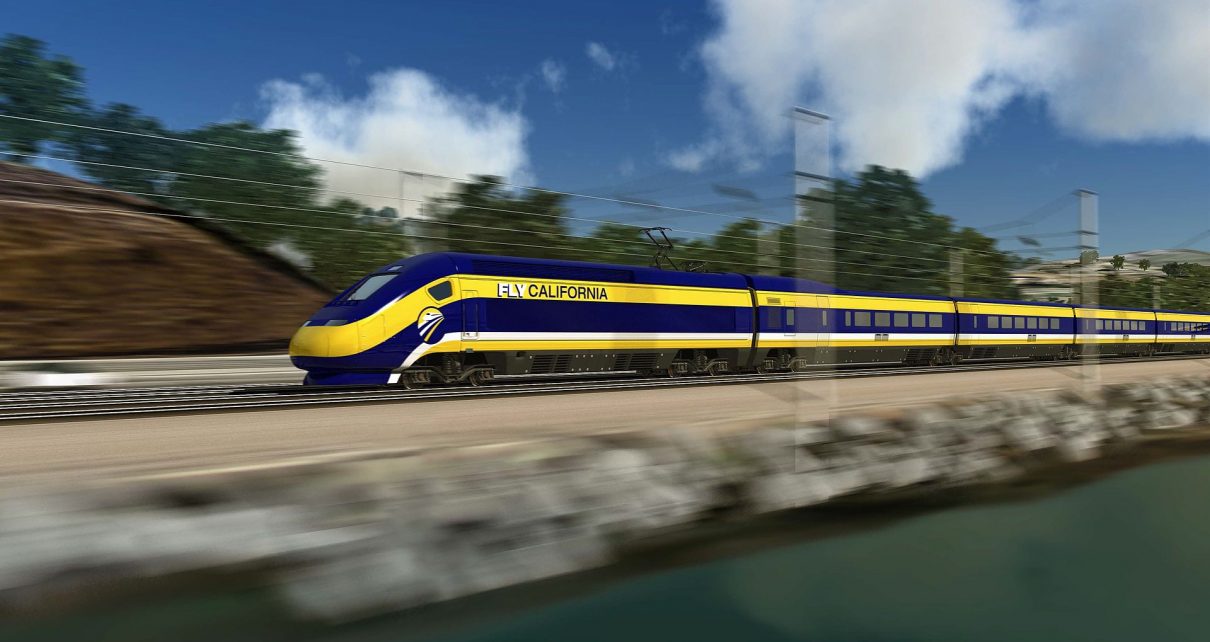
High Speed Rail train, artists rendering. (Photo: CHSRA.ca.gov)
The Bullet Train’s Cash Clock: Funding Could Run Out by December 2027
A state watchdog says the price tag leaves out billions in interest and contingency
By Jose Navarro, October 9, 2026 10:00 am
A project budget is only as honest as what it leaves out. California’s high-speed rail authority is learning that in public, because the state’s own inspector general says the agency could exhaust its funding as soon as December 2027 if it does not secure new financing. That is about 14 months away, and less than a year after a new governor takes office.
The inspector general’s numbers are specific. The authority faces a cumulative funding gap of $9.5 billion from fiscal 2027-28 through 2031-32, and it needs $2.2 billion in 2027-28 alone to keep construction on schedule. It has identified $39.3 billion in long-term funding, including $1 billion a year from the state’s Cap-and-Invest program, but that money arrives too slowly for the peak construction years, according to the report as summarized by FOX 11. The authority says the Cap-and-Invest commitment runs until 2045, per the International Railway Journal.
Then comes the part a controller reads first: what the estimate excludes. The Merced-to-Bakersfield segment is now priced at $35.7 billion. By the inspector general’s account, that figure leaves out $3.6 billion to $6.6 billion in interest if the authority borrows, along with a $1.2 billion contingency gap, $816 million in construction costs covered by third parties and $1.7 billion for required infrastructure. If all of those apply to the same segment, the omissions run from about $7.3 billion to $10.3 billion, or roughly 20 to 29 percent on top of the stated price. That is my arithmetic, not the report’s, and the authority may dispute how the pieces fit together.
The schedule carries the same optimism. The authority still points to a 2032-33 start for the first segment. The inspector general says September 2034 is the appropriate estimate and that even this may be “likely insufficient,” according to KPBS. The plan also disclosed a nine-month slip without explaining it, and the segment itself shrank from 171 miles to 162. The inspector general also warned that moving the Merced station would break a legal requirement to connect with Amtrak and Altamont Corridor Express service, per the railway journal.
Procurement tells a similar story. An August 6 notice cut the initial train order from six trainsets to three, moved delivery to February 2030 and dropped Buy America requirements for the first trains, as FOX 11 reported. The International Railway Journal adds that the authority is weighing a lease-purchase structure and keeps an option for 19 more trains. Buying fewer trains lowers this year’s bill, which is the point. It does not shorten the track that must be finished before they run.
The authority is entitled to its side. It told the inspector general it values constructive oversight, and it disputed some findings as differences of interpretation, according to KPBS. Its supporters note that Washington pulled about $4 billion in federal grants in 2025, a move the administration justified by calling the project a boondoggle and California challenged in court as political retribution. Those fights over motive are real. They do not change the arithmetic of what the state must now finance.
What does change the conversation is the inspector general’s warning about disclosure. KPBS reports that the watchdog said the authority “has obscured basic facts about the project,” that its draft plan lacked statutory elements and that many earlier recommendations remain unimplemented. Lawmakers cannot weigh a financing decision they cannot see.
That decision is coming. Options under consideration include internal state borrowing, revenue bonds and private financing, and each carries interest the current estimate does not show. Newsom leaves office at the end of this year, so the next governor and the next Legislature will inherit the choice, along with annual budget deficits of $25 billion to $30 billion that the Legislative Analyst’s Office and the governor projected earlier this year.
Three steps would give Californians a fair accounting. First, the authority should publish an all-in cost estimate, with interest, contingency and third-party costs shown as ranges and updated every quarter, not once a year. Second, the Legislature should decide the financing structure before construction contracts lock in peak-year spending, and it should ask the Legislative Analyst for a lifetime-cost score. Third, the authority should report publicly on every open inspector general recommendation until each one is closed.
There is a deadline worth watching. According to KPBS, the revised train solicitation is due October 16, and the authority’s next update report is due March 1, 2027. Both will show whether transparency is improving or whether the cash clock is simply running.
Voters can reasonably disagree about whether California should build this railroad. They should not have to guess what it costs. A budget that omits interest, contingency and delay is a wish list. The honest question is the whole bill, who pays it, and when the public will be told.


- The Bullet Train’s Cash Clock: Funding Could Run Out by December 2027 - October 9, 2026
- California Budget Hides Over $1 Billion in Earmarks - October 6, 2026
RELATED ARTICLES
-
-
 October 22, 2024
 -
 November 5, 2018