
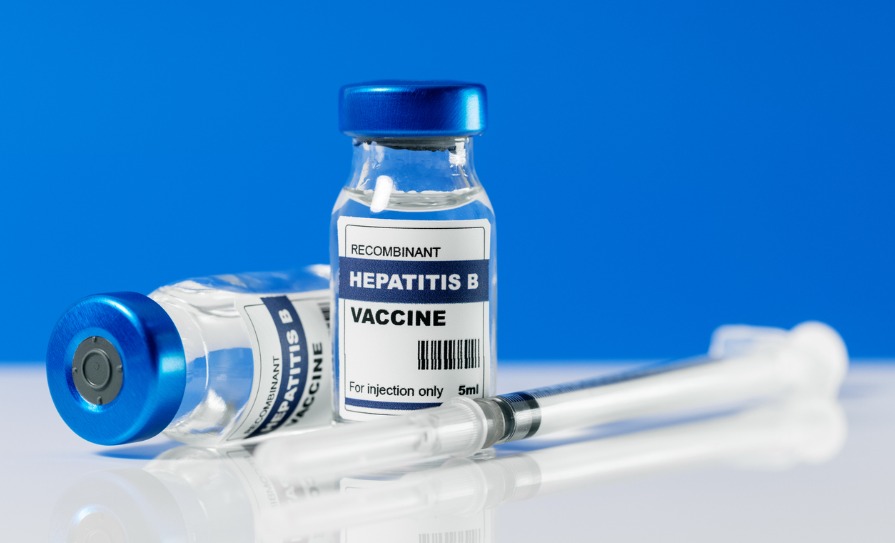
Hepatitis B Vaccination | Environmental Health & Safety. (Photo: ehs.ucr.edu)
The CDC Just Overhauled the Childhood Vaccine Schedule — What It Means for California Families
A Major Federal Shift — And California’s Immediate Rejection
By Rita Barnett-Rose, January 7, 2026 11:57 am
Under the new guidance, the federal government will now universally recommend immunization against 11 diseases for all children, down from 17 previously recommended — a change that sharply reduces the number of doses and injections across childhood. Previously, children were advised to receive approximately 84–88 total doses delivered in 57–71 injections, far more than in most peer nations. Under the revised framework, total doses are expected to fall to roughly the low-30s, according to multiple analyses of the new schedule.
Several vaccines once treated as routine — including influenza, rotavirus, COVID-19, RSV, hepatitis B, and certain meningococcal vaccines — will no longer be universally recommended for every child. Instead, they are now limited to high-risk populations or governed by shared clinical decision-making (SCDM) between parents and clinicians, marking a shift away from blanket “every child gets every vaccine” directives and toward a more individualized model of care.
This realignment brings the United States closer to international norms and elevates transparency, parental autonomy, and clinical nuance. But it does not immediately alter school vaccine requirements in most states.
And in California, it may change nothing at all. Within hours of the federal announcement, state officials — including Governor Gavin Newsom— publicly condemned the overhaul and signaled that California does not intend to follow the new federal guidance.
Absent significant pushback from parents or intervention through the courts, the state’s school mandates remain locked in place, even as federal policy evolves in response to new evidence and acknowledged uncertainty about vaccine risk. That widening dissonance raises a serious and unavoidable question: what, exactly, is California’s rigid vaccine policy designed to protect?
Why Is the CDC Acting Now?
The overhaul was triggered by a December 5, 2025 presidential directive ordering HHS and the CDC to reassess the childhood schedule against peer nations and modern evidence. According to the CDC’s own decision memorandum, the review was driven by three uncomfortable realities: public trust collapsed after COVID and vaccination rates declined; the U.S. has long recommended far more vaccines and doses than peer nations, without superior health outcomes; and large gaps remain in the scientific understanding of true risks and benefits, especially when the full schedule is considered as a combined exposure.
Despite acknowledging these uncertainties, federal officials retained most vaccines based largely on international consensus rather than new safety data. Even so, the shift is monumental. For the first time, U.S. health authorities have formally conceded that more is not always better, and that trust cannot be rebuilt without restoring parental choice and clinical judgment.
What This Does — and Does Not — Mean for Families
Under the revised federal schedule, the diseases that remain universally recommended for all children include measles, mumps, and rubella; diphtheria, tetanus, and pertussis; polio; Haemophilus influenzae type b; pneumococcal disease; human papillomavirus (now recommended as a single dose); and varicella (chickenpox). Because the CDC acknowledges that vaccines on the “routine” schedule almost inevitably become school mandates, these are the vaccines most likely to remain compulsory in schools.
That reality explains why — despite headlines about “cutting vaccines” — the immediate experience for many families will not change dramatically. Most vaccines removed from the universal category were not tied to school-entry requirements in many states. Influenza, COVID-19, rotavirus, RSV, and others were typically handled between parents and providers, not enforced by schools. Insurance coverage also remains intact.
Still, any move away from universal recommendation matters. Shifting from 17 routinely recommended childhood vaccines to 11 is not cosmetic; it materially changes the landscape of medical pressure, institutional persuasion, and default expectations placed on parents.
What This Means in California Under AB 144
California’s response to the CDC’s overhaul is governed by Assembly Bill 144, enacted in 2025 just before the new HHS leadership took office. AB 144 locked California’s vaccine baseline to the federal ACIP schedule as it existed on January 1, 2025 — including routine COVID shots for children as young as six months. CDPH may add vaccines to that baseline but has no authority to remove any; removal now requires direct legislative action. When the science shifts, California’s policy is therefore structurally insulated from having to follow.
California currently requires ten vaccines for school entry and strongly promotes two doses of the HPV vaccine through school-based notifications. The CDC’s new schedule places California in direct tension on two fronts: hepatitis B and HPV.
Under the revised federal framework, hepatitis B is no longer universally recommended, having been moved into high-risk and shared clinical decision-making categories. California, however, continues to mandate hepatitis B for school attendance, meaning parents are still told their children must receive a vaccine that federal authorities now say should be decided individually.
HPV presents a different but equally serious problem. The CDC has now determined that one dose is sufficient, scaling back from the long-standing two-dose regimen based on safety and risk-benefit concerns, including recognition that additional doses may offer diminishing benefit while increasing exposure to risk. California, however, has built its public-health messaging around the two-dose model and expanded CDPH’s authority to frame HPV notices to parents. HPV is not an acute childhood disease spread in classrooms; it targets a sexually transmitted virus that may lead to cancer decades later and remains one of the most controversial vaccines on the schedule.
CDPH must now decide whether it will follow the CDC’s new one-dose recommendation — or whether, consistent with the state’s immediate rejection of the federal overhaul, California will continue to insist on a more aggressive dosing regime despite the federal government’s explicit retreat.
Why These Changes Are Still a Good Thing
The real importance of the CDC’s overhaul lies not in which individual shots were adjusted, but in the framework it finally breaks. Federal health authorities have stepped away from the dogma that every vaccine must be given to every child by default. By elevating shared clinical decision-making, the CDC has restored a foundational medical truth: that care should be individualized, guided by real risk, real evidence, and real families — not bureaucratic uniformity.
Equally important are the admissions contained in the decision memo itself. Federal officials now openly acknowledge that substantial scientific uncertainties remain, including unresolved questions about long-term risks and the cumulative effects of the full childhood schedule — even for vaccines they continue to recommend by “consensus.” That acknowledgment is deeply concerning, but it is also profoundly vindicating for countless parents who have spent years insisting that their children were harmed, only to be dismissed with the reflexive and often cruel refrain that vaccines are “safe and effective” and “robustly studied.” The ground of the debate has shifted. Vaccines are no longer treated as a monolithic category immune from scrutiny, but as medical products subject to the same evaluation of risk, benefit, and context as any other intervention.
What Happens Next
While the CDC’s long-overdue overhaul of an overexpanded vaccine schedule is a welcome step, the ultimate goal must be a system in which all vaccines are governed by shared clinical decision-making. Mandates are ethically indefensible. They convert medicine into force, replacing the patient-physician relationship with state power. That coercion is especially unjustifiable when several vaccines California mandates for school attendance do not prevent infection or transmission at all, eliminating the original public-health rationale for compulsion.
California’s immediate rejection of the new CDC framework — alongside recent developments such as AB 144, the expansion of the CAIR data system, and the PHNIX initiative — indicates that the state is moving not toward restraint, but toward deeper institutional control.
When a government refuses to let policy evolve with evidence, when coercion persists after its justification has eroded, the project is no longer public health. It is something else entirely.


- Another COVID Case, Another Warning: California Courts Are Backing Power Over Law - February 12, 2026
- As the United States Leaves the WHO, Newsom Grandstands - January 27, 2026
- How California Eliminated Medical Exemptions by Design—and Why Hepatitis B Will Expose the Lie - January 22, 2026
RELATED ARTICLES
-

-

-
 February 10, 2023