
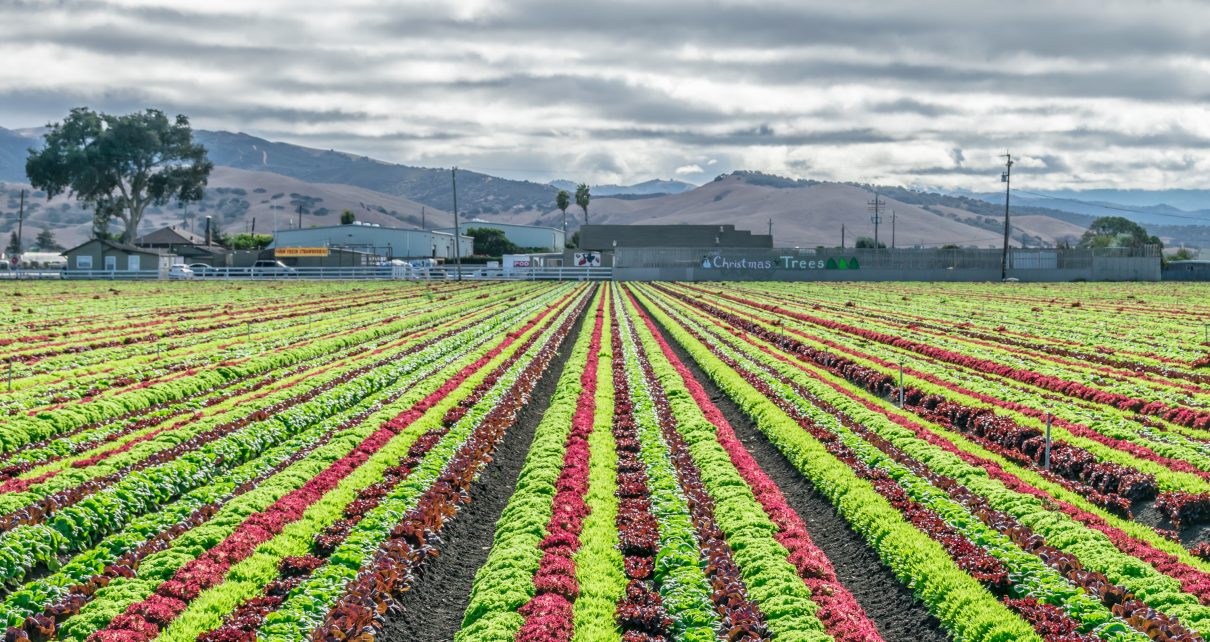
Salinas Valley agriculture: colorful lettuce crops. (Photo: Shutterstock, David A Litman)
In California, You Can Do Everything Right, and Still Get Crushed
Californians who are trying, often heroically, to follow the rules and still finding themselves buried under them
By Charles Yates, February 10, 2026 6:34 am
Take an oil and gas operator who spends millions upgrading equipment, filing emissions reports, and complying with air-quality rules that change more often than a coastal forecast. Every form is filed. Every inspection is passed. And yet, a permit is suddenly delayed or reinterpreted, a new reporting requirement is layered on top of the old one, or an agency decides that yesterday’s compliance no longer counts. Production halts. Workers are sent home. The shutdown has nothing to do with pollution and everything to do with paperwork.
Or consider a farmer trying to plan for the growing season. Water allocations shift midyear. Drought rules conflict across agencies. A permit required by one regulator violates the conditions of another. After spending thousands on consultants and compliance, fields are still forced to go fallow. Crops aren’t planted, workers aren’t hired, and food prices creep higher—not because water was wasted or laws were ignored, but because predictability vanished.
These aren’t stories about bad actors cutting corners. They’re stories about Californians who are trying, often heroically, to follow the rules and still finding themselves buried under them. The consequences are real: lost jobs, stalled production, shrinking water supplies, higher energy and food prices, and communities slowly hollowed out.
California’s problem isn’t just aggressive enforcement. It’s the crushing weight of regulation itself.
The state has built a sprawling regulatory maze: thousands of rules, permit requirements, reporting systems, and overlapping agency directives that frequently contradict one another. Agencies are often granted broad discretion to reinterpret standards, impose new conditions, or deny permits outright, without meaningful legislative oversight. Compliance becomes a moving target, with standards shifting faster than businesses or farmers can reasonably adapt.
By the time enforcement arrives, the damage is already done. The system is designed in a way that sets people up to fail, then punishes them for falling behind.
The costs are staggering. Billions of dollars are spent annually on compliance. California’s oil and gas production continues to decline, not because demand has vanished or pollution is rising, but because permits languish and operations are shuttered for administrative reasons. Farmers leave fields unplanted because they can’t get reliable water allocations. Businesses shut down not for environmental harm, but because they missed a filing deadline or couldn’t reconcile contradictory instructions from different agencies.
This approach doesn’t protect the environment. It undermines it. When compliance becomes impossible, the system stops encouraging stewardship and starts breeding cynicism. People spend more time navigating bureaucracy than investing in new technology, safer infrastructure, or more efficient practices.
That’s why Pacific Legal Foundation recently launched its Environment and Natural Resources (ENR) practice group—a direct response to this growing crisis.
The mission is straightforward: defend private property owners, farmers, ranchers, and energy producers from arbitrary, contradictory, or unlawful regulations. Confront enforcement activities that punish compliance rather than promote environmental responsibility. Restore constitutional limits on agency power and ensure that agency rules are actually rooted in law.
This isn’t anti-environmentalism. It’s pro-rule of law, pro-clarity, and pro-common sense.
California’s regulatory system has become punitive by design—not because of any single fine or rule, but because the architecture itself ensures failure. Regulations pile up without serious consideration of cost, practicality, or scientific grounding. Agencies create new requirements faster than regulated parties can absorb them. Enforcement then swoops in to penalize those who inevitably fall behind.
The impacts ripple outward. In the energy sector, unlawful shutdowns and delayed permits mean reduced production and lost jobs in communities that can least afford them. In agriculture, unpredictable water rules and soaring compliance costs translate into lower yields and threats to the food supply. The state cannot achieve environmental goals by breaking the very people who produce its energy and grow its food.
There is a better way.
A better regulatory system starts with clear, consistent rules that don’t shift with political winds. It provides notice, guidance, and education before punishment. It focuses enforcement on true wrongdoing—actual pollution, real harm—not technical missteps or paperwork errors. And it includes robust judicial oversight to ensure agencies don’t exceed the authority granted to them by lawmakers.
PLF’s ENR practice group is positioned to demand that fairness. By going to court when necessary, it can check regulatory overreach, defend constitutional boundaries, and protect Californians whose livelihoods are on the line.
California cannot continue piling regulation on top of regulation and punishing those who comply while expecting either environmental protection or economic stability. Stewardship thrives on clarity, predictability, and trust, not on fear and confusion.
California can protect its environment—but it can’t do it by crushing the very people who play by the rules.


- In California, You Can Do Everything Right, and Still Get Crushed - February 10, 2026
RELATED ARTICLES
-
 November 3, 2024
 -
 July 12, 2022
 -
 January 8, 2026
Good answer to one of California’s problem.
Best of luck to Pacific Legal Foundation.