

President Trump discussing Supreme Court ruling on tariffs. (Photo: Whitehouse.gov)
Could President Trump End the Income Tax?
Under the FAIR Tax, the IRS would be abolished
By Katy Grimes, February 26, 2026 3:48 pm
I just received another text from President Trump’s team: “NO INCOME TAX. Thanks to tariffs, it’s a possibility!”
In his State of the Union address Tuesday, President Donald Trump teased once again that tariffs could replace the federal income tax.
“As time goes by, I believe the tariffs, paid for by foreign countries, will, like in the past, substantially replace the modern-day system of income tax, taking a great financial burden off the people that I love.”
Of course, Trump critics immediately belched a few Harrumph Harrumph Harrumphs. It’s unimaginable to most that the United States could operate without an income tax.
But the United States did operate just fine for the first 125 years until the passage of the 16th Amendment in 1913. “Passed by Congress on July 2, 1909, and ratified February 3, 1913, the 16th amendment established Congress’s right to impose a Federal income tax.”
“If you were an American citizen before 1913, with a few exceptions you didn’t have to deal with an April deadline and the IRS,” the National Constitution Center reported. ”
February 3rd marked the anniversary of the ratification of the 16th Amendment in 1913, which gave us the income tax. “Its champion was President William Howard Taft, and its ratification was an effort to make sure more higher-income people paid taxes, and that the government wasn’t wholly dependent on revenue earned from tariffs and taxes on goods.”
“It wasn’t the first national income tax that was enacted. In fact, it was the third. But this third attempt had the power of a constitutional amendment behind it, and it’s still in force today.”
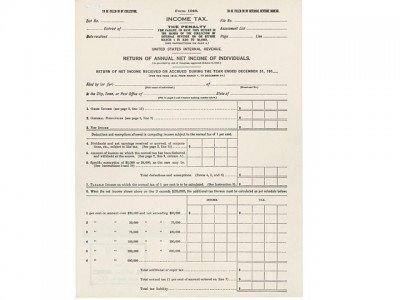
“The Founding Fathers and the generation of leaders that followed them weren’t big on the idea of an income tax. Tariffs and sales taxes helped fund the federal government in the early days. But the financial needs of the Civil War led to the first national income tax.”
Most of us remember learning that “no taxation without representation” originated during the American Revolution, which was one of the primary grievances of the American colonists for Great Britain.
In fact, the Founding Fathers were unsurprisingly leery of income taxes, preferring tariffs and sales taxes to fund the government. However, the need for revenue during the Civil War led to the first national income tax, and eventually the 16th Amendment in 1913 established the federal government’s right to impose income taxes.
The rest is history.
Economist Steve Moore reports, “under the FAIR Tax, an 18% sales tax/tariff could replace the federal personal income tax, the capital gains tax, the corporate tax and the dividend tax.”
“Imagine that America had no income tax. This would be the greatest wealth and job generator in world history. The only problem would be that everyone in the world would want to come here. We’d need a bigger wall.”

The Fair Tax is a proposed tax reform in H.R.25 – FairTax Act of 2025 by Rep. Carter, Earl L. “Buddy” [R-GA-1]:
This bill replaces federal income, payroll, estate, and gift taxes with a federal sales tax beginning in 2027 and eliminates the Internal Revenue Service.
The bill establishes a 23% tax-inclusive (30% tax-exclusive) federal sales tax rate on taxable property and services to be administered primarily by each state. The federal sales tax rate is adjusted annually beginning in 2028 so that it is the sum of the
-
- general revenue rate (14.91%);
- old-age, survivors and disability insurance rate; and
- hospital insurance rate.
The bill includes exemptions for property or services purchased for business, investment, and certain state government functions.
Registered, qualified families may receive a monthly sales tax rebate in the amount of the monthly federal poverty level (or twice such amount for married individuals) multiplied by the federal sales tax rate. Each family member must have a Social Security number and be a lawful resident of the United States.
Federal sales tax revenues are allocated to general revenue, the Social Security trust funds, and the Medicare trust funds. (Special allocation rules apply for 2027.)
The bill eliminates appropriations for the Internal Revenue Service after FY2029 and establishes an Excise Tax Bureau and a Sales Tax Bureau within the Department of the Treasury.
Finally, the bill terminates the federal sales tax if the Sixteenth Amendment to the Constitution (authorizing a federal income tax) is not repealed within seven years from the date the bill is enacted.
Called a “prebate,” the monthly payment offsets the regressive nature of a sales tax up to the poverty level.
According to FairTax.org:
The FairTax is a national sales tax that treats every person equally and allows American businesses to thrive, while generating the same tax revenue as the current four-million-word-plus tax code. Under the FairTax, every person living in the United States pays a sales tax on purchases of new goods and services, excluding necessities due to the prebate. The FairTax rate after necessities is 23% compared to combining the 15% income tax bracket with the 7.65% of employee payroll taxes under the current system — both of which will be eliminated!
Important to note: the FairTax is the only tax plan currently being proposed that includes the removal of the payroll tax.
For the first time in recent history, American workers will get to keep every dime they earn; including what would have been paid in federal income taxes and payroll taxes. You will get an instant raise in your pay!
This would all be possible with President Trump’s reciprocal tariff plan. And despite the United States Supreme Court striking down some of Trump’s tariffs, he and Treasury Sec. Scott Bessent immediately leveraged Section 232 and Section 301 tariff authorities that have been validated through thousands of legal challenges, and reimposed a 10% tariff. And then upped it to 15%.
Trump has been touting such a plan since being reelected.
In April, President Donald Trump said in an interview with Fox News’ Rachel Campos-Duffy There was a “real chance” tariffs could replace income tax:
“There’s a real chance,” Trump said. “There is a chance that the money from tariffs could be so great that it would replace. You know, in the old days, about 1870 to 1913, the tariffs were the only form of money. And that’s when our nation was relatively the richest. We were the richest.”
The president said during the interview that there was a committee formed in the 1880s to “get rid of money.”
“And this committee’s sole purpose was how to dispose of it, who to give it to, what do we do? And then, brilliantly, in 1913, they went to the income tax system. Then around 1931 or 1932, they tried to bring back tariffs, but it was too late,” the president told Campos-Duffy. “And they loved to blame tariffs for the Great Depression. But the Great Depression came before they put the tariffs on.”
The history of the income tax at the National Constitution Center is actually quite interesting.
You can read more about the FAIR Tax here.


A California native and Navy mom, Katy lives in Sacramento, CA.
- How the DMV Enabled Voter Fraud in California - October 21, 2026
- Newsom Doth Protest Over DOJ Voter Fraud Allegations and 20,000 Noncitizens Receiving Ballots - October 20, 2026
- Rioting for More… It’s Never Enough - October 20, 2026
RELATED ARTICLES
-
 January 30, 2022
 -

-
Hi Katy,
“GOD BLESS YOU” for this truthful writing about the FAIRtax Act HR25. It is the solution to over 20 problems, bad practices and deceptions of the federal income/payroll tax system. To learn more please visit https://flfairtax.org/problems-bad-practices-and-deceptions-of-the-federal-income-payroll-tax-system/. The FAIRtax is a pay as you spend sales/consumption tax with monthly tax refund, called Prebate, so the effective tax rate progresses upward to a maximum of 23%. The present income/payroll tax system progresses upward to a maximum of 37%.
How else can I be of assistance?
Of course, tariffs and excise taxes were the main source of income prior to 1913. There also was no huge entitlement (welfare) system to hand out cash to millions of people. Nor was there a large military with unbelievably expensive materiel. Can we possibly shrink the government some before trying out a radically different taxation system? Remember, when the 16th Amendment was first proposed, a provision was considered that would have limited the tax rate to 6%; it was rejected because many feared that would cause it to go that high!
More emphasis should be placed on the tax embedded in the income tax which goes away with the income tax. On many purchases this could be as much as 22% reducing the FairTax to 1% on consumption. Figuring back in the prebate, passing the FairTax could actually result in a net gain for all tax payers.